Yes, you can negotiate a sign-on bonus, and in most cases, you should. The single best first move: wait for a written offer, calculate exactly what you’re leaving behind at your current employer (unvested equity, a pending bonus, relocation costs), and ask for that specific amount. A one-line script that works on a call or in an email: “I’m genuinely excited about this role. Based on the compensation I’ll be forgoing at my current employer, I’d like to discuss a signing bonus of $[X] to bridge that gap.”
Before you pick up the phone, have these three things ready:
- The number you’ll cite: your forgone compensation in dollars (unvested equity, upcoming bonus, moving costs)
- Your desired structure: lump sum at start vs. installments, and whether you want a gross-up for taxes
- Your fallback ask: a lower amount or an alternative lever (earlier salary review, extra PTO) if they push back
Table of Contents
- What to prepare before your sign-on bonus negotiation
- Why employers offer signing bonuses in the first place
- When is it appropriate to ask for a signing bonus?
- Exactly how to ask for a signing bonus
- Scripts and email templates you can use right now
- How to evaluate the tradeoff between a bonus, base salary, and equity
- Typical sign-on bonus amounts by level and industry
- Tax treatment, payment timing, and clawback clauses to watch for
- Practical negotiation tactics and how much to counter with
- What to ask HR and the contract terms that should give you pause
- What recruiters actually think when you ask for a sign-on bonus
- After you accept: how to make sure you actually get paid
- What I’ve learned about when to push and when to accept
- TalentFB helps senior professionals negotiate offers they’re proud of
- Sources
What to prepare before your sign-on bonus negotiation
Preparation is where most professionals lose money before the conversation even starts. The goal is to arrive with a defensible number, not a vague feeling that you deserve more.
When to prepare: Start building your case as soon as you receive verbal interest. Save the actual ask for after you have a written offer in hand. That window, after the offer letter arrives and before you sign, is when your leverage is highest. Relo confirms this timing principle: the strongest position for negotiating any upfront compensation, including relocation and sign-on bonuses, is after a formal offer and before acceptance.
Here’s the checklist to build before that conversation:
- Forgone bonus: What is your current employer paying you in Q1 or Q2? If you leave before that date, you forfeit it. Get the exact figure.
- Unvested equity: Pull your vesting schedule. Calculate the dollar value of shares or options that will lapse if you leave in the next 6, 12, or 24 months.
- Relocation costs: If you’re moving, get at least one real quote from a moving company. Temporary housing, travel, and storage are all legitimate line items for a relocation package negotiation.
- Market benchmarks: Use Levels.fyi, Glassdoor, LinkedIn Salary, or Radford data to confirm what peers at your level earn in total compensation at this company or comparable ones.
- Internal pay bands (if known): Sometimes a recruiter will tell you the band is maxed. That’s your cue to pivot to sign-on, because sign-on often lives in a separate budget.
The calculation example: Say you’re leaving $18,000 in unvested RSUs that vest in March, plus a $12,000 annual bonus you’d forfeit by leaving in January. Your forgone compensation is $30,000. That’s your anchor. You might ask for $35,000 to leave room to land at $30,000, or ask for $30,000 and hold firm because the math is airtight.
Pro Tip: Prepare two asks before the call: your ideal number and a reasonable fallback. Write the math on a single page you can reference during the conversation. If the recruiter asks how you arrived at your number, you can walk them through it in 30 seconds, and that specificity signals you’re serious, not just fishing.
Why employers offer signing bonuses in the first place
Understanding the employer’s motivation changes how you frame your ask. A signing bonus isn’t a gift; it’s a business tool. When you position your request as a solution to their problem, approval becomes much easier.
WorldatWork’s research on bonus programs and practices shows that signing bonuses are among the most widely used forms of bonus programming, with substantial variation by role and seniority. Employers reach for them for specific, predictable reasons:
- Beating competition: When two companies are competing for the same candidate, a sign-on can close the gap faster than a base salary renegotiation.
- Bridging internal pay bands: Base salary is constrained by internal equity and compensation bands. Sign-on budgets often sit in a separate line item, making them easier to approve without disrupting the broader team’s pay structure.
- Compensating forgone pay: Employers know you’re leaving money on the table. A sign-on is the cleanest way to make you whole without creating a permanent payroll obligation.
- Accelerating hiring timelines: A strong sign-on reduces the candidate’s hesitation and shortens the decision window, which matters when a role has been open for months.
The budget structure point deserves emphasis. Sign-on bonuses frequently come from a different approval chain than base salary. A hiring manager might need three levels of sign-off to raise a base by $10,000, but can approve a $15,000 sign-on with one email to HR. Leon Consulting’s negotiation playbook notes this structural reality explicitly: sign-on budgets are a flexible lever precisely because they don’t affect the recurring payroll model.
Role and level patterns follow a clear gradient. Entry-level hires might see $2,000–$5,000. Senior managers and directors typically land in the $10,000–$30,000 range. VPs and executives at competitive firms can see $50,000–$150,000 or more, particularly in tech and finance. The more specialized or senior the role, the more an employer is willing to pay upfront to secure the hire.
When is it appropriate to ask for a signing bonus?
Timing and situation determine whether your ask lands well or creates friction. The good news: there are clear rules.
The timing rule is non-negotiable. Ask after you have a written offer, never before. Asking during interviews signals you’re focused on money before you’ve even demonstrated value. Asking after you’ve signed eliminates your leverage entirely. The written offer is the sweet spot. Once you have it, you have a few days to respond, and that window is yours to use.
Situations that clearly justify asking:
- Your base salary offer is at or below market rate and the recruiter has indicated the band is fixed
- You’re leaving unvested equity or a bonus that will pay out within the next 12 months
- The role requires relocation and the company isn’t offering a full relocation package
- You have a competing offer at a higher total compensation figure
- You’re taking a title step down for a better long-term opportunity and need to offset the short-term pay cut
Seniority changes the conversation significantly. At the entry level, asking for a sign-on can feel bold, and it sometimes works, but the amounts are smaller and the employer’s flexibility is limited. At the director and VP level, sign-on negotiation is expected. Recruiters at this level are often authorized to offer one proactively, and not asking can actually leave money on the table. At the executive level, the executive signing bonus is a standard part of the package conversation, often structured in tranches and tied to specific milestones.
A few scenario examples:
- Base is capped, equity is modest: Ask for a sign-on equal to the gap between the offer and your market rate for one year.
- Leaving a Q1 bonus: Ask for the exact amount of the bonus you’ll forfeit, framed as “making me whole.”
- Relocating cross-country: Ask for relocation costs plus a buffer. Get a moving quote first.
- Competing offer exists: Use the competing number as a reference point, not a threat. “I have another offer at $X total; I’d prefer to be here, and a signing bonus would help me make that decision.”
Exactly how to ask for a signing bonus
The channel matters. Start with a phone or video call, not an email. A live conversation lets you read the recruiter’s reaction, adjust your framing in real time, and build rapport that email can’t replicate. Follow up in writing immediately after, so there’s a documented record of what was discussed.
The step-by-step sequence:
- Open with enthusiasm. Confirm you want the role. Never let the recruiter wonder if you’re negotiating because you’re ambivalent.
- Anchor with a specific number. “Based on the compensation I’ll be forgoing, I’d like to discuss a signing bonus of $[X].” A range is acceptable if you’re uncertain, but a specific number anchors the conversation more effectively.
- Justify with the math. Walk through your forgone compensation in one or two sentences. “I have $18,000 in RSUs vesting in March and a $12,000 bonus I’ll forfeit by leaving in January. That’s $30,000 I’m walking away from.”
- Frame it as a solution. “I know this helps both of us move quickly. I’m ready to sign as soon as we can align on this.”
- Plan your concession. Know in advance what you’ll accept if they come back lower. Don’t reveal your floor, but have it ready.
- Close with a timeline. “I’d love to get this resolved by [date] so I can give my notice and start the transition.”
When a recruiter says “this offer is final,” Robert Half’s signing bonus guidance recommends staying collaborative and reframing: ask specifically whether a sign-on is possible even if the base is fixed. Many recruiters use “final” to mean the base is fixed, not that every element is locked. The script: “I completely understand the base is set. Is there any flexibility on a one-time signing bonus to help bridge the gap?”
If they say yes, confirm these terms before you celebrate:
- Payment date (first paycheck? 30 days after start?)
- Tax treatment (will it be grossed up, or will you receive the net?)
- Clawback period and conditions (what triggers repayment?)
- Whether it’s a lump sum or paid in installments
Scripts and email templates you can use right now
These templates are ready to adapt. Change the numbers, keep the structure.
Phone opening lines (three styles):
Conservative: “I’m very excited about this opportunity. Before I sign, I wanted to have a brief conversation about the total compensation package, specifically whether there’s room for a signing bonus.”
Direct: “I’d like to accept this offer. One item I’d like to discuss is a signing bonus of $[X] to offset the unvested equity I’ll be leaving behind. Can we make that work?”
Executive: “I’ve reviewed the offer and I’m aligned on the role and the base. Given the equity I’m forgoing and the market rate for this level, I’d like to discuss a signing bonus in the range of $[X] to $[Y]. What’s the process for getting that approved?”
Email template 1: Initial ask
Subject: Re: Offer Letter — [Your Name]
Hi [Recruiter Name],
Thank you for sending the offer. I’m genuinely excited about joining [Company] and the work ahead.
Before I sign, I’d like to discuss one item: a signing bonus. I’ll be forgoing approximately $[X] in unvested equity and a $[Y] bonus that pays out in [Month]. To bridge that gap, I’d like to request a signing bonus of $[Z].
I’m happy to walk through the math on a quick call. I’m ready to move quickly once we align on this.
Best,
[Your Name]
Email template 2: When base is capped
Subject: Follow-Up on Compensation Discussion
Hi [Recruiter Name],
I appreciate you clarifying that the base is fixed at [amount]. I understand the band constraints.
Given that, I’d like to explore whether a one-time signing bonus is possible. A bonus of $[X] would allow me to accept the offer confidently and start without delay. This wouldn’t affect the ongoing payroll structure, and I’m committed to making an immediate impact.
Would you be able to check on that internally?
Best,
[Your Name]
Email template 3: Countering a low sign-on offer
Subject: Re: Signing Bonus Offer
Hi [Recruiter Name],
Thank you for including a signing bonus of $[their amount] in the offer. I appreciate the gesture.
To be transparent, I’m leaving $[X] in unvested compensation. I’d like to respectfully counter with $[your number], which more closely reflects what I’m walking away from. I’m flexible on structure — lump sum or installments both work for me.
I’m committed to this role and want to get this resolved quickly. Can we find a middle ground?
Best,
[Your Name]
Rebuttal lines for pushback:
- “I understand. Is a sign-on something that could be approved separately from the base?”
- “If the full amount isn’t possible, would a partial sign-on or an earlier salary review be an option?”
- “I want to make this work. What flexibility does the team have on the upfront package?”
Collaborative vs. combative phrases:
| Collaborative | Combative |
|---|---|
| “I’d like to find a way to make this work” | “I won’t accept without this” |
| “Can we explore options?” | “Other companies are offering more” |
| “I’m ready to move quickly once we align” | “This is my final answer” |
| “I want to be transparent about my situation” | “You need to match this offer” |
How to evaluate the tradeoff between a bonus, base salary, and equity
A sign-on bonus feels good in the moment, but it’s a one-time payment. Base salary compounds. Every raise, every bonus percentage, every future employer’s offer is anchored to your base. That’s the core tension in sign-on bonus negotiation.
The compounding math: Say you’re choosing between a $20,000 sign-on or a $10,000 increase in base salary. In year one, the sign-on wins by $10,000. By year two, the base increase has paid $20,000 in cumulative additional earnings, and it keeps compounding from there. If you stay three years, the base increase is worth $30,000 more than the sign-on.
When to prioritize each lever:
- Prioritize base when you plan to stay 2+ years and the role has a clear promotion path. The compounding effect makes base the highest-ROI ask for most senior professionals.
- Prioritize sign-on when you’re leaving significant forgone compensation, the base is genuinely fixed, or you need immediate cash flow (relocation, mortgage, etc.).
- Prioritize equity at growth-stage companies where the upside is real and the vesting schedule is reasonable. Equity can dwarf both base and sign-on if the company performs.
PON’s signing bonus negotiation primer recommends considering whether you can convert a portion of a large sign-on into base salary, which preserves the long-term compounding effect while still addressing your short-term gap.
Pro Tip: Lead with base in every negotiation. Use sign-on as your realistic fallback when the base is truly fixed. This sequencing means you’ve already pushed for the highest-ROI outcome before settling for the one-time payment.
Typical sign-on bonus amounts by level and industry
Knowing the range for your level and sector is the difference between a credible ask and one that gets dismissed. These figures reflect U.S. market norms and vary by company size, location, and market conditions.
Leon Consulting’s sign-on negotiation guide provides company-tier ranges that are useful as reference bands:
| Role Level | Startup / Series A–B | Mid-Market | Tier-1 Tech / Finance |
|---|---|---|---|
| Individual Contributor | $2,000–$5,000 | $5,000–$15,000 | $10,000–$30,000 |
| Senior Manager / Director | $5,000–$15,000 | $15,000–$35,000 | $10,000–$30,000 |
| VP / Head of | $10,000–$30,000 | $10,000–$30,000 | $50,000–$100,000 |
| C-Suite / Executive | $10,000–$30,000 | $50,000–$150,000 | $50,000–$150,000 |
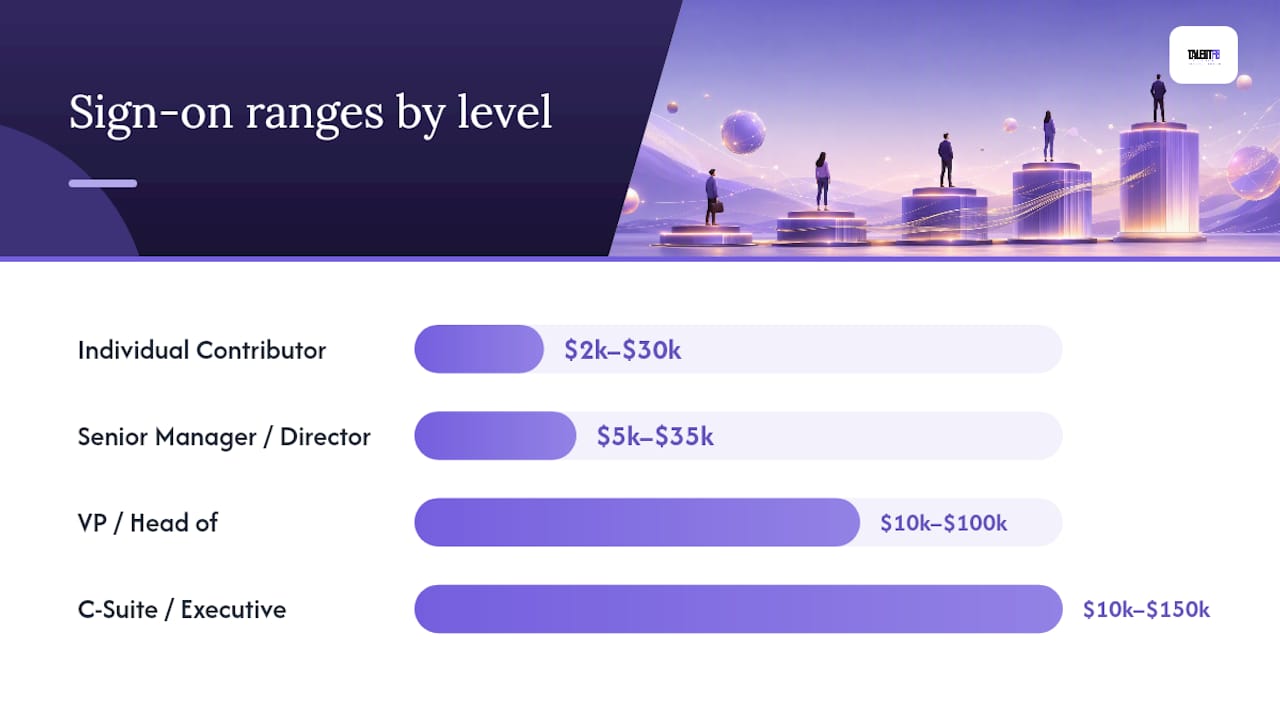
For a $200,000 base, that’s a $10,000–$40,000 range. The upper end is more defensible when you have documented forgone compensation to justify it.
Industry notes:
- Tech: The most aggressive sign-on market. FAANG and Tier-1 tech companies routinely offer $20,000–$100,000+ for senior roles, often in addition to RSU grants.
- Finance and banking: Investment banks and hedge funds use sign-ons heavily to compensate for deferred comp left behind at prior firms. Six-figure sign-ons for VP-level and above are common.
- Healthcare and pharma: Sign-ons are standard for physicians, specialized nurses, and senior research roles. Amounts vary widely by specialty and geography.
- Consulting: Major strategy firms use sign-ons to recruit MBAs and experienced hires. Amounts tend to be structured and tied to tenure commitments. For consulting-specific framing on how to position yourself during compensation talks, Cut to the Case’s career advice offers useful perspective.
- Startups: Cash-constrained early-stage companies may offer smaller sign-ons but compensate with equity. Negotiate the equity cliff and acceleration terms carefully.
WorldatWork’s bonus research confirms that sign-on amounts vary substantially by role and seniority, with no single universal standard. Use these ranges as a starting point, then adjust based on your specific forgone compensation and the employer’s urgency to hire.
Tax treatment, payment timing, and clawback clauses to watch for
A $30,000 sign-on bonus is not $30,000 in your pocket. Understanding the tax and contract mechanics protects you from surprises that can make the bonus feel much smaller, or create real financial risk if you leave early.
How sign-on bonuses are taxed in the U.S.: The IRS treats sign-on bonuses as supplemental wages. For large bonuses, a gross-up is worth negotiating: the employer pays the taxes on your behalf so you receive the full stated amount net. This is more common at the executive level and for relocation-related payments.
Payment timing structures:
- Lump sum at start: Most common. You receive the full amount on your first paycheck or within 30 days of your start date.
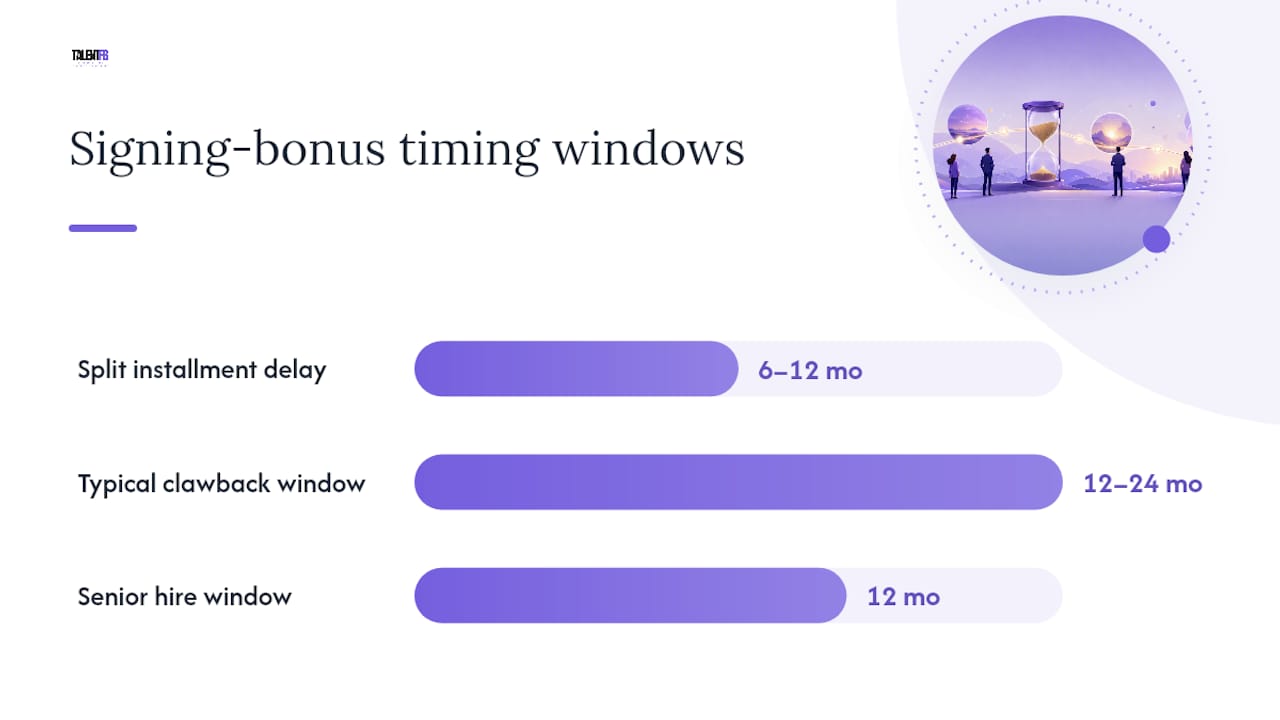
- Split installments: Some employers pay 50% at start and 50% after 6 or 12 months. This reduces their clawback risk but delays your cash flow.
- Milestone-tied payments: Less common, but some executive agreements tie tranches to specific deliverables or performance reviews.
Clawback clauses: This is where many professionals get caught. A clawback (or repayment) clause requires you to return the bonus if you leave before a specified period, typically 12–24 months. The key terms to scrutinize:
- Trigger conditions: Does the clawback apply only if you voluntarily resign, or does it also apply if you’re laid off or terminated without cause? An unconditional clawback on any separation is a serious red flag.
- Proration: A fair clause prorates the repayment. If you leave after 9 months of a 12-month window, you repay 25%, not 100%. Push for proration if it’s not already in the language.
- Shortened windows for senior hires: At the VP and executive level, a 12-month clawback window is more reasonable than 24 months. Negotiate the window down if you can.
Watch for this clause language: “Employee agrees to repay the full signing bonus if employment is terminated for any reason within [X] months of the start date.” The phrase “for any reason” is the danger. It means a layoff triggers repayment just as a resignation does. Counter with: “for any reason other than termination without cause or a material change in role or compensation.”
Indeed’s sign-on bonus guide recommends reading all terms carefully before signing and understanding the long-term implications of clawback provisions, particularly for candidates who might face restructuring in their first year.
Practical negotiation tactics and how much to counter with
Knowing what to ask for is one thing. Knowing how to move the conversation when you hit resistance is another. These are the tactics that actually work in the room.
Sizing your counteroffer:
- The forgone compensation method: Add up everything you’re leaving behind (unvested equity, bonus, relocation costs) and ask for that amount. This is the most defensible anchor.
- The percentage-of-base method: Target 10–20% of your base salary as a sign-on ask. For a $180,000 base, that’s $18,000–$36,000. Use the lower end if you have no specific forgone compensation to cite; use the upper end if you do.
- The company-tier method: Use the ranges in the section above to confirm your ask is within the employer’s typical range for your level.
Tactics when you face pushback:
- Split the difference: If they offer $15,000 and you asked for $30,000, propose $22,500. It signals flexibility while protecting most of your ask.
- Ask for a gross-up: If the amount is fixed, ask them to gross it up so you receive the stated amount after taxes. This costs the employer more but feels cleaner to you.
- Request installments tied to milestones: If they’re hesitant about a lump sum, offer to take it in two payments. This reduces their perceived risk.
- Shift some amount into salary: If sign-on is truly maxed, ask whether any portion can be added to base. Even $5,000 in annual base is worth more over time.
Handling multiple offers: If you have two offers, you can use one as leverage without making it adversarial. “I have another offer I’m considering. I’d prefer to be here, and a signing bonus would make that decision straightforward.” Don’t fabricate a competing offer. Recruiters talk, and a bluff that gets called destroys trust.
Pro Tip: Leave room to trade. If you’re negotiating both the sign-on amount and the clawback terms, consider accepting a slightly lower sign-on in exchange for a shorter clawback window or a proration clause. A $25,000 sign-on with a 12-month prorated clawback is often a better deal than $30,000 with a 24-month unconditional repayment obligation.
What to ask HR and the contract terms that should give you pause
Before you sign anything, get answers to these questions in writing. A verbal “yes” from a recruiter is not a contract term.
Questions to ask HR directly:
- What is the exact payment date for the signing bonus?
- Will the bonus be grossed up for taxes, or will I receive the net amount?
- What are the clawback terms, and what events trigger repayment?
- Is the bonus paid as a lump sum or in installments? If installments, what is the schedule?
- Does the clawback apply if I’m laid off or terminated without cause?
- Is the bonus documented in the offer letter, or in a separate agreement?
Red flags that should give you pause:
- The clawback triggers on “any separation,” including layoffs
- Payment timing is described as “within a reasonable period” with no specific date
- The bonus is tied to future performance metrics that haven’t been defined yet
- The recruiter promises a sign-on verbally but it doesn’t appear in the written offer
- The repayment clause requires you to return the gross amount, not the net amount you actually received (you’d be repaying taxes you already paid)
- The agreement is presented as non-negotiable boilerplate with no room for modification
Minimum documentation to secure before you start:
- A signed offer letter or addendum that states the bonus amount, payment date, tax treatment, and clawback terms
- Written confirmation of any verbal promises made during negotiation
- A copy of the clawback agreement with your signature and the employer’s signature
If any of these are missing, ask for them before you give notice at your current job. Once you’ve resigned, your leverage to request documentation drops to near zero.
What recruiters actually think when you ask for a sign-on bonus
After 15 years inside hiring rooms across tech, fintech, adtech, gaming, and maritime-tech, Frederic Bonifassy has seen sign-on requests land well and fail badly. The difference almost always comes down to framing and timing, not the amount.
Here’s what actually happens on the recruiter’s side when you make the ask:
The approval triggers that move a sign-on request forward:
- The candidate has a competing offer (urgency)
- The role has been open for more than 60 days (pain)
- The candidate’s ask is specific and documented (credibility)
- The amount is within the company’s tier range (feasibility)
- The hiring manager is advocating internally (sponsorship)
The phrases that kill a sign-on request before it reaches approval:
- “I just feel like I deserve more” (no anchor, no justification)
- “Other companies pay more” without naming a specific competing offer
- Asking during the interview process before an offer exists
- Asking for an amount far outside the company’s tier range without justification
What recruiter paperwork looks like: a sign-on request typically requires the recruiter to submit a compensation exception form to HR, which goes to the hiring manager and sometimes to a compensation committee. At large companies, amounts above a certain threshold (often $25,000–$50,000) require VP or C-suite approval. This is why timing matters: the recruiter needs time to get internal sign-off, and if you ask the day before your deadline, you’re creating pressure that can backfire.
Hiring-room advice that most candidates never hear:
- Ask the recruiter directly: “Do you have flexibility on a signing bonus?” This gives them permission to check without committing them to anything.
- If the recruiter says no, ask whether the hiring manager has been consulted. Sometimes the recruiter hasn’t escalated yet.
- For executive roles, ask whether legal needs to review the sign-on agreement. This signals you’re serious and experienced with the process.
- Never negotiate against yourself. If you’ve made an ask and they haven’t responded, wait. Silence is not a no.
After you accept: how to make sure you actually get paid
Accepting the offer is not the finish line. The sign-on bonus isn’t real until it appears in your bank account. Here’s how to protect it.
What to get in writing before you start:
- The offer letter or a signed addendum that includes: the exact bonus amount, the payment date, whether it’s gross or net, and the full clawback terms
- If the bonus was negotiated after the initial offer letter, request a revised letter or a separate signed agreement. An email chain is better than nothing, but a signed document is the standard to hold out for.
Follow-up timeline:
- Week 1: Confirm with HR or your onboarding contact that the sign-on is in the payroll system and scheduled for the correct date.
- If payment is late: Email your HR contact and CC your hiring manager on day 2 after the expected payment date. Keep the tone professional: “I wanted to follow up on the signing bonus of $[X] that was scheduled for [date]. Could you confirm the payment status?”
- Keep documentation: Save every email, the signed offer letter, and any written confirmation of the bonus terms. If a repayment dispute arises later, this paper trail is your protection.
Pro Tip: Before your start date, ask HR whether the sign-on runs through payroll or through accounts payable. Payroll bonuses appear on your pay stub and are subject to standard withholding. AP payments may arrive as a separate check or wire with different documentation. Knowing the channel helps you follow up with the right person if there’s a delay.
What I’ve learned about when to push and when to accept
There’s a version of sign-on bonus negotiation advice that treats every conversation as a battle to win. That’s not how I see it, and it’s not what I’d recommend to any senior professional I work with.
The most valuable thing you can do is know your number before the call. Not a range you’re hoping for, but a specific figure grounded in what you’re actually leaving behind. When you have that number, the conversation becomes straightforward: you’re not asking for more money, you’re asking to be made whole. That framing changes the dynamic entirely.
For senior candidates, the highest-ROI asks are almost always the ones tied to forgone compensation. An unvested equity calculation is concrete, verifiable, and hard to argue with. A vague “I feel underpaid” is not. Document everything, rehearse the conversation with a trusted peer or a coach, and go in with your fallback ready.
The risk/reward calculus is simple: if you have a written offer and a justified number, the downside of asking is nearly zero. A reasonable employer won’t rescind an offer because you asked professionally. The upside can be $20,000–$100,000 in your first paycheck. That’s an asymmetric bet worth taking.
One candid note: if an employer reacts poorly to a well-framed, reasonable sign-on request, that reaction tells you something important about the culture you’re about to join. A company that treats a professional, documented ask as a problem is showing you how it handles disagreement before you’ve even started.
TalentFB helps senior professionals negotiate offers they’re proud of
Senior professionals who’ve worked with TalentFB’s JobSearch/OS™ coaching program arrive at offer conversations with a clear number, a rehearsed script, and a fallback plan already mapped out. That preparation is what separates a confident negotiation from a stressful one.
TalentFB’s negotiation coaching covers the full offer debrief: reviewing the math behind your ask, stress-testing your scripts, walking through clawback clause language, and rehearsing the recruiter conversation until it feels natural. For directors, VPs, and executives navigating complex offers with equity, relocation, and multi-year comp structures, that level of preparation pays for itself in the first conversation.
Practical benefits of working with TalentFB on negotiation:
- Script practice and live roleplay with someone who has sat on the hiring side
- Offer math review: forgone compensation, equity valuation, and total comp comparison
- Contract term review: clawback language, payment timing, and gross-up negotiation
- Fallback strategy: what to ask for when the primary ask is declined
If you’re preparing for an offer conversation and want to go in with the confidence of someone who knows how the other side thinks, book a coaching session with TalentFB and get your negotiation strategy dialed in before the call.
Sources
- Signing Bonus Negotiation 101 – PON – Program on Negotiation at Harvard Law School
- WorldatWork — bonus programs and practices
- How to Ask for a Signing Bonus With Confidence – Robert Half
- How to Negotiate a Sign-On Bonus: Exact Ranges and Scripts for 2026 | Leon Consulting
- Relo
- Indeed — What Is a Sign-On Bonus? Definition and How To Negotiate