Here’s the fastest version: state the problem you fix, the outcome you drive, why you’re credible, and end with a clear ask. That’s a leadership pitch. It works because it leads with impact rather than title, which is what separates an executive introduction from a job title recitation.
Keep it to 30 to 60 seconds, or 100 to 200 words — long enough to make a point, short enough that nobody checks their watch.
Here’s one built for a networking event:
- “I help mid-market SaaS companies fix churn problems that usually trace back to onboarding, not the product itself. At my last company, I significantly reduced early customer churn by rebuilding the customer success motion from scratch. I’m exploring board advisory roles right now. Would love to hear what retention challenges you’re seeing.”
The formula behind it: Problem you solve + proof it worked + what you want next. Swap the details, keep the shape.
Table of Contents
- What Is an Executive Elevator Pitch and When Do You Use It?
- How Long Should an Executive Elevator Pitch Be?
- What Makes an Executive-Level Pitch Actually Land?
- How Do You Write an Executive Pitch Step by Step?
- Copy-Ready Templates for Different Situations
- 15 Executive Elevator Pitch Examples You Can Adapt
- How Do You Deliver a Pitch That Doesn’t Sound Rehearsed?
- What Mistakes Do Senior Leaders Make When Pitching Themselves?
- How Do You Turn Decades of Experience Into a 60-Second Story?
- When Should You Practice Alone vs. Get Coaching?
- Where TalentFB Fits If You Want Help Getting This Right
- Where Else Can You Learn More About Executive Pitching?
- Frequently Asked Questions
- Sources
What Is an Executive Elevator Pitch and When Do You Use It?
An executive elevator pitch is a short, spoken introduction that answers one question fast: why should this person care what you do? It’s not your résumé condensed. It’s the sharpest possible version of your value.
You’ll use different versions of it in:
- Job interviews, especially the “tell me about yourself” opener
- Networking events and conferences
- Boardroom or investor introductions
- Passing a colleague in the hallway or a client in the elevator (literally)
A boardroom version runs more formal; if you’re a healthcare founder preparing for investor introductions, consider using this healthcare startup investor pitch checklist to refine your message. A conference hallway version can sound almost conversational. Same bones, different clothes.
How Long Should an Executive Elevator Pitch Be?
Thirty to sixty seconds. That’s roughly 100 to 200 words, based on a normal speaking pace, and it’s the range that keeps a listener’s attention without testing their patience.
A few practical splits:
- Networking: aim for the shorter end, 30 to 40 seconds. People are standing, holding a drink, half-listening.
- Interview intros: you can stretch to 60 seconds since the interviewer expects more context.
- Time yourself out loud during practice. Written pitches always sound shorter in your head than they play out loud.
What Makes an Executive-Level Pitch Actually Land?
The best executive pitches follow what I think of as a 3-C shape: Context (the problem your audience actually has), Contribution (what you specifically did about it), and Credibility (why anyone should believe you). Miss any one of the three and the pitch feels either vague or self-congratulatory.
Here’s the part senior leaders get wrong most often: leading with the title instead of the impact. “I’m a VP of Engineering” tells a listener nothing about what problems you actually solve. Naming the measurable outcome you drove, like cutting deployment time or scaling a platform through a funding round, does the positioning work a title never can.
- Context: what business problem were you solving?
- Contribution: what did you specifically do?
- Credibility: what evidence backs it up?
Pro Tip: A pitch isn’t a performance. Think of it as the clearest possible answer to a fair question, not a script you’re reciting. The moment it sounds rehearsed, it stops sounding credible.
How Do You Write an Executive Pitch Step by Step?
Build it in five parts. High-impact leadership pitches tend to include the problem, the impact, the audience, and your credibility, in that order.
- The hook. Name a problem your audience recognizes. “Most fintech platforms struggle to scale compliance without slowing product velocity.”
- What you do. One sentence on your approach. “I build compliance infrastructure that scales with engineering, not against it.”
- Quantified impact. This is where most executives go soft. Don’t say “improved efficiency.” Say “reduced compliance review time by 40% while doubling release frequency.”
- Credibility. Why you, specifically? A title, a company name, or a domain (12 years across three fintech scale-ups) does this efficiently.
- The ask. Every pitch needs one, or it goes nowhere. A vague pitch with no destination is just small talk with better vocabulary.
Tailoring notes: investors want growth and return metrics, interviewers want problem-solving evidence tied to their role, peers want relevance to shared challenges, and boards want risk and governance framing. Same five parts, different metrics plugged in.
To shorten it for a hallway moment, keep steps one, three, and five. To expand it for an interview, let step three breathe with a short story.

Copy-Ready Templates for Different Situations
Templates work best as scaffolding, not scripture. Adjust the language to sound like you, not like a template.
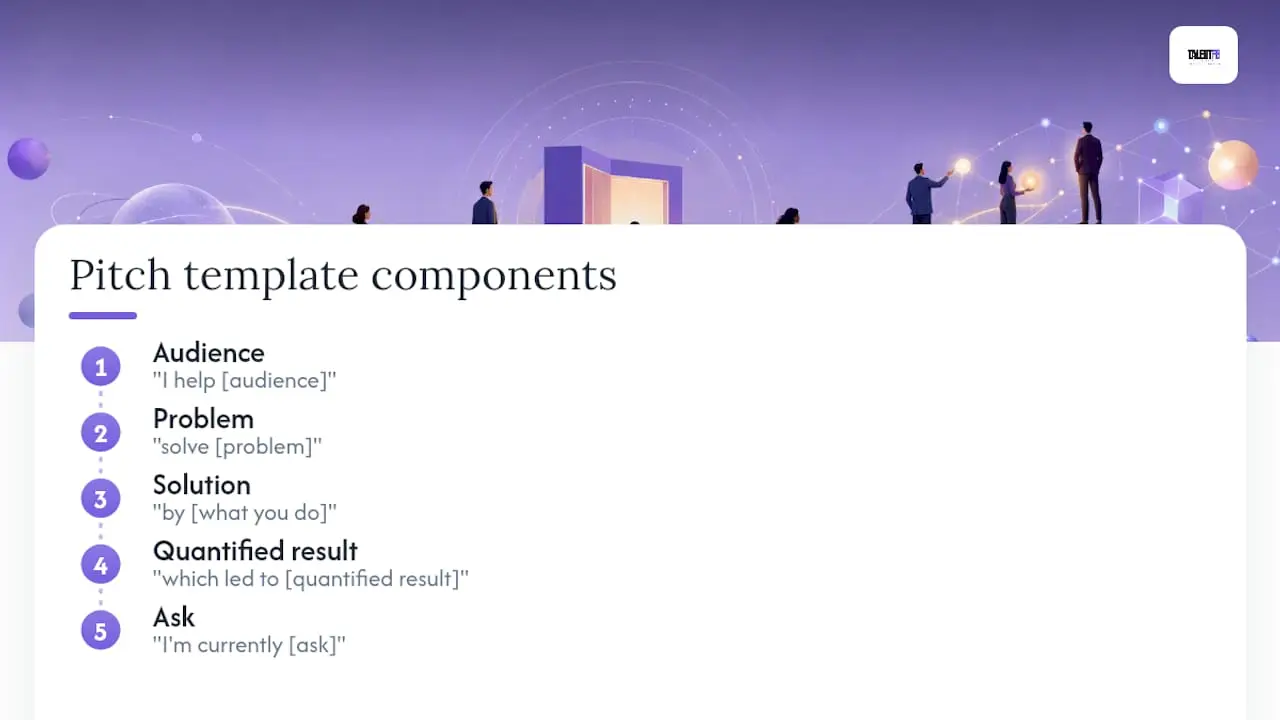
General one-liner: “I help [audience] solve [problem] by [what you do], which led to [quantified result]. I’m currently [ask].”
Interview template (Before/After/Bridge): “When I joined [company], [before state, e.g., ‘churn was above industry average’]. I [bridge, what you did]. Today, [after state, with a number]. That’s the kind of turnaround I’m looking to repeat at [target company/role].”
Networking template: “I focus on [specific problem] for [audience type]. Most recently, [one metric]. What’s your team seeing on [related challenge]?” Ending on a question keeps the conversation moving instead of dying after your last sentence.
Fill-in examples for senior titles: a VP might say “I lead platform engineering for a Series C fintech.” An SVP might say “I run product and engineering across three business units.” A C-suite executive might say “I set technology strategy for a $200M ARR company.” Same structure, scaled ambition.
15 Executive Elevator Pitch Examples You Can Adapt
Organized by where you’ll actually use them. Swap the industry, title, and metric, and these hold up across most senior functions.
Interview pitches:
- VP of Sales, interview: “I’ve spent the last decade building enterprise sales teams from scratch. At my last company, I grew annual recurring revenue substantially over three years by restructuring the sales motion around customer success handoffs. I’m looking for a similar scale-up challenge.”
- SVP of Operations, interview: “I fix operational bottlenecks that slow growing companies down. My last role significantly improved order fulfillment times across multiple warehouses. I want to bring that same discipline somewhere earlier stage.”
- CTO, interview: “I’ve led engineering through two acquisitions and one IPO. My focus is making technical debt visible to the business, not just the engineering team.”
- CFO, interview: “I specialize in taking finance teams from spreadsheets to systems. I built the FP&A function that supported a Series B to Series D raise.”
- CHRO, interview: “I rebuild talent strategy for companies scaling past 500 employees. My last team reduced time-to-hire while improving retention.”
Networking pitches:
- Marketing VP, conference: “I help B2B companies fix demand gen when leads are high but pipeline quality is low. What’s your team’s biggest gap between marketing and sales right now?”
- Product leader, networking mixer: “I’ve spent my career turning messy product roadmaps into ones engineering teams actually trust. Curious what’s slowing your roadmap down these days.”
- COO, industry event: “I specialize in operational scaling for companies doubling headcount in under 18 months. What’s breaking first for you, systems or people?”
Investor and board intros:
- Founder to investor: “We solve inventory forecasting for mid-market retailers, reducing overstock costs for our early customers. We’re raising a Series A to scale the sales team.”
- Board candidate: “I bring extensive maritime-tech operations experience, including multiple successful platform migrations. I’m looking for a board seat where operational scaling is the core challenge.”
- CEO to prospective board member: “We’ve significantly grown our annual recurring revenue over several years. What we need next is governance experience around international expansion.”
Client and internal stakeholder pitches:
- Consultant to prospective client: “I help enterprise clients cut vendor costs without cutting service quality, usually by 15% to 20% within the first year.”
- Internal stakeholder, cross-team pitch: “My team owns the data infrastructure that your reporting depends on. I want ten minutes to show you what’s coming that could affect your Q3 numbers.”
- Business development, client meeting: “We’ve helped three companies in your sector significantly reduce onboarding time. I’d like to understand what onboarding looks like for you today.”
- Advisor pitch, long career compression: “Over 20 years, I’ve led three companies through acquisition. The common thread is building teams that survive leadership change. That’s the advisory work I focus on now.”
A few adjustment notes: swap the percentage or dollar figure to match your real results, never inflate one. Swap the industry noun (“fintech,” “maritime-tech,” “retail”) to match your audience’s world, and swap the ask depending on whether you’re job hunting, fundraising, or just building a relationship.
How Do You Deliver a Pitch That Doesn’t Sound Rehearsed?
Slow down. Most executives rush the delivery because the content feels obvious to them, forgetting it’s brand new to the listener. Pause after your result. Let the number land.
- Open with something other than “Hi, I’m [name], [title] at [company].” Try leading with the problem instead: “I spend my time fixing X.”
- Practice out loud, not just in your head. Record yourself once. It’s uncomfortable and useful in equal measure.
- Time it. If you’re consistently running past 60 seconds, cut examples before you cut substance.
- In virtual settings, pause slightly longer than feels natural. Video calls eat micro-pauses that would read fine in person.
Pro Tip: If someone asks a follow-up question after your pitch, that’s success, not interruption. A pitch that invites a question is doing exactly what it should.
What Mistakes Do Senior Leaders Make When Pitching Themselves?
Leaning on titles instead of outcomes is the most common one. “I’m the VP of Engineering” says nothing about what you actually do. Fix: replace the title with the problem you solve.
Cramming in every achievement from a 20-year career is another. Nobody remembers a list. Fix: pick one theme, one or two proof points, done.
Skipping the ask entirely leaves the listener with nowhere to go, and a pitch without a next step tends to go nowhere. Fix: always close with a specific, small request.
- Overusing jargon that means something internally but nothing externally
- No metrics, just adjectives like “significant” or “strong”
- Underselling out of misplaced modesty, which reads as uncertainty, not humility
How Do You Turn Decades of Experience Into a 60-Second Story?
Pick one theme, not a highlight reel. If your career has touched five industries and eight roles, find the connective thread, maybe it’s turnarounds, maybe it’s scaling teams past a specific headcount, and build around that. Experienced professionals do best when they anchor on an overarching theme plus one or two achievements with real numbers, then keep three or four supporting stories in reserve for when someone asks “tell me more.”
For quantifying impact without overstating it, stick to verifiable phrasing: “grew revenue from $X to $Y,” “reduced [specific cost] by [percentage] over [timeframe],” “led a team of [size] through [specific transition].” Numbers you can back up in an interview beat impressive-sounding vagueness every time.
The close matters as much as the open. A pitch that ends without a next step is a monologue, not a conversation starter. Three asks that consistently work: requesting a follow-up conversation, asking for an introduction to someone specific, or offering to send a one-page summary of your background.
Frederic Bonifassy has spent 15 years inside hiring rooms across tech, fintech, adtech, gaming, and maritime-tech in APAC, and has coached over 350 senior professionals through TalentFB’s JobSearch/OS™ program, where a sharp, metrics-driven pitch is often the difference between a polite interview and a real offer.
When Should You Practice Alone vs. Get Coaching?
If you can already name your career theme and back it with real numbers, practice out loud a dozen times and you’ll be fine. Where I’ve seen leaders get stuck is compressing 20 years into two believable achievements without either underselling or rambling. That’s the part worth outside eyes. Not because you can’t write it yourself, but because you’re too close to your own story to see what actually lands.
Where TalentFB Fits If You Want Help Getting This Right
TalentFB exists because most executives are too close to their own careers to compress them into 60 seconds that actually land. That’s not a knock, it’s just hard to edit your own story down when you lived every detail of it. TalentFB’s coaching, built from 15 years inside hiring rooms across tech, fintech, adtech, gaming, and maritime-tech, focuses on exactly this problem: turning a long, complicated career into a pitch that gets remembered.
The JobSearch/OS™ program has coached over 350 senior tech professionals, Directors, VPs, and Senior Managers, toward next roles within 90 days, often with a 20% to 30% salary increase. If you’re a CEO or founder instead, Talent/OS™ rebuilds your LinkedIn presence so the right talent finds you organically, without executive search fees eating your budget.
Start by tightening what you already have. Review your LinkedIn profile alongside your pitch, since the two should tell the same story, then book a diagnostic call to see where your narrative needs the most work.
Where Else Can You Learn More About Executive Pitching?
- Salesforce’s elevator pitch guide for timing and structural basics.
- Rutgers–Newark Careers on the four-part leadership pitch structure.
- Asana’s pitch examples and template for the importance of the closing ask.
- Cornell SC Johnson on leading with impact instead of titles.
- IESE Standout for compressing long careers into a short pitch.
- Princeton’s Center for Career Development for stepwise pitch-building advice.
Frequently Asked Questions
How long should an executive elevator pitch be?
Thirty to sixty seconds, or about 100 to 200 words. Trim toward the shorter end for networking, and let it breathe a bit more in an interview.
What’s the difference between a leadership pitch and a regular elevator pitch?
A leadership pitch centers on measurable business impact and strategic scope rather than job duties, positioning the speaker as someone who solves problems, not just holds a title.
Do I need a different pitch for investors versus interviewers?
The five-part formula stays the same, but the metrics change. Investors want growth and return numbers. Interviewers want problem-solving evidence tied to the role they’re hiring for.
What if I have 20+ years of experience and too much to fit in?
Pick one overarching theme and one or two achievements with real numbers, then keep three or four backup stories ready if someone asks a follow-up question.
Should I always end with an ask?
Yes. A pitch without a next step rarely leads anywhere. Keep the ask small and specific, a follow-up call, an introduction, or permission to send a short summary.
Sources
- Elevator pitch examples and templates | Salesforce
- How to give a great elevator pitch (with examples) | Rutgers–Newark Careers
- 15 elevator pitch examples + template & tips | Asana
- Understanding leadership beyond titles | Cornell SC Johnson
- Elevator pitch for a job interview: how to condense 20+ years into 3 minutes | IESE Standout
- Developing Your Elevator Pitch | Center for Career Development (Princeton)