
TL;DR:
- Senior technology executives must specialize in high-demand areas like AI, cloud, and cybersecurity.
- Building targeted thought leadership and online branding is critical for visibility and credibility.
- Success relies on proactive outreach, data-driven adjustments, and leveraging AI tools for job search optimization.
The executive technology job market in 2026 is not simply competitive. It is structurally different from what most senior professionals experienced even three years ago. Seasoned technology leaders with decades of broad experience are discovering that their resumes disappear into silence while peers with narrower, deeper specializations field multiple offers. AI-driven applicant tracking systems filter candidates before a human ever reads a single line. Executive search firms operate on tightly defined mandates. If your job search strategy was built for 2019, it is working against you now. This guide delivers an evidence-driven framework covering preparation, execution, and verification so you can position yourself where the real demand lives.
Table of Contents
- The new reality: Why old job search tactics fail
- Preparation: Building a futureproof skill and branding toolkit
- Execution: Advanced job search tactics for executives
- Verification: Measuring progress and adjusting quickly
- Why high-level candidates win by becoming industry specialists
- Accelerate your executive job search with TalentFB
- Frequently asked questions
Key Takeaways
| Point | Details |
|---|---|
| Specialization is critical | Focusing your skills in AI/ML, cloud, or cybersecurity dramatically increases executive job prospects. |
| Brand strategically | Executive success depends on a visible, trusted digital presence that highlights industry leadership. |
| Use advanced tactics | The most effective candidates rely on targeted, data-driven approaches and AI-powered search tools. |
| Measure and adapt fast | Tracking conversions and adjusting strategy quickly leads to better outcomes in executive job searches. |
The new reality: Why old job search tactics fail
For most of your career, a strong resume, a warm referral, and a respected title were enough to open doors. That formula has quietly stopped working at the senior level. The recruitment landscape for technology executives has shifted in ways that reward a very specific kind of candidate, and understanding those shifts is the first step toward navigating them.
First, consider how companies now source executive talent. Many organizations have moved toward retained search firms and internal talent intelligence platforms that proactively map the market. Passive candidates are identified through LinkedIn signals, conference speaking records, published content, and patent filings. If you are not generating those signals, you are invisible to the searches that matter most.
Second, AI-driven applicant tracking systems now operate at the executive level too. Even VP and C-suite applications pass through keyword filters before reaching a recruiter’s desk. A resume that reads beautifully to a human but lacks the precise language of a job description will be ranked low automatically. This is why AI job search strategies have become essential knowledge, not optional reading.
Third, and most critically, the market has bifurcated. The 2025-2026 labor market research confirms a market split between surplus generalists and a genuine shortage of specialists. Executives with deep expertise in AI governance, cloud architecture, cybersecurity leadership, and data science strategy are being actively recruited. Executives with broad but shallow portfolios are competing in an overcrowded pool.
Here is what that means practically:
- Broad experience alone no longer differentiates you from hundreds of other senior candidates
- Generic leadership narratives fail to resonate with hiring committees looking for domain authority
- Spray-and-pray applications generate near-zero response rates at the executive level
- Passive waiting after submitting applications is a strategy that stalls careers
“The executives who thrive in this market are those who have made a deliberate choice to own a domain, not just manage one.” This is the core insight behind the reversed job search system that consistently produces results for senior technology professionals.
With the challenges in mind, let’s examine the strategic shifts required.
Preparation: Building a futureproof skill and branding toolkit
Once you are committed to a new approach, start by preparing yourself and your executive profile. Preparation at the senior level is not about adding certifications to a resume. It is about building a visible, credible identity around a high-demand specialization.

The key 2026 tech skills confirm that upskilling in AI/ML, data science, cloud, cybersecurity is no longer optional for executives who want to remain competitive. Boards and hiring committees expect technology leaders to speak fluently about AI strategy, data governance, and cloud economics, not just manage teams that handle those areas.
Thought leadership is the other half of this equation. Publishing insights on LinkedIn, speaking at industry events, contributing to technical advisory boards, and sharing case studies from your career all build the kind of external credibility that executive recruiters notice. Your LinkedIn career branding profile is your digital mirror, and it needs to reflect a specialist, not a generalist.
Use the following toolkit as your preparation baseline:
| Branding asset | Current state | Target state | Action required |
|---|---|---|---|
| LinkedIn headline | Generic title | Specialization-anchored | Rewrite with domain keywords |
| Executive resume/CV | Chronological duties | Achievement and impact led | Quantify outcomes by domain |
| Thought leadership content | Minimal or absent | 2 to 4 posts per month | Build a content calendar |
| Speaking engagements | Occasional | Targeted industry events | Pitch 3 to 5 conferences |
| Case study portfolio | Internal only | Shareable on request | Develop 2 to 3 external stories |
Beyond the table, consider using your current role strategically. Every project you lead, every cross-functional initiative you drive, and every measurable result you generate is raw material for your executive brand. Use the tech leadership career checklist to audit where your profile stands today versus where it needs to be.
Pro Tip: Do not wait until you are actively searching to build thought leadership. The executives who land the best roles are those whose names are already circulating in the right circles before a position is even posted.
- AI/ML strategy: Demonstrate executive-level understanding of model governance and ethical AI deployment
- Cloud leadership: Speak to multi-cloud economics, vendor strategy, and enterprise migration outcomes
- Cybersecurity: Show board-level risk communication and incident response leadership
- Data science: Translate analytical capability into business value narratives
Execution: Advanced job search tactics for executives
Once equipped with this upgraded toolkit, you can execute the following strategies. Execution at the senior level is about precision, not volume.

The most effective channels for executive technology roles are not the ones most people use. Compare them directly:
| Channel | Traditional approach | Advanced approach |
|---|---|---|
| Job boards | Apply to posted roles | Monitor for market intelligence only |
| Passive profile | Active outreach and content strategy | |
| Executive recruiters | Wait to be contacted | Proactively map and engage 20 to 30 firms |
| Board placements | Not considered | Engage board advisory networks |
| Stealth searches | Unknown | Build relationships before roles open |
| Internal referrals | Hope for introductions | Orchestrate targeted referral campaigns |
The recent executive hiring data reinforces that specialists in AI/ML and cybersecurity are being placed faster and at higher compensation than generalist candidates across every seniority level.
Here is a step-by-step execution framework:
- Map your target companies. Identify 30 to 50 organizations where your specialization creates immediate value. Prioritize growth-stage companies, PE-backed firms, and enterprises undergoing digital transformation.
- Engage executive search firms directly. Research the 20 to 30 firms that specialize in your domain and initiate conversations before you need them. Relationships with retained search partners are built over months, not days.
- Optimize your resume for AI screening. Use the language of the roles you target. A/B test your resume by tracking which versions generate recruiter responses. The AI job search playbook provides specific frameworks for this.
- Orchestrate your network. Do not broadcast that you are searching. Instead, make targeted, individual outreach to former colleagues, board members, and investors who can make warm introductions to the right decision-makers.
- Prepare for executive interviews early. Review top executive interview questions and develop concise, impact-focused narratives for each specialization area.
- Access curated resources. The job search resources available to senior professionals can significantly shorten your learning curve.
Pro Tip: A single warm introduction from a trusted mutual contact is worth more than fifty cold applications. Invest 60% of your weekly search time in relationship-driven outreach, not applications.
Verification: Measuring progress and adjusting quickly
With tactics in motion, it is critical to monitor and adjust to maintain momentum. Senior professionals often underestimate how much data their own search generates, and how actionable that data can be.
The labor market analytics confirm the market split between generalists and specialists is widening, which means the feedback loop from your search activity tells you whether your positioning is landing correctly. If outreach is generating low response rates, the problem is usually positioning, not effort.
Track these metrics weekly:
- Outreach-to-response rate: Target 20 to 30% for personalized executive outreach
- Recruiter engagement rate: How many search firm conversations convert to active consideration
- Interview conversion rate: Percentage of first conversations that advance to formal interviews
- Time-to-offer tracking: Benchmark your pace against a 60 to 90-day target for active searches
- Content engagement: LinkedIn post views, profile visits, and connection request acceptance rates
“A senior job search is not a waiting game. It is an active iteration cycle. The executives who land fastest are those who treat every week as a sprint with measurable outcomes.”
Review your metrics every Friday. If outreach response rates drop below 15%, rewrite your messaging. If interview conversion stalls, revisit your executive narrative and consider whether your specialization positioning is clear enough. The job search masterclass provides a structured system for running these weekly reviews.
Recognize the signs of a stalling search early. Three or more weeks without a new recruiter conversation, declining LinkedIn profile visits, or a pattern of first-round interviews that never advance are signals to pivot your approach, not to apply more broadly.
Four channels for an executive search, compared
| Channel | Best for | Watch out for |
|---|---|---|
| Referrals from your network | Roles filled before they are advertised | Only works if people know exactly what you want |
| Executive search firms | Confidential and very senior roles | They work for the client and call when you fit a brief |
| Direct outreach to decision makers | Target companies with a problem you can solve | Needs a clear value proposition and a personal message |
| Job postings | Well defined roles in large companies | High competition and applicant tracking filters |
A strong senior search runs the first three together and treats postings as a signal of which companies are hiring, not as the main route in.
Why high-level candidates win by becoming industry specialists
Let’s add a candid perspective on what truly works at the executive level. Conventional career advice has long urged senior professionals to build broad experience, lead diverse teams, and demonstrate versatility. That advice served well for a previous era.
Today, the research on specialization is unambiguous. The market favors specialists over generalists at every senior tier. We have seen this pattern repeatedly: a VP of Technology with fifteen years of broad leadership experience competes against a VP whose career has been anchored in AI platform strategy. The specialist fields three offers. The generalist waits months.
The counterintuitive truth is that specialization does not limit your options. It multiplies them. When you own a domain, companies come to you because you represent a solution to a specific, urgent problem they cannot solve internally. That is a position of leverage, not constraint.
The most effective path forward is to audit your career, identify the two or three areas where you have the deepest expertise and the strongest outcomes, and then build your entire brand, content strategy, and outreach around those areas. Understanding strategic talent acquisition from the hiring side also helps you see exactly what decision-makers are looking for when they brief a search firm.
Set your direction before you start searching
The most common mistake I see in senior job searches is starting with activity instead of direction. Before you update a CV or send a message, decide three things: the role and level you are targeting, the kind of company where you add the most value, and the 30 companies you would most like to work for. Every later step, from your LinkedIn headline to your outreach, gets easier once those are clear. A focused search with a short target list almost always beats a broad one.
Accelerate your executive job search with TalentFB
Ready to take action and multiply your job search results? Explore these resources:
If the strategies in this guide resonate with you, TalentFB is built to help you execute them with precision and speed. The platform combines AI-powered tools, expert coaching, and a structured framework designed specifically for senior technology professionals who want results in 90 days or less.
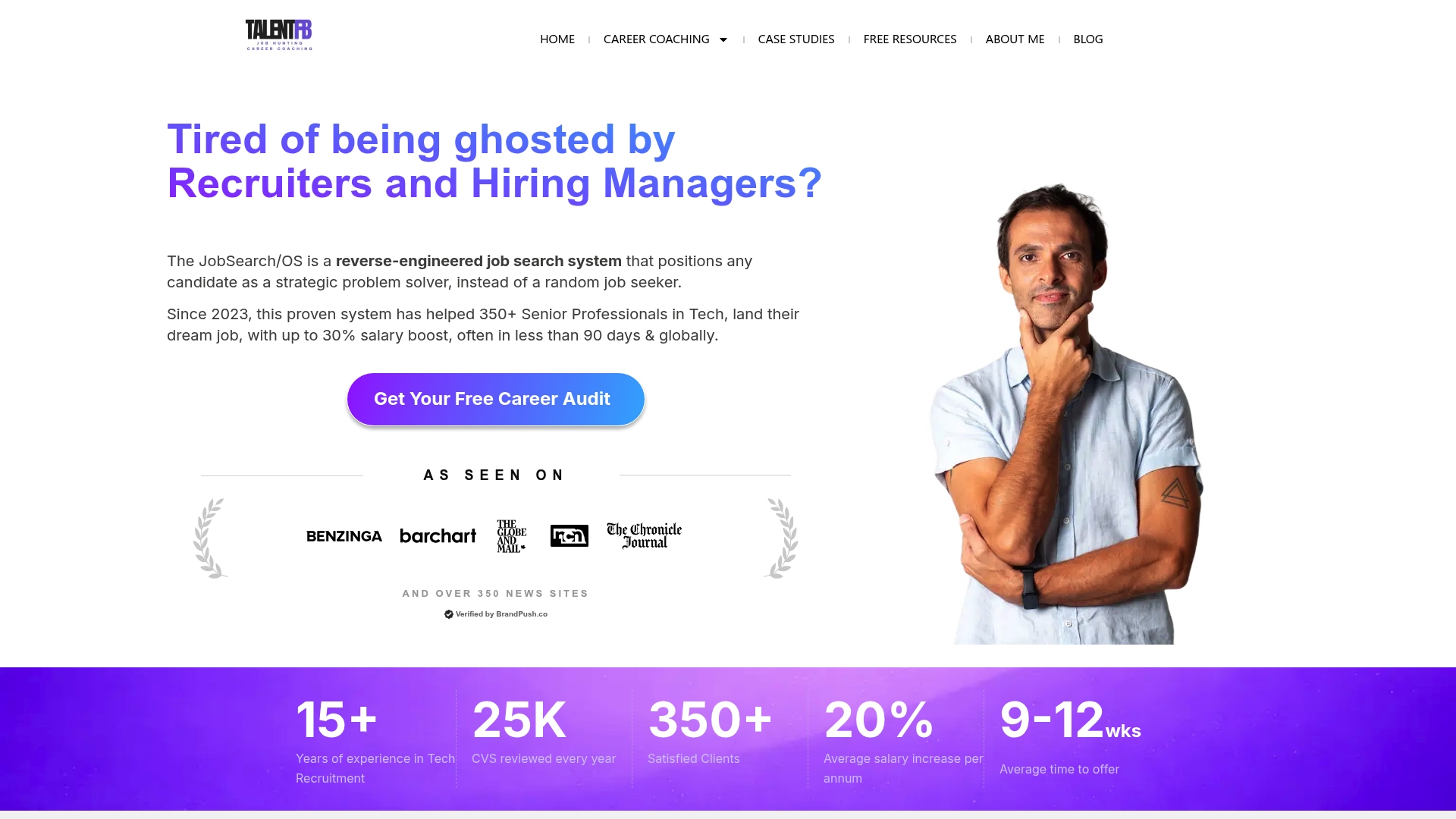
Start with the AI Job Search Playbook to sharpen your resume, optimize your LinkedIn presence, and identify the hidden market opportunities that most executives never see. Book one of the AI career coaching sessions to get personalized guidance on your specialization positioning and outreach strategy. And use the Executive Visibility Scorecard to benchmark exactly where your brand stands today and what to fix first.
Frequently asked questions
What should senior tech executives focus on during a job search in 2026?
Prioritize deep specialization in AI/ML, cloud, and cybersecurity while investing in executive branding and targeted networking. Generalist positioning consistently underperforms in the current market.
How can I increase my visibility for executive recruiter searches?
Publish thought leadership content consistently on LinkedIn, align your headline and summary with your specialization, and proactively engage with retained search firms in your domain before you need them.
Which metrics best track progress for executive job searches?
Focus on outreach-to-response rate, interview conversion rate, and time-to-offer. The widening generalist-specialist gap means your metrics will quickly reveal whether your positioning is resonating with the right decision-makers.
Are AI tools important for executive job searches in 2026?
Absolutely. AI tools are now essential for resume keyword optimization, ATS compatibility testing, and identifying stealth market opportunities that never appear on public job boards.
Recommended
- 6 proven talent acquisition strategies to attract tech talent
- Career development checklist for tech leaders: advance strategically
- Get 3x Job Interviews with the AI Job Search Playbook
- Get 3x Job Interviews with the AI Job Search Playbook
- Crafting Long-Term Recruitment Strategies in Dynamic Markets: A Guide for Success – Mcglynn Personnel