

TL;DR:
- Talent acquisition is a strategic, long-term process that focuses on building talent pipelines and employer branding.
- It differs from reactive recruitment, which addresses immediate vacancies and short-term needs.
- Modern TA leverages data, AI, skills-based sourcing, and metrics to optimize hiring outcomes and reduce costs.
Most tech leaders believe they understand hiring. They post a job, screen resumes, conduct interviews, and extend an offer. Clean, simple, done. But talent acquisition is something fundamentally different, and the gap between those who know the distinction and those who don’t is widening fast. In a sector where a single mis-hire at the leadership level can cost hundreds of thousands of dollars and set a product roadmap back by months, treating talent acquisition as just another word for recruitment is a strategic blind spot. This guide will sharpen your understanding, map the full process, and give you frameworks you can apply immediately.
Table of Contents
- Definition and fundamentals of talent acquisition
- The five-step talent acquisition process in technology
- Modern strategies: Data, AI, and skills intelligence
- Nuances, challenges, and future directions
- Beyond the buzzwords: What top tech leaders get right about talent acquisition
- Level up your talent strategy with TalentFB
- Frequently asked questions
Key Takeaways
| Point | Details |
|---|---|
| Strategic vs. reactive hiring | Talent acquisition uses long-term, proactive planning distinct from transactional recruitment. |
| Five-step process | Successful acquisition means nailing workforce planning, sourcing, screening, evaluation, and onboarding. |
| Leverage data and AI | Modern tech hiring requires data-driven, AI-powered sourcing and skills-based selection. |
| Balance speed and quality | Prioritize quality-of-hire and structured processes over mere speed to avoid costly mis-hires. |
| Futureproof with leadership | The best tech leaders invest in strategic, tech-enabled talent systems for sustained edge. |
Definition and fundamentals of talent acquisition
With the stakes set, the first critical distinction is defining talent acquisition and shattering the myth it’s just another word for hiring.
Talent acquisition (TA) is a strategic, proactive process built around long-term organizational needs. It is not simply filling open seats. It involves anticipating future workforce requirements, building relationships with potential candidates before roles exist, and positioning the organization as a destination employer. Recruitment, by contrast, is reactive. It activates when a vacancy appears and ends when the seat is filled.
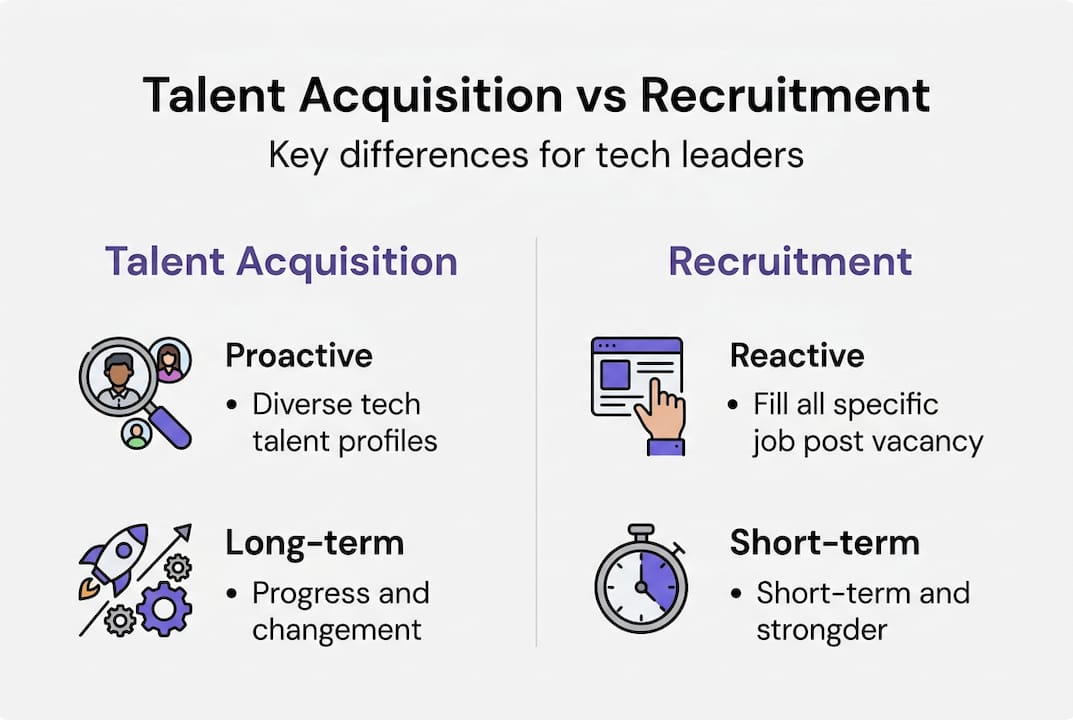
Here is how the two approaches compare:
| Dimension | Talent acquisition | Traditional recruitment |
|---|---|---|
| Orientation | Long-term, strategic | Short-term, transactional |
| Trigger | Workforce planning | Open vacancy |
| Candidate pool | Pre-built pipeline | Sourced on demand |
| Employer brand | Actively cultivated | Rarely prioritized |
| Measurement | Quality-of-hire, retention | Time-to-fill |
The foundational pillars of talent acquisition include:
- Workforce planning: Forecasting headcount needs based on business goals and market trends
- Employer branding: Shaping how your organization is perceived by potential candidates
- Proactive talent pipeline: Nurturing relationships with passive candidates before roles open
- Structured assessment: Evaluating candidates against defined competencies, not gut instinct
- Data and analytics: Using metrics to optimize every stage of the funnel
The shift from recruitment to TA is not cosmetic. Reactive recruitment fails when organizations scale beyond roughly 24 hires per year, because the just-in-time model cannot keep pace with demand. At that inflection point, organizations need a TA operating model with workforce forecasting built in. For tech companies scaling engineering teams or expanding into new product lines, this threshold arrives quickly.
You can explore talent acquisition strategies tailored specifically for attracting tech talent to see how leading organizations operationalize these pillars.
The five-step talent acquisition process in technology
With a clear definition in hand, let’s map the tangible process tech organizations must master for effective talent acquisition.
The core talent acquisition mechanics follow five sequential phases, each requiring deliberate attention:
- Workforce planning and requisition: Align headcount requests with business strategy. Define role scope, required competencies, and success metrics before opening a search.
- Sourcing: Activate both active and passive channels. This includes job boards, LinkedIn outreach, employee referrals, and AI-powered sourcing tools that surface candidates based on skills rather than keywords alone.
- Screening and assessment: Use structured screening criteria and skills assessments to evaluate candidates consistently. Standardized scorecards reduce unconscious bias and improve downstream quality.
- Interviewing: Deploy structured interview formats with calibrated panels. Each interviewer should assess a specific competency, not repeat the same questions.
- Offer management and onboarding: Extend competitive, data-informed offers and invest in a structured onboarding program. The first 90 days are where new hire success or failure is largely determined.
Context matters here. Tech industry benchmarks show an average of 110 applications per hire, 48 days to hire, and 26 requisitions per recruiter per month. These numbers reveal the volume and pressure tech TA teams operate under.

| Metric | Tech industry benchmark |
|---|---|
| Applications per hire | 110 |
| Average days to hire | 48 |
| Requisitions per recruiter/month | 26 |
Pro Tip: If your average time-to-hire exceeds 48 days, audit where candidates are stalling in the funnel. Most delays cluster in the interview scheduling and offer approval stages, not sourcing. Fixing process friction here reduces mis-hire risk because rushed decisions at the end of a long process often produce poor outcomes.
For deeper guidance on managing talent once they’re in the door, the tech talent management tips resource covers how to sustain performance post-hire. You can also access curated job search resources to better understand what top candidates expect from your process.
Modern strategies: Data, AI, and skills intelligence
Understanding the traditional framework is only the start. The real edge in tech hiring now comes from embracing new strategies and technology.
The data is clear. AI for resume screening and job description optimization is already in use at 58% of organizations. Skills-based hiring, internal mobility programs, and employer branding investments are reshaping how the best tech companies compete for talent. The organizations still relying on keyword-matched job descriptions and reactive outreach are losing ground.
Here is what modern TA strategy looks like in practice:
- Skills-based sourcing: Moving beyond job titles to identify candidates by demonstrated capabilities expands your pool significantly
- AI-assisted screening: Tools that analyze skills signals rather than credentials alone reduce time-to-shortlist
- Employer brand investment: A compelling, authentic employer narrative reduces cost-per-hire and improves offer acceptance rates
- Internal mobility: Promoting from within or redeploying talent cuts time-to-hire and preserves institutional knowledge
- Full-funnel analytics: Tracking conversion rates at each stage reveals where your process leaks top candidates
The payoff is measurable. Tech TA leaders using AI and skills intelligence report access to candidate pools 6.1 times larger than those using traditional search methods. Yet only 44% of organizations currently track quality-of-hire as a primary metric, meaning the majority are optimizing for speed rather than outcome.
Pro Tip: Full-funnel visibility only delivers value when paired with structured human evaluation. AI can surface the right candidates faster, but unchecked algorithmic screening introduces bias at scale. Build in human review checkpoints at the screening and shortlist stages to keep your process both efficient and equitable.
For a practical breakdown of how to apply these tools in your own search, the tech leadership search strategies guide offers a step-by-step approach built for senior professionals.
Nuances, challenges, and future directions
Even with the strongest tools and strategies, tech leaders face key dilemmas and future risks in talent acquisition.
The most important reality check: 70% of the workforce is made up of passive candidates, meaning people who are not actively job searching but are open to the right opportunity. If your TA strategy only targets active applicants, you are competing for a fraction of the available talent. Engaging passive talent requires a different approach, one built on relationship-building, thought leadership, and warm outreach rather than job postings.
Key challenges tech leaders must navigate include:
- Speed vs. quality tradeoff: Pressure to fill roles quickly often leads to shortcuts in evaluation, increasing mis-hire risk
- AI bias and compliance: Algorithmic screening tools must be audited regularly for disparate impact across protected groups
- Remote hiring complexity: Cross-border hiring introduces tax, legal, and compliance considerations that vary by jurisdiction
- Hidden costs: Beyond the average cost-per-hire of $4,683, factor in lost productivity, manager time, and onboarding investment when calculating the true cost of a bad hire
- Referral channel underutilization: Only 16% of hires come from referrals, yet referral hires typically onboard faster and stay longer
“The future of talent acquisition is not faster hiring. It is smarter hiring, built on skills intelligence, human oversight, and strategic forecasting that aligns people decisions with business outcomes.”
Looking ahead, the organizations that will win the talent competition are those treating TA as a core business function, not an HR support service. That means executive sponsorship, dedicated investment, and a willingness to measure what actually matters. If you want to understand how the best candidates experience this process from the other side, the reversed job search system offers a revealing perspective.
Beyond the buzzwords: What top tech leaders get right about talent acquisition
Having mapped the complexity, an honest take on what separates adequate from extraordinary in tech talent acquisition is overdue.
Most organizations invest in tools. Fewer invest in measurement. The real differentiator is not the sophistication of your ATS or the number of AI plugins in your sourcing stack. It is whether your leadership team has the discipline to track full-funnel quality and act on what the data reveals.
The common error we see repeatedly is an over-focus on speed. Time-to-fill becomes the headline metric, and everything else gets subordinated to it. But speed without quality is just expensive churn. Internal mobility and AI skills intelligence can cut time-to-hire by more than 50% while simultaneously improving quality, but only when leadership commits to building the infrastructure rather than treating TA as a cost center.
The uncomfortable truth is that talent strategy cannot be fully delegated. Senior tech leaders who stay close to hiring decisions, who understand their talent pipeline, and who invest in both technology and recruiter capability build organizations that attract better people. That is not a soft observation. It is a measurable competitive advantage. The AI job search playbook offers further insight into how the best candidates are navigating this landscape, which is knowledge that sharpens your own TA thinking.
Level up your talent strategy with TalentFB
Readers ready to apply these insights can tap into tailored support and resources.
Understanding talent acquisition at a strategic level is one thing. Translating it into a personal career advantage or a sharper hiring practice is another. TalentFB is built specifically for senior tech professionals who want to move faster and smarter.
Whether you are refining your approach to the AI job search playbook, building a more targeted job search strategy for leaders, or ready to accelerate your results with the AI Job Search Accelerator, TalentFB provides the tools, coaching, and network to help you land the role you’ve been building toward. The next step is yours to take.
Frequently asked questions
How does talent acquisition differ from traditional recruitment in tech?
Talent acquisition is proactive, focusing on building a pipeline for long-term needs, while recruitment responds to immediate vacancies. The distinction is strategic, not semantic.
What key metrics should tech leaders track in talent acquisition?
Focus on quality-of-hire, time-to-hire, candidate source effectiveness, and referral conversion rates for full-funnel visibility. Only 44% of organizations currently track quality-of-hire, making it a clear differentiator.
How can AI improve talent acquisition for tech companies?
AI accelerates sourcing, identifies passive talent, and enables skills-based screening, but must be balanced with human oversight to avoid bias. AI adoption for screening is already at 58% across organizations.
What is the average cost-per-hire in the tech industry?
The average cost-per-hire in tech is $4,683, with significant variation by role and process efficiency. Referral hires typically reduce this figure while improving retention outcomes.
Recommended
- 6 proven talent acquisition strategies to attract tech talent
- Talent management tips for tech leaders: boost team performance
- Job search strategy guide: Secure your next tech leadership role
- Career development checklist for tech leaders: advance strategically
- Mastering audit team leadership: strategies for effective management