

TL;DR:
- Approaching headhunters effectively requires thorough research, targeted messaging, and clarity on your constraints to increase your chances of success. Building long-term relationships through honest communication, timely updates, and confidentiality ensures more favorable search outcomes. Proper preparation and strategic industry networking are vital for senior professionals seeking leadership roles in competitive executive search processes.
Most senior professionals know headhunters exist, yet few know how to approach headhunters in a way that actually opens doors. The typical mistake is treating the outreach like a job application, sending a CV cold and hoping for a callback. The reality is that executive search operates on a different logic entirely. Headhunters are not HR generalists filling requisitions; they are specialists retained to solve a specific talent problem for a specific client. When you understand that distinction and act accordingly, your chances of becoming a placed candidate, rather than just a name in a database, improve dramatically.
Table of Contents
- Key Takeaways
- How to approach headhunters: preparation comes first
- Finding and initiating contact with the right headhunters
- Mastering the initial conversation
- Maintaining productive relationships with headhunters
- My honest take after years of watching this play out
- Take your search strategy to the next level
- FAQ
Key Takeaways
| Point | Details |
|---|---|
| Research before reaching out | Vet the search firm’s process, leadership, and track record before your first call to avoid wasting time. |
| Be concise and targeted | Your outreach message should communicate role alignment and career highlights in under 150 words. |
| Treat first calls as mutual assessment | Share recent, metric-backed achievements and ask calibrated questions rather than trying to sell yourself exhaustively. |
| State your constraints upfront | Sharing compensation expectations, geography, and deal-breakers early saves everyone multiple wasted conversations. |
| Maintain the relationship actively | Keep headhunters updated on your status and continue your independent search in parallel for best results. |
How to approach headhunters: preparation comes first
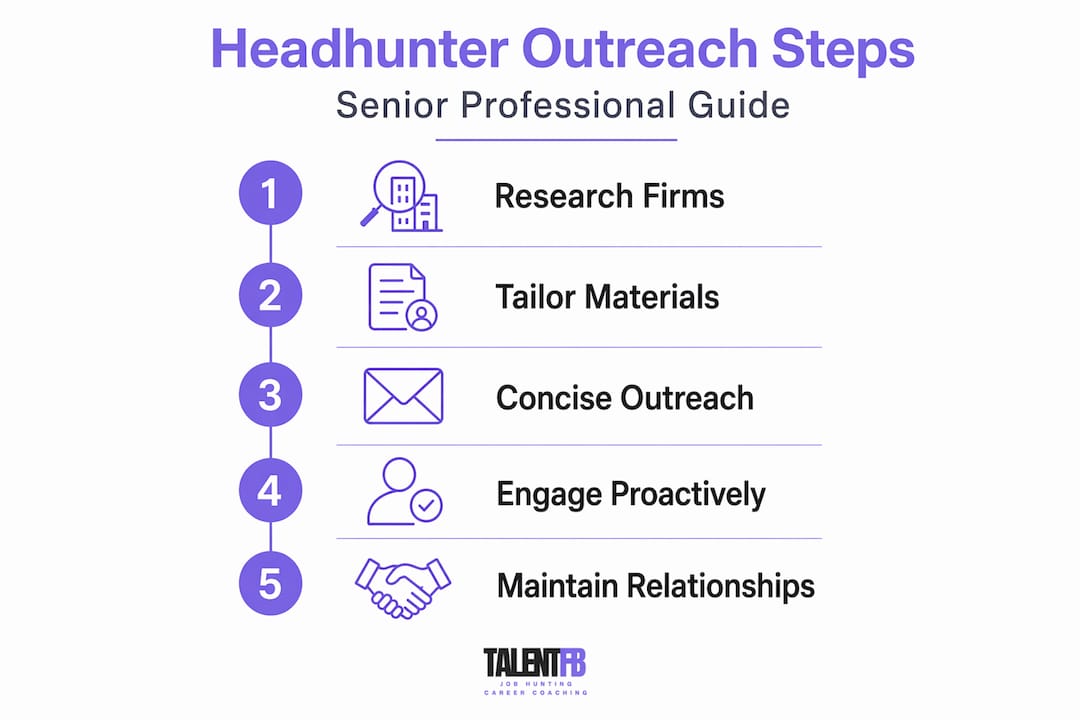
Before you write a single word of outreach, you need to understand who you are actually contacting. The executive search world has three distinct tiers: general staffing agencies, contingency recruiters who only earn a fee on placement, and retained executive search firms that are paid upfront to conduct a confidential, structured search. As a senior professional targeting leadership roles, you are primarily interested in the third category.
Retained search firms run a process that is methodical and often long. Intake briefings alone can run two to four hours, involving multiple stakeholders and resulting in a detailed engagement brief. That tells you something critical: these firms have precise requirements. Generic outreach will not land.
Vet the firm before you pick up the phone
Approaching recruitment agencies without due diligence is one of the most common and costly mistakes at the senior level. Before you reach out, research the firm’s specialty, the seniority level they typically place, and who leads their searches in your sector. Vetting retained search firms means asking targeted questions about success rates, search leadership, timelines, and guarantee policies. You should be selective about who gets your time, just as they will be selective about whose profile they advance.
Get your professional materials ready
Your LinkedIn profile and CV are not formalities. They are the first documents a headhunter will review after your initial contact. Your CV should be achievement-driven, showing scope, scale, and measurable outcomes for each role. Your LinkedIn profile should reinforce the same narrative, because headhunters cross-reference both.
Here is what to prepare before contacting headhunters:
- A two-page senior executive CV with quantified achievements, not just responsibilities
- A LinkedIn profile with a strong headline, a compelling About section, and recent activity that signals you are engaged in your field
- A concise elevator pitch: who you are, what you have built or led, and the type of role you are targeting next
- Clarity on your non-negotiables: geography, compensation band, sector preferences, and the role scope you will consider
Pro Tip: Write your elevator pitch in 60 seconds of spoken language, roughly 120 to 150 words. If you cannot explain your value and goals in that window, a headhunter will fill the silence for you, and rarely in your favor.
Finding and initiating contact with the right headhunters
Once your materials and narrative are sharp, the next challenge is identifying the right people to contact. Networking with recruiters who specialize in your sector and seniority level is far more productive than broadcasting to any firm with an online presence.
Here is a practical sequence for finding and engaging the right headhunters:
- Ask your network for referrals. Former colleagues, board members, or peers who have recently made senior moves are your best source. A warm introduction converts significantly better than cold outreach.
- Search LinkedIn by specialty. Use filters to find headhunters with titles like “Executive Search Consultant” or “Partner” at retained firms, then check their recent placements and posts to confirm they work in your sector.
- Attend industry conferences. Search firm partners attend industry events specifically to map talent. A brief, well-placed conversation at a conference often leads to a follow-up that no email could replicate.
- Identify firms that placed your peers. When a colleague lands a senior role, ask who placed them. A firm that recently placed someone at your level in your sector is actively mapping that talent pool.
When you reach out, keep your message short and targeted. State your current level, your sector, and the type of opportunity you are open to. One concise paragraph. No CV attachment on the first message unless specifically requested. Headhunters receive dozens of unsolicited messages weekly; a message that respects their time signals professionalism before you have said a word about your credentials.
Pro Tip: Personalize every message with one specific detail about the headhunter’s recent work, a placement, a published article, or a panel they moderated. It takes 60 seconds of research and immediately distinguishes your message from the mass of generic outreach they receive.
Timing also matters when you are thinking about how to get a recruiter’s attention. Avoid outreach in the final weeks of December or the first week of January when most search firms are in transition mode. Mid-January through March, and September through November, are historically active periods for senior searches.
Mastering the initial conversation
When a headhunter agrees to speak with you, whether you initiated the call or they reached out to you, the framing of that conversation matters enormously. Initial calls are qualification conversations, not full interviews. Treat them as a mutual assessment: you are evaluating the firm and the opportunity just as much as they are evaluating you.
Here is how to conduct that first call effectively:
- Lead with your most recent, most relevant work. One or two focused examples with real numbers are more persuasive than a chronological career summary. Revenue generated, teams led, transformations delivered: metrics matter.
- Be explicit about your constraints early. Sharing your compensation expectations and geographic flexibility upfront is not oversharing; it prevents wasted cycles for both parties.
- Ask questions that demonstrate strategic thinking. Questions for headhunters such as “What has made candidates successful in this role historically?” or “How is the search committee structured?” show that you think like an executive, not just an applicant.
- Avoid over-preparing a pitch. Polished sales presentations feel rehearsed and create distance. Conversational confidence, grounded in genuine knowledge of your work, is more compelling.
Candidates who ask relevant, high-level questions early create stronger impressions with headhunters than those who wait passively to be assessed. The goal of this call is not to close a deal. It is to earn a second conversation and to be clearly mapped in the headhunter’s mind for the right type of role.
Pro Tip: End every initial call with a specific next step. Ask when you might follow up or whether there are other colleagues at the firm who specialize in adjacent areas you should connect with. It keeps the relationship moving without being pushy.
Maintaining productive relationships with headhunters
Working with recruiters effectively over time requires the same discipline you would apply to any professional relationship: consistency, honesty, and mutual respect.

One of the most common mistakes senior professionals make after initial contact is going quiet. Ongoing communication improves search outcomes and strengthens recruiter advocacy on your behalf. A brief email every six to eight weeks noting a promotion, a major project completion, or a shift in your role preferences keeps you active in the headhunter’s mental file without being intrusive.
| Practice | What it looks like | Why it matters |
|---|---|---|
| Regular status updates | Short email noting career changes or updated preferences | Keeps your profile current and your name visible |
| Parallel independent search | Continuing to apply and network on your own | Prevents over-reliance and maintains your leverage |
| Confidentiality discipline | Avoiding disclosure of the client or role until authorized | Protects your reputation and respects legal frameworks |
| Constructive feedback | Sharing honest reactions to role fit or process concerns | Helps headhunters refine their approach on your behalf |
| Realistic timeline expectations | Acknowledging that retained searches can take months | Reduces frustration and preserves the working relationship |
Confidentiality deserves specific attention. Under the AESC Candidate Bill of Rights, you are entitled to confidentiality, with disclosure levels ranging from fully confidential to open. Ask the headhunter directly at what stage the client’s identity is shared, and never disclose that information to your network before it is appropriate. Senior-level searches are small worlds, and a careless comment can derail an opportunity before it formally begins.
Retained search timelines are often long, but responsiveness on your end accelerates placement velocity. Reply to emails promptly, confirm availability quickly, and if your circumstances change, tell the headhunter before they hear it elsewhere. Explore confidential job search strategies if you are conducting a sensitive search that requires particular care around disclosure.
How headhunters run their outreach, and how to be on their list
Understanding how a headhunter works a search helps you get found. When they take a mandate, they define an ideal candidate profile, map the companies where those people work, build a longlist from LinkedIn and their own database, and send short, personal messages to a few dozen names. Candidates who reply quickly, are clear about what they want and are easy to assess move forward.
- Make sure you match searchable profiles. Your headline and experience should use the titles and terms headhunters search for.
- Reply even when it is not the right role. A polite, specific reply keeps you in their database for the next search.
- Be clear in the first call about your target role, your compensation range and your notice period.
- Stay in touch with the two or three headhunters who cover your market best.
My honest take after years of watching this play out
I have seen talented executives miss out on genuinely transformational roles not because they lacked credentials, but because they approached the headhunter relationship badly. They either came in overselling, treating every call like a pitch, or they were so guarded that the headhunter could not get a clear enough picture to advocate for them confidently.
What I have found actually works is straightforward: be honest, be specific, and be curious. The candidates who stand out are not the ones with the longest list of achievements. They are the ones who communicate clearly, ask intelligent questions, and make the headhunter’s job easier. When a headhunter can articulate your value precisely to their client, your chances of advancing multiply.
I also believe strongly in vetting the search firm before you invest your time. Not all retained firms are created equal. Early in my work with senior professionals, I learned to encourage thorough due diligence on any firm before a first call, examining their process, who leads the engagement, and their track record in your specific sector. The time you spend on that research pays back in avoided wasted searches.
Finally, maintain multiple relationships in parallel. Relying on one headhunter, however well-connected, limits your optionality. The executive search community is not as large as it appears, but the right firms for your specific role type are a selective group. Map them deliberately, engage them specifically, and build those relationships with the same care you would apply to any executive roles search strategy.
— Frederic
Take your search strategy to the next level
If you are serious about how you engage headhunters and want to stop leaving opportunities to chance, Talentfb’s coaching programs are built specifically for senior professionals and technology executives who want a smarter, faster path to their next leadership role.
Talentfb’s career coaching for tech executives covers everything from refining your executive narrative and positioning your LinkedIn profile to preparing targeted outreach for search firms and negotiating offers. The AI Job Search Accelerator is designed to deliver results within 90 days through structured strategy, personalized coaching, and access to a professional network that matters. If you want guidance on your tech leadership job search, the resources are ready for you.
FAQ
What is the best way to first contact a headhunter?
Send a concise, personalized message via LinkedIn or email that states your current level, sector, and the type of role you are open to. Keep it under 150 words and avoid attaching a CV unless the headhunter requests it.
How do I stand out to a retained executive search firm?
Research the firm before reaching out, tailor your outreach to their specialty, and treat the first call as a mutual qualification conversation rather than a sales pitch. Specific, metric-backed examples of your work are more memorable than generic career summaries.
Should I contact multiple headhunters at the same time?
Yes. Best practices for headhunters recommend maintaining relationships with several search firms simultaneously, while continuing your own independent search in parallel, to maximize options and avoid over-reliance on a single contact.
How do I handle confidentiality during an executive search?
Ask the headhunter directly at what stage the client’s identity will be disclosed and respect that timeline strictly. Under the AESC’s confidentiality standards, both parties have obligations, and protecting sensitive information protects your professional reputation.
What questions should I ask a headhunter on the first call?
Ask about the search timeline, who leads the engagement, what has made past candidates successful in the role, and how the client’s decision process is structured. These questions signal executive thinking and demonstrate genuine interest in finding the right fit.