

TL;DR:
- Senior leaders often view coaching as a remedy for failure, but it actually accelerates performance and decision-making. External coaching provides unbiased feedback and helps surface blind spots that internal managers cannot address effectively. Structured programs with clear goals significantly boost leadership capabilities, organizational retention, and long-term success.
Most senior leaders assume coaching is something you seek when something has gone wrong. That assumption is one of the most expensive misbeliefs in modern leadership. Research shows that executive coaching delivers a median ROI of 5 to 7 times the initial investment, with some studies showing returns as high as 529% when factoring in productivity and retention gains. The case for why senior leaders need coaching has never been stronger, and it goes far beyond crisis management. It is about sustained performance, sharper decisions, and leading with the kind of intentionality that complex organizations actually require.
Table of Contents
- Key takeaways
- Why senior leaders need coaching: clearing up the misconception
- The quantifiable benefits of leadership coaching
- What makes coaching uniquely suited to senior leaders
- How structured coaching programs build leadership pipelines
- How to get the most out of leadership coaching
- My perspective: coaching is not optional at the top
- Take your leadership further with Talentfb
- FAQ
Key takeaways
| Point | Details |
|---|---|
| Coaching delivers measurable ROI | Executive coaching returns 5 to 7 times the initial investment, making it a financially sound leadership practice. |
| Senior leaders have growing blind spots | Success compounds confidence but also conceals gaps; coaching surfaces what performance reviews and peers won’t. |
| External coaches offer what managers can’t | An outside coach provides psychologically safe, unbiased feedback that internal relationships rarely allow. |
| Structure determines coaching value | Coaching without clear KPIs drifts; measurable goals tied to business outcomes separate effective programs from expensive conversations. |
| Coaching builds succession readiness | Organizations that coach high-potential leaders see significantly higher retention and promotion-ready talent in their pipelines. |
Why senior leaders need coaching: clearing up the misconception
Executive coaching is not a remediation tool. It is a performance accelerator, and the distinction matters. At its core, executive coaching is a confidential, structured development relationship between a leader and a trained coach. The goal is not to fix what is broken but to unlock what is possible.
What separates coaching from mentoring, consulting, or traditional training is specificity and objectivity. A mentor shares their experience. A consultant recommends solutions. A trainer delivers content. A coach holds up a mirror. The process is built around your context, your decisions, and your leadership patterns, not a generic framework someone designed for a classroom.
Critically, managers cannot effectively provide both operational direction and genuine developmental coaching at the same time. The dual role creates conflicts. When your manager is also your coach, psychological safety erodes. You self-censor. You present a polished version of your challenges rather than the real ones. An external coach removes that dynamic entirely.
Here is what executive coaching actually covers for senior leaders:
- Blind spot identification: Structured feedback processes reveal the leadership patterns you cannot see from the inside.
- Strategic reflection: Dedicated space to think beyond day-to-day operations and examine your long-term direction.
- Behavioral change: Translating insight into new habits and measurable shifts in how you lead.
- Decision quality: Working through high-stakes choices with an objective thinking partner who has no stake in the outcome.
Pro Tip: Before your first coaching session, document three leadership challenges you’ve been avoiding or are unsure how to approach. Arriving with real material accelerates the value from session one.
The quantifiable benefits of leadership coaching
The data on coaching outcomes for senior leaders is not anecdotal. It is consistent across multiple independent studies.
Coached leaders report significant gains across three core dimensions: 70% see improvements in work performance, 80% report increased self-confidence, and 73% see stronger professional relationships. These are not soft metrics. They translate directly into how a senior leader shows up in the boardroom, handles team conflict, and builds organizational culture.
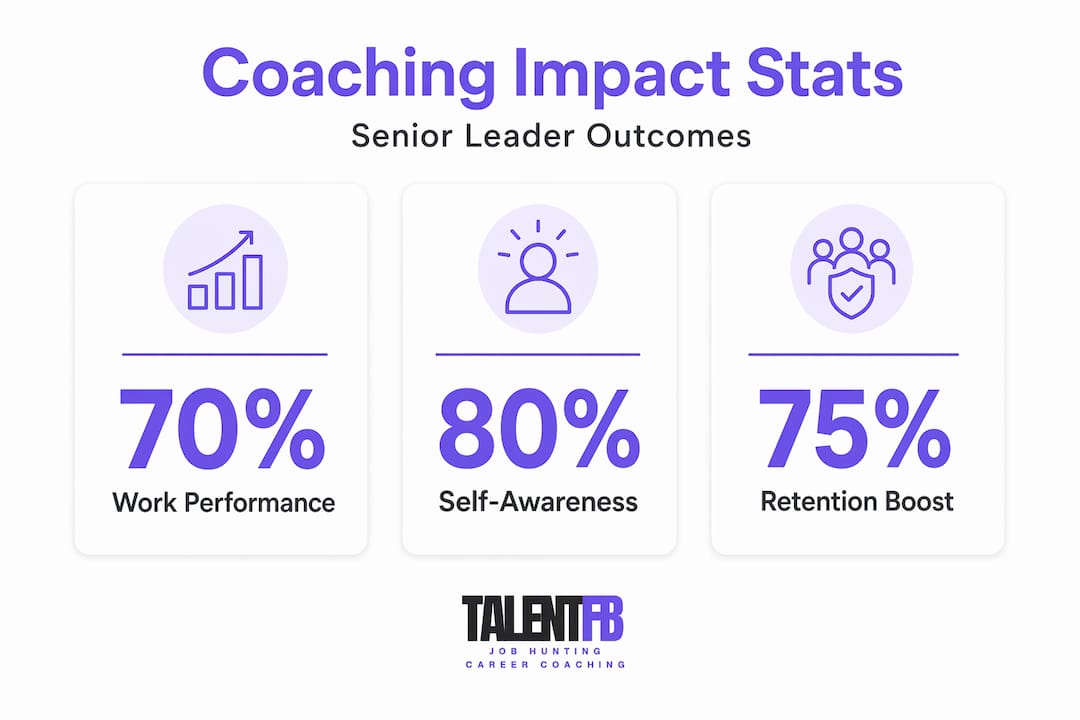
| Outcome Metric | Improvement Rate | Organizational Impact |
|---|---|---|
| Work performance | 70% of coachees report improvement | Faster execution, better prioritization |
| Self-confidence | 80% of coachees report improvement | Stronger stakeholder influence |
| Professional relationships | 73% of coachees report improvement | Lower conflict, higher team trust |
| Retention of coached leaders | 25% higher than peers | Reduced turnover costs |
The retention figures deserve particular attention. A 2025 study found that 75% of coachees report a positive influence on their desire to stay with their organization. Senior leaders who feel invested in are significantly less likely to take the call from a competitor. When you consider the cost of replacing a senior executive (often estimated at 200% or more of annual salary), even modest retention gains generate substantial financial returns.
Leadership mistakes at the senior level also carry amplified consequences. A poor strategic call, a blind spot in cross-functional communication, or a cultural misstep can cascade across an entire organization. Coaching mitigates that risk by providing an external perspective precisely when it matters most.
What makes coaching uniquely suited to senior leaders
The higher you rise, the fewer people around you will tell you the truth. That is not cynicism. It is organizational reality. Direct reports manage up. Peers navigate politics. Boards focus on outcomes, not development. The result is that senior leaders often develop in isolation, accumulating blind spots that grow proportionally with their success.

This is one of the most underappreciated reasons why leaders should seek coaching. It is not about being deficient. It is about the structural absence of honest input at the top.
Three specific challenges that coaching addresses for senior leaders:
- Leadership isolation: At the executive level, you carry context and pressure that most peers cannot fully appreciate. A coach provides the confidential sounding board that your role inherently denies you elsewhere. This is especially relevant for high-stakes decisions where the consequences of getting it wrong extend beyond your own career.
- Transition from operator to architect: Many leaders who are promoted to senior roles continue behaving like high-performing managers. They keep solving problems rather than building systems that solve problems. Coaching accelerates the shift from reactive management to what Emory Business calls intentional, trust-building leadership. That transition does not happen naturally. It has to be worked at deliberately.
- Reputational risk amplification: At scale, a leader’s behavioral patterns become cultural norms. What might have been a manageable quirk at the manager level becomes a systemic issue at the VP or C-suite level. Coaching surfaces these patterns before they become costly.
Pro Tip: Ask your coach to conduct a 360-degree feedback process in the first month. The data that comes back will almost certainly surface one blind spot that reframes your entire development focus.
The importance of coaching for leaders at senior levels is also about agility. Markets shift. Organizational structures evolve. The leadership approach that worked two years ago may actively undermine you today. Coaching builds the reflective capacity to recognize when adaptation is needed, not just when a crisis forces it.
You can explore how this plays out in the tech sector through Talentfb’s analysis of coaching and tech leadership, which illustrates how senior leaders use coaching to stay ahead of industry change rather than react to it.
How structured coaching programs build leadership pipelines
The benefits of leadership coaching extend beyond the individual leader. When organizations embed coaching into their leadership development architecture, the returns multiply.
High-potential leaders who receive structured coaching accelerate their behavioral change and readiness for expanded roles. But the word “structured” carries significant weight. Effective coaching engagements require clear KPIs from the start: 360-feedback improvements, retention metrics, and promotion readiness are the benchmarks that separate high-impact programs from expensive, well-intentioned conversations that drift.
| Coaching Approach | Strengths | Limitations |
|---|---|---|
| Human-only coaching | Deep relational trust, nuanced feedback | Cost, scale, and scheduling constraints |
| AI-only coaching | Scalable, always available, data-driven | Limited depth for complex leadership challenges |
| Hybrid (human + AI) | Combines depth with scale and continuous reinforcement | Requires thoughtful integration and clear role delineation |
The hybrid model is gaining traction for a practical reason: senior leaders rarely have the time or patience for a program that only adds value once every two weeks in a scheduled session. AI-enabled tools that reinforce coaching themes between sessions, track behavioral commitments, and surface real-time data extend the coaching relationship without requiring proportional time investment.
Organizations that want to understand why companies hire coaches are increasingly recognizing that coaching is not a perk for individual leaders but an investment in organizational capability. When senior leaders model a coaching mindset, their teams tend to follow. A manager who has been coached tends to coach their own reports more effectively, creating a development ecosystem rather than a development silo.
How to get the most out of leadership coaching
Leadership development through coaching only delivers if you approach it with the same rigor you apply to business outcomes. Here is what that looks like in practice:
- Choose a coach with senior-level context. A coach who has only worked with mid-level managers will not have the frame of reference to challenge you at the executive level. Look for coaches with direct experience in your industry or comparable organizational complexity. Talentfb’s executive coaching guide for tech leaders outlines what to prioritize in the selection process.
- Define measurable goals before your first session. Vague goals produce vague results. Commit to specific outcomes: improving a 360-feedback category by a defined score, increasing team engagement in the next organizational survey, or completing a defined leadership transition within six months.
- Use sessions for strategic reflection, not status updates. Coaching sessions are not progress reports. They are thinking spaces. Bring the decisions that are keeping you up at night, the relationships that feel stuck, and the leadership patterns you suspect are limiting you.
- Build accountability structures outside of sessions. Coaching accelerates what you practice consistently between sessions. Identify two or three specific behavioral commitments after each session and build them into your weekly schedule.
- Combine coaching with stretch assignments. A coaching insight that never meets real pressure remains theoretical. Pair your coaching work with assignments that force you to apply new approaches under real conditions.
Pro Tip: Keep a brief coaching journal. After each session, write three sentences: what you learned, what you will do differently, and what you want to explore next time. Over six months, this document becomes a precise record of your leadership evolution.
My perspective: coaching is not optional at the top
I have worked with enough senior leaders to recognize the pattern. The ones who resist coaching tend to do so with the same confidence that created their blind spots in the first place. Success is not evidence that no further development is needed. Often, it is evidence of the opposite.
What I have observed consistently is that the leaders who engage with coaching proactively (not reactively) make better decisions under pressure. They course-correct faster. They build stronger cultures around them because they understand their own impact. The leaders who wait until there is a crisis to seek coaching are paying a much higher price to learn lessons that were always available to them.
The discomfort of having your leadership patterns examined by an outside observer is real. But it is far less uncomfortable than watching a team disengage because you never addressed the behavior that was driving it. Coaching is not a confession. It is a professional discipline, the same way elite athletes use coaches not because they are failing but because sustained performance requires external perspective.
If you are a senior leader reading this, I want to be direct: the complexity of your role demands a level of self-awareness and adaptability that you cannot develop by yourself. Coaching gives you the structure to build both. The best time to engage with it was before the first moment you needed it. The next best time is now.
— Frederic
Take your leadership further with Talentfb
If this article has made you reflect on your own leadership development, that reflection deserves a concrete next step. Talentfb works with senior professionals and executives in the technology sector to accelerate leadership growth through structured, personalized coaching programs.
Whether you are preparing for a larger leadership role, working through a complex career transition, or looking to sharpen your executive presence and strategic impact, Talentfb’s coaching ecosystem is built specifically for professionals at your level. Explore the career coaching guide for tech executives to see how a structured program maps to your specific goals. For leaders interested in AI-augmented development, Talentfb also offers AI coaching sessions that extend learning between human coaching engagements. Your next level of leadership is not out of reach. It requires the right support structure.
FAQ
Why do senior leaders need coaching if they’re already successful?
Success creates blind spots. The more senior your role, the fewer people will give you honest feedback. Coaching provides the objective, confidential perspective that organizational dynamics at the top rarely allow.
What is the ROI of executive coaching?
Executive coaching delivers a median ROI of 5 to 7 times the initial investment, with some organizations reporting returns up to 529% when productivity and retention improvements are factored in.
How is executive coaching different from mentoring?
Mentoring shares the mentor’s experience and advice. Coaching is built entirely around you, your context, your decisions, and your leadership patterns, using structured techniques to surface insight rather than transferring someone else’s knowledge.
How long does it take to see results from leadership coaching?
Most leaders report measurable improvements in performance, confidence, and professional relationships within three to six months of structured coaching. Talentfb’s programs are designed to produce visible progress within 90 days.
What makes a coaching program effective for senior leaders?
Structured coaching with clear KPIs is what separates effective programs from ones that drift. Defining 360-feedback targets, retention goals, and promotion readiness benchmarks at the start ensures the engagement stays focused and measurable throughout.