TL;DR:
- Building a talent community fosters ongoing relationships with candidates before roles open, reducing recruiting costs and time. Successful communities rely on clear ownership, niche audiences, valuable content, and dedicated platforms that support engagement and personalization. A disciplined 90-day process focused on foundation, activation, and conversion transforms casual members into engaged talent pipelines.
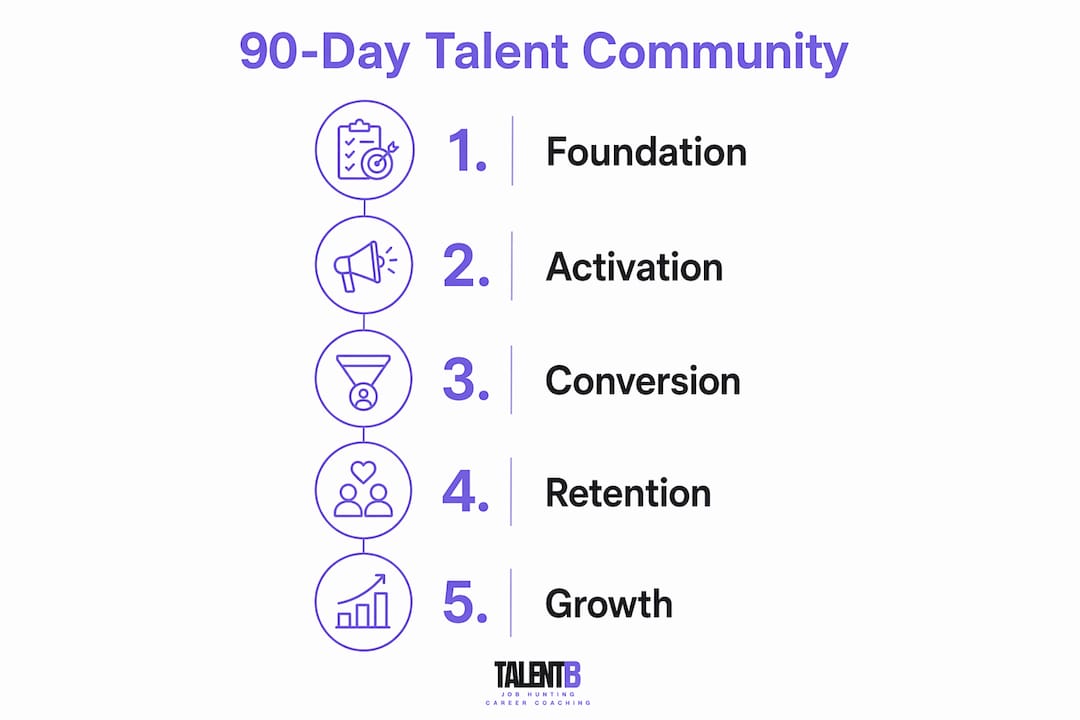
A talent community is defined as a permission-based, branded network of candidates who opt in to engage with your employer brand before any specific role exists. Unlike an ATS folder or a generic email list, a true talent community is a living relationship. Organizations that know how to build talent communities correctly reduce cost-per-hire by up to 30% and cut time-to-hire by up to 40%. The 90-day sprint framework covered here walks you through every phase: foundation, activation, and conversion.
How to build talent communities: the first 30-day foundation
The first 30 days are not about recruiting. They are about architecture. Get this phase wrong and every effort that follows will feel like pushing water uphill.

The single most important decision you make in this phase is ownership. Splitting responsibility across recruitment, marketing, and HR is the most common reason talent community projects fail. You need one named Talent Marketing Lead with at least 8 protected hours per week dedicated to the community. This person owns the platform, the content calendar, and the member experience. Without that single point of accountability, the community will stagnate within 90 days.
Your second priority is audience definition. The instinct to build a broad “tech talent” community is understandable but counterproductive. Hyper-segmented audiences, such as senior UX designers in fintech or DevOps engineers with Kubernetes experience, produce engagement rates ten times higher than broad communities. Narrow your focus before you build your front door.
Here is what your first 30 days should produce:
- A one-page community thesis. Define who joins, what value they receive, and how you will measure success. This document becomes your north star for every content and platform decision.
- A dedicated platform selection. ATS modules are built for tracking, not engagement. Choose a dedicated community recruitment platform that supports content publishing, segmentation, and behavioral data capture.
- A branded entry point. Create an appealing, memorable URL and a landing page that communicates the community’s value proposition clearly. First impressions determine whether a passive candidate opts in or moves on.
- A content inventory. Audit what employer brand content, salary data, career guides, and leadership Q&A material already exists. You will need it in phase two.
Pro Tip: Write your community thesis as if you are pitching it to a skeptical senior candidate. If the value exchange is not obvious in 30 seconds, rewrite it until it is.
Pair this foundation work with a review of your broader talent acquisition strategy to confirm the community aligns with your hiring roadmap for the next 12 months.
How to activate your talent community in days 31 to 60
Activation is where most communities either gain momentum or quietly die. The goal of this phase is not a large member count. It is a small, engaged one.
Follow this sequence to build early momentum:
- Seed with warm leads first. Past candidates who reached final rounds, employee referral contacts, alumni networks, and LinkedIn connections are your highest-probability early members. These people already have a relationship with your brand and are far more likely to engage than cold outreach targets.
- Set a realistic size target. Aim for 200 to 500 relevant members in this phase, not thousands. A community of 300 engaged professionals is worth more than a list of 3,000 passive email addresses. Talent networks with warm relationships generate 60 to 80% response rates, compared to 10% from cold messaging.
- Launch a content cadence immediately. Publish twice per week from day one. Insider knowledge, practical career resources, salary benchmarks, and leadership Q&A sessions all outperform job alerts. Communities offering value beyond job postings achieve up to 3.4 times higher response rates than cold outreach.
- Introduce a gamified challenge or skills assessment. This is the most underused activation tactic. A short skills challenge or scenario-based assessment gives members something to do, gives you behavioral data, and begins qualifying talent before a role ever opens.
- Track weekly active members, not total registrations. Total sign-ups is a vanity metric. Weekly active members tells you whether the community is alive.
Pro Tip: Send a personal welcome message from the community owner to every new member in the first 200. It takes time, but the reply rate and early engagement data you collect will shape your entire content strategy.
For a structured approach to building talent pipelines that feed directly into your community, review the step-by-step framework Talentfb has published for HR professionals.
What are the best strategies to convert community engagement into hires?
Days 61 to 90 are where the investment pays off. By this point, you have a segmented, engaged group of professionals who know your brand and have opted in to hear from you. The conversion phase turns that goodwill into actual hires.
- Create a smooth handoff from community to ATS. Pre-filled applications using data members have already shared reduce friction dramatically. Every extra click in the application process costs you candidates.
- Run targeted multi-touch nurture campaigns for upcoming roles. Do not blast the entire community with every job opening. Use engagement data to identify members whose activity signals readiness, then send a personalized sequence of two to three messages before the formal application invite.
- Start recruiter conversations at advanced readiness. Community members who have completed a skills challenge, attended a webinar, or engaged with three or more content pieces are warm candidates. Recruiters should approach these conversations as relationship continuations, not cold calls.
- Measure the right metrics at day 90. Track weekly active members, hires sourced from the community, and cost-per-hire delta compared to your traditional sourcing channels.
| Metric | What it measures | Target at day 90 |
|---|---|---|
| Weekly active members | Community health and engagement | 20% of total members |
| Hires sourced from community | Direct recruitment ROI | At least 2 to 3 hires |
| Cost-per-hire delta | Financial return vs. traditional sourcing | 15 to 30% reduction |
| Response rate to nurture campaigns | Engagement quality | Above 40% |
Successful communities typically recoup their platform investment within 4 to 8 months. That timeline accelerates significantly when the conversion phase is executed with discipline and the right data.
How does personalization improve talent community retention?
Personalization is the difference between a community that grows and one that churns. Generic communication trains members to ignore you. Targeted, relevant messages make them feel seen.
The mechanics of personalization start at sign-up. Capture job role, experience level, location, and content preferences through a short intake form. This data feeds your segmentation engine and determines which content each member receives. Segmented email campaigns generate 30% more opens and 50% more click-throughs than generic blasts. Welcome emails alone are 86% more likely to be opened than standard messages, making your first communication the highest-leverage moment in the entire member journey.
Implement a preference center that allows members to choose content types and frequency. Some professionals want weekly career insights. Others only want to hear about senior leadership roles in specific cities. Giving members control over their experience reduces unsubscribes and builds the kind of trust that translates into referrals.
| Communication type | Engagement level | Best use case |
|---|---|---|
| Segmented job alerts | High | Role-specific, experience-matched |
| Career webinars and Q&A | Very high | Relationship building, brand authority |
| Salary and market reports | High | Value delivery, trust building |
| Generic newsletter | Low | Avoid unless highly personalized |
| Skills challenges | Very high | Qualification and behavioral data |
Balance job alerts with genuine career content. Webinars featuring your engineering leaders, salary reports for specific specializations, and candid Q&A sessions with hiring managers all deliver value that passive candidates cannot get from a job board. That value exchange is what sustains long-term engagement and keeps your community from becoming just another email list.
Pro Tip: Set a rule: for every job alert you send, send two pieces of career value content. This ratio keeps your community feeling like a professional resource rather than a recruitment funnel.
Which platforms are critical for managing a talent community?
Your ATS is not a community platform. This is the most important technology decision you will make in this process, and the wrong choice will undermine every engagement tactic you deploy.
ATS systems are designed to track applicants through a hiring workflow. They lack the features that active talent communities require: content publishing, gamified challenges, branded member experiences, and behavioral data capture. Using an ATS to run a talent community is like using a spreadsheet to run a marketing campaign. It technically works, but it produces none of the results you actually need.
When evaluating dedicated community recruitment platforms, look for these capabilities:
- Content publishing tools that allow you to post articles, videos, and event invitations directly within the community experience
- Gamified challenges and skills assessments that generate behavioral insights and qualify candidates passively
- Segmentation and automated nurturing that delivers personalized content based on member behavior and preferences
- ATS integration that creates a clean handoff when a member becomes an active applicant
- Branded member experience with your employer brand front and center, not the platform’s logo
The platform you choose should also support a single owner model. If the tool requires a team of three to operate, it will not survive the inevitable periods of reduced bandwidth. Simplicity and single ownership are the two most underrated criteria in platform selection. Explore AI-driven sourcing tools that integrate with community platforms to further automate candidate identification and outreach.
What I have learned from watching talent communities succeed and fail
After working with talent acquisition leaders across the technology sector, the pattern is consistent. The communities that thrive share three characteristics: a single passionate owner, a niche audience, and a genuine commitment to value exchange. The ones that fail share one: they were built to serve the recruiter, not the candidate.
The 90-day timeline is not arbitrary. It mirrors the psychological arc of any new professional relationship. The first 30 days establish credibility. The next 30 build familiarity. The final 30 create enough trust for a meaningful conversation about a career move. Rushing any phase produces a community that looks active on a dashboard but delivers no hires.
My honest recommendation is to resist the temptation to scale before you have proven the model. Start with one audience segment, one platform, and one content format. Get 200 engaged members before you worry about 2,000. The talent pipeline advantage is real, but only when the foundation is solid.
The most common mistake I see is treating a talent community like a passive candidate database. A database is something you search. A community is something you serve. The moment your communication becomes purely transactional, members disengage and the pipeline dries up. Protect the value exchange above everything else, and the recruitment outcomes will follow naturally.
— Frederic
How Talentfb can accelerate your talent community results
Building an engaged talent community requires the right tools, the right strategy, and the right support. Talentfb’s AI Job Search Accelerator and recruitment resources are designed to help talent acquisition leaders move faster and smarter.
Whether you are looking to sharpen your candidate engagement approach, explore AI-powered sourcing alternatives, or build a recruitment marketing strategy that converts passive candidates into loyal community members, Talentfb has the frameworks and masterclasses to get you there. The AI Job Search Playbook offers structured, proven methods that translate directly into stronger talent pipelines and faster hiring outcomes. Take the next step and put your community strategy on solid ground.
FAQ
What is a talent community in recruitment?
A talent community is a permission-based network of candidates who opt in to engage with an employer brand before specific roles open. It differs from an ATS in that it prioritizes relationship building and value exchange over applicant tracking.
How long does it take to build an effective talent community?
A disciplined 90-day framework covering foundation, activation, and conversion phases is the proven standard, with platform investment typically recovered within 4 to 8 months.
How many members should a talent community start with?
Start with 200 to 500 highly relevant members rather than chasing large numbers. Warm leads from past candidates, employee referrals, and alumni networks produce the highest early engagement rates.
What content keeps talent community members engaged?
Career webinars, salary reports, leadership Q&A sessions, and skills challenges consistently outperform job alerts. Communities that deliver value beyond job postings achieve up to 3.4 times higher response rates than cold outreach.
Do I need a dedicated platform to run a talent community?
Yes. ATS systems lack the content publishing, gamification, and branded experience features that active communities require. A dedicated community recruitment platform is the foundation of any sustainable talent community strategy.