TL;DR:
- Step-by-step headhunter outreach involves a disciplined process of candidate profiling, personalized messaging, multi-channel sequencing, and compliance to engage passive candidates effectively.
- Effective outreach requires defining a precise candidate profile, building a vetted list, and crafting personalized messages that focus on candidate achievements and shared challenges.
- A multi-touch, follow-up sequence from day one to day twelve significantly increases response rates, with most replies coming from persistent follow-up efforts.
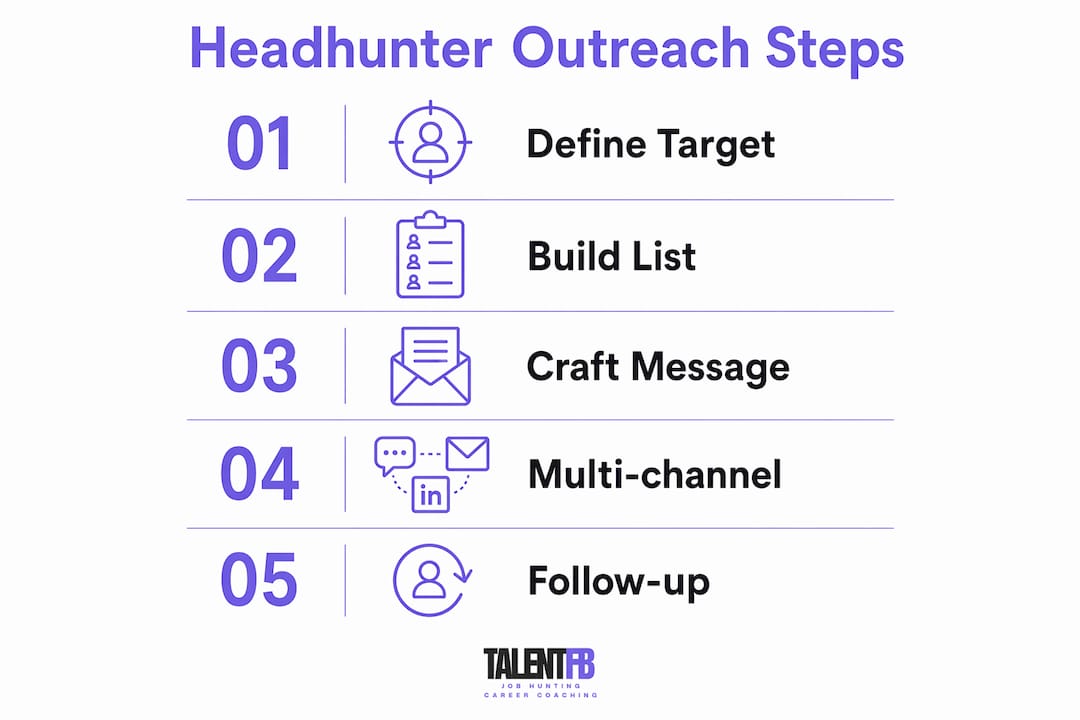
Step by step headhunter outreach is a disciplined, repeatable process that combines targeted candidate profiling, personalized messaging, multi-touch sequencing, and legal compliance to engage passive candidates effectively. Known in the industry as outbound sourcing or direct sourcing, this approach moves recruiters away from reactive job board dependency and toward proactive talent engagement. The core stages are: define your ideal candidate profile, build a vetted list, research and personalize each message, execute a multi-channel first touch, and follow up systematically. Tools like LinkedIn Recruiter, GitHub, and ATS platforms with GDPR and CAN-SPAM compliance features are the infrastructure that makes this repeatable at scale.

How to define your ideal candidate profile and build an outreach list
The foundation of any effective headhunter outreach guide is precision. Before you write a single message, you need a sharply defined picture of who you are looking for. Vague criteria produce bloated lists and wasted effort. Specific criteria produce a shortlist of people worth your time.
Your ideal candidate profile should define the following:
- Skills and technical competencies: List must-have skills separately from nice-to-have ones. For a senior backend engineer, Go or Rust proficiency might be non-negotiable, while Kubernetes experience is a bonus.
- Seniority and scope: Define the level by impact, not just title. “Led a team of 5 or more” is more useful than “Senior Engineer.”
- Location and work model: Remote, hybrid, or on-site. Be honest about this upfront to avoid wasting both parties’ time.
- Company fit signals: Target candidates currently at companies of similar scale, growth stage, or technical complexity.
- Disqualifiers: Candidates who have recently changed jobs (within 6 months) or whose current role is a clear mismatch in scope are worth filtering out early.
A practical outbound sourcing workflow recommends building a list of 100 to 200 vetted candidates before beginning outreach. That range gives you enough pipeline depth to absorb low response rates without running dry. For list building, LinkedIn Recruiter is the default tool for most roles, but GitHub and Stack Overflow are worth using for technical positions where public code contributions reveal skill level directly.
Hand-vet every name before adding it to your list. Automated scraping produces noise. A recruiter who spends 90 seconds reviewing a profile before adding it to the list will send better messages and get better results.
Pro Tip: Quality beats quantity every time. A list of 120 well-matched candidates will outperform a list of 400 loosely matched ones. Higher relevance means higher response rates, and higher response rates mean less time chasing dead ends.
What makes a headhunter outreach message actually get a response?
Most outreach messages fail for one reason: they are written for the recruiter’s convenience, not the candidate’s interest. Passive candidates are not looking for a job. They are not scanning their inbox for opportunities. Your message needs to earn their attention in the first two sentences.
Effective message research takes about two minutes per candidate. Look for recent achievements: a conference talk, a published blog post, a GitHub project, a promotion, or a notable product launch. One specific reference to their actual work signals that you are not sending a mass blast. Personalization through profile research can increase response rates by five times compared to generic outreach. That is not a marginal improvement. It is the difference between a 5% reply rate and a 25% one.
The structure of a strong first message follows a clear pattern:
- Who you are: One sentence. Your name, role, and company. No paragraph of company history.
- Why them specifically: Reference one concrete thing from their background. “I noticed your work on the distributed caching layer at [Company X]” beats “I came across your impressive profile.”
- The problem your team is solving: Frame the opportunity around a challenge, not a job description. Candidates engage with problems, not titles.
- A soft ask: “Would you be open to a 15-minute conversation?” is far less threatening than “Are you interested in this role?”
Keep the entire message to three to five sentences. Anything longer signals that you have not done the work to distill what matters. Personalized, high-value outreach that references accomplishments and frames career growth consistently outperforms generic recruiting emails, and the data supports making this a non-negotiable standard in your process.
Pro Tip: Write the message, then cut it by 30%. If you cannot explain why this person specifically should care about this opportunity in five sentences, you do not yet understand the opportunity well enough to pitch it.
How to design a multi-channel outreach and follow-up sequence
The most common mistake recruiters make is treating the follow-up as an afterthought. It is not. About 70% of replies come from follow-up messages, not the initial outreach. That single fact should reshape how you allocate your effort.
A proven sequence for passive candidate outreach looks like this:
- Day 1: LinkedIn InMail with a personalized hook referencing a specific achievement.
- Day 3: Email with a “why now” framing. Explain what has changed at your company or in the market that makes this moment relevant.
- Day 7: A nudge message, ideally sent on behalf of a senior leader (SOBO, or send-on-behalf-of). A message from a VP of Engineering or CTO carries different weight than one from a recruiter.
- Day 12: A value-add or “breakup” touch. Share something genuinely useful (a relevant article, a market insight) and close with a low-pressure note that you will not follow up again.
Multi-channel sequences with four to five personalized messages over 10 to 14 days, incorporating channel and sender variation, significantly increase reply rates. Sequences that include SOBO touches have shown doubled or tripled reply rates at the later stages of the sequence.
| Touch | Day | Channel | Sender | Purpose |
|---|---|---|---|---|
| 1 | Day 1 | LinkedIn InMail | Recruiter | Personalized hook |
| 2 | Day 3 | Recruiter | Why now framing | |
| 3 | Day 7 | Senior leader (SOBO) | Authority and warmth | |
| 4 | Day 12 | Email or LinkedIn | Recruiter | Value-add and close |
Stop after four attempts. Sending a fifth message does not improve your odds. It increases your spam complaint rate and damages your sender reputation. For specialized roles, expect the full cycle from first outreach to signed offer to take four to eight weeks. Build that timeline into your hiring plan.
Pro Tip: A/B test your subject lines and send times by role and seniority level. What works for a mid-level engineer often does not work for a VP. Small adjustments in timing and framing compound into meaningful differences in reply rates over time.
Navigating compliance and ethics in headhunter outreach
Compliance is not a legal checkbox. It is a trust signal. Recruiters who build opt-out mechanisms and documented consent into their workflows protect their brand reputation and their deliverability rates at the same time.
The two frameworks that govern most outreach are CAN-SPAM and GDPR. Here is what each requires in practice:
- CAN-SPAM: Requires a clear opt-out mechanism in every commercial email, honored within 10 business days. Your ATS or outreach tool must suppress opted-out contacts automatically.
- GDPR: Requires a documented lawful basis for processing personal data. For B2B recruiting outreach, “legitimate interest” is the most commonly used basis, but it must be recorded and defensible.
- Suppression lists: Maintain a live suppression list that syncs across all outreach channels. A candidate who opts out of email should not receive a LinkedIn message the next day.
- No purchased lists: Purchased contact lists almost never meet GDPR’s data quality and consent standards. They also produce terrible response rates.
- Record-keeping: Document when you collected data, from what source, and on what legal basis. This is not bureaucracy. It is protection.
Compliance is operationalized best by weaving documented consent and opt-out mechanisms deeply into outreach workflows to maintain brand trust and deliverability. (Email Compliance Guide: GDPR, CAN-SPAM, and Privacy Laws Explained)
Automating compliance through integrated suppression lists and automated opt-out handling within your outreach engine reduces human error and legal exposure. Treat compliance infrastructure as a one-time investment that pays dividends in deliverability and candidate trust for every campaign you run.
What candidates expect from the first headhunter conversation
The first call with a candidate is not an interview. Treating it like one is one of the fastest ways to lose a strong passive candidate. Initial headhunter calls are exploratory conversations designed to discuss the candidate’s current role, career goals, and openness to new opportunities, not to assess technical competency.
Candidates who respond to outreach are giving you a small window of trust. How you use that window determines whether the relationship moves forward. A few principles that hold up in practice:
- Lead with curiosity, not pitch. Ask about their current scope, what they find energizing, and where they want to be in two to three years before you describe the role in detail.
- Be transparent about the opportunity. Share the company name, the team context, and the core challenge. Candidates who feel they are being kept in the dark disengage quickly.
- Frame it as relationship-building. Even if this specific role is not the right fit, a well-handled first call creates a candidate who will refer others and respond to future outreach.
- Assess timing honestly. A candidate who is six months into a new role is unlikely to move. Acknowledge that and keep the relationship warm for later.
Treat the first call as structured discovery: assess current role scope, goals, timing, and candidate interest without premature pitching of full job details. The goal is to gather enough context to know whether this person is worth advancing and to leave them feeling respected regardless of the outcome. Candidates who feel heard are far more likely to stay engaged across a longer hiring timeline.
What I’ve learned about outreach that most guides won’t tell you
I have reviewed hundreds of outreach sequences over the years, and the pattern that separates the ones that work from the ones that do not is almost never the tool or the channel. It is the mindset behind the message.
Most recruiters approach passive candidates as if the candidate needs them. The reality is the opposite. A passive candidate who is performing well has no urgency. Your job is to make them curious, not convince them they need to leave. That shift in framing changes everything, from how you open a message to how you handle a “not right now” response.
The other thing I would push back on is the instinct to automate everything. Automation is useful for sequencing and timing, but the moment a candidate senses they are inside a drip campaign, the trust evaporates. The targeting passive candidates work that produces real results is the kind where a human being clearly spent two minutes thinking about why this specific person might care. That is not scalable in the traditional sense, but it is the only thing that actually works at the senior level.
Compliance also deserves more credit than it gets. Recruiters who build clean suppression lists and respect opt-outs do not just avoid legal risk. They build a reputation in the market as professionals worth engaging with. That reputation compounds over time in ways that no outreach tool can replicate.
Finally, do not give up after the first message. The data is clear: follow-ups drive the majority of replies. Plan your follow-up sequence before you send the first touch, not after you notice the silence.
— Frederic
How Talentfb helps recruiters build outreach that actually converts
Talentfb’s AI Job Search Accelerator is built for exactly the kind of structured, personalized outreach this guide describes. The platform supports multi-channel sequencing, compliance-by-design with automated opt-outs, and AI-assisted personalization that helps recruiters craft messages that feel human at scale.
If you are a recruiter or hiring manager looking to reduce time-to-hire and increase candidate reply rates, the Job Search OS Masterclass gives you the frameworks, templates, and sequencing strategies to put this into practice immediately. Talentfb also offers a comparison of AI recruitment tool alternatives if you are evaluating platforms to support your outreach workflow. The goal is simple: fewer wasted messages, more conversations with the right people.
FAQ
What is the ideal number of candidates for a headhunter outreach list?
A well-structured outreach list contains 100 to 200 hand-vetted candidates. This range provides enough pipeline depth to absorb low response rates while keeping quality high enough to support genuine personalization.
How many follow-up messages should a recruiter send?
Send three to four follow-up messages spaced four to seven days apart, stopping after the fourth touch. About 70% of replies come from follow-ups rather than the initial message, making a planned sequence non-negotiable.
What laws govern recruiter outreach emails?
CAN-SPAM requires a clear opt-out honored within 10 business days, while GDPR requires a documented lawful basis such as legitimate interest for B2B outreach. Both frameworks tie directly to deliverability and brand reputation.
What should a recruiter cover in the first headhunter call?
The first call is an exploratory conversation, not an interview. Cover the candidate’s current role, career goals, openness to change, and timing before sharing detailed role information. Transparency and a relationship-building tone produce the best outcomes.
How long does a full headhunter outreach cycle typically take?
For specialized roles, expect four to eight weeks from first outreach to a signed offer. Building this timeline into your hiring plan prevents the pressure that leads to rushed decisions and poor candidate experiences.