TL;DR:
- Step-by-step career advancement involves deliberate planning across skills, visibility, relationships, and positioning to achieve professional growth. Regular self-assessment, setting focused behavioral goals, closing skill gaps through micro-actions, and actively building networks are essential strategies. Flexibility, consistency, and intentionality are key to sustaining momentum and adapting to changing opportunities.
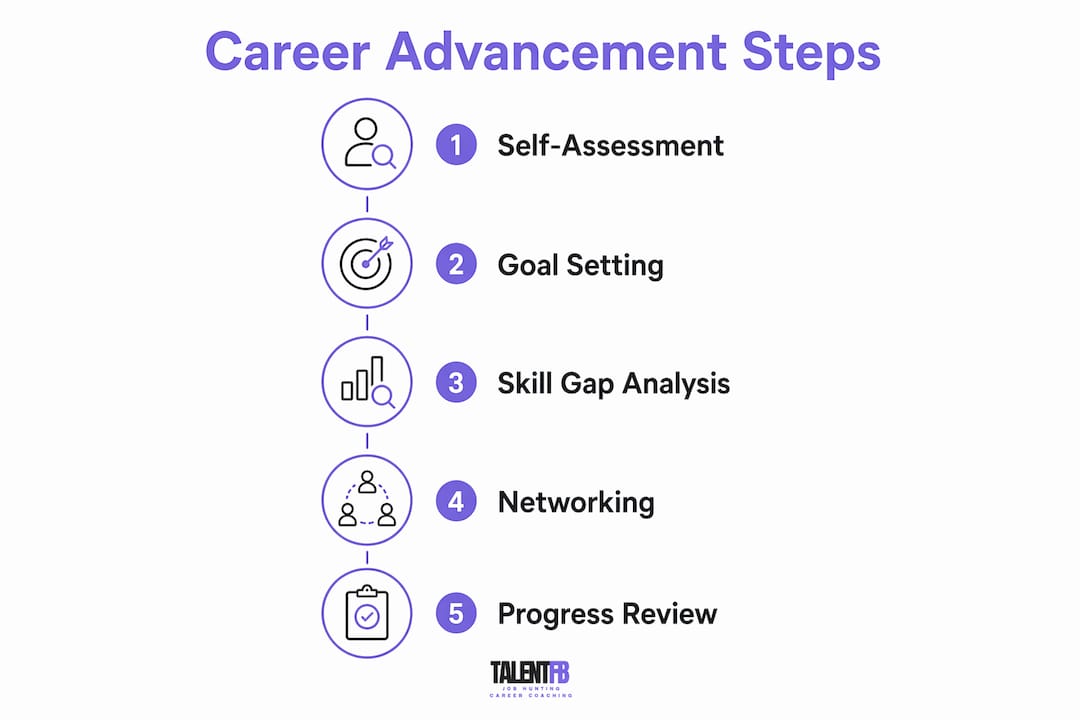
Step by step career advancement is defined as a structured, repeatable process of self-assessment, goal setting, skill development, networking, and progress review that moves you systematically from where you are now to where you want to be professionally. Platforms like Coursera and Forbes recognize this approach as the most reliable path to sustainable growth, and frameworks like the Career Growth Compass give it a practical shape. The difference between professionals who advance and those who stagnate is rarely talent. It is almost always the presence or absence of a deliberate plan.
What does step by step career advancement actually look like?
Career advancement planning, the formal term for this process, is not about writing a five-year vision on a whiteboard and forgetting it. It is a living system with four interconnected dimensions: Skills, Visibility, Relationships, and Positioning. The Career Growth Compass framework identifies these as the four pillars of effective growth, and the research is clear that growth stalls whenever any single dimension lags behind the others. Most professionals over-invest in skills and under-invest in visibility. That imbalance is one of the most common and costly career mistakes you can make.

The good news is that a structured plan does not require a career coach or a complete life overhaul. It requires honest reflection, a few clear priorities, and consistent small actions. The sections below walk you through each stage in sequence.
How to assess your current career position effectively
Every strong career development plan starts with an honest baseline. Without one, you are setting goals in the dark. The most practical tool for this is a personal SWOT analysis: map your Strengths, Weaknesses, Opportunities, and Threats in the context of your current role and industry. Be specific. “Good communicator” is not a strength. “I have led cross-functional product launches for teams of 20 or more in fintech environments” is a strength.
Beyond SWOT, assess yourself across the four Career Growth Compass dimensions:
- Skills: What technical and transferable capabilities do you have today? Where are the gaps relative to your next target role?
- Visibility: Does your manager’s manager know your name? Is your work recognized beyond your immediate team?
- Relationships: Do you have sponsors, not just mentors? Is your network broad enough to open doors outside your current organization?
- Positioning: How do decision-makers perceive you? Are you seen as a specialist, a leader, or a future executive?
The most common blind spots at this stage are overestimating technical skills while underestimating how invisible you are to senior stakeholders. Many professionals assume that doing good work is enough. It is not. Visibility and positioning are active choices, not passive rewards. Understanding what career planning entails in 2026 means accepting that your reputation is a product you manage, not a byproduct of your output.
Pro Tip: Schedule a 30-minute “career audit” session with yourself every quarter. Use the four Career Growth Compass dimensions as your checklist and score yourself honestly from 1 to 10 in each area. The lowest score tells you where to focus next.
How to set clear and motivating career goals
Ambition without structure produces anxiety, not results. The most effective way to translate career aspirations into progress is through SMART goals: Specific, Measurable, Achievable, Relevant, and Time-bound. But there is a layer most people miss. Behavioral micro-goals consistently outperform outcome-focused goals like “get promoted.” A goal like “complete one LinkedIn post per week showcasing a project outcome” is behavioral. It is within your control. “Get promoted by Q3” is not.
Here is a practical sequence for setting goals that actually stick:
- Define your 12-month vision. Where do you want to be in title, compensation, or scope of responsibility one year from now?
- Break it into 90-day milestones. What three things, if accomplished in the next 90 days, would move you meaningfully closer to that vision?
- Identify skill acquisition targets. Which specific capabilities do you need to build, and by when?
- Set networking goals. Aim for a concrete number: five new meaningful conversations per month, or two informational interviews per quarter.
- Align with your values. A goal that conflicts with how you want to live will not survive contact with a difficult week.
The research recommends limiting development priorities to three behavioral goals every 90 days. This constraint is not a limitation. It is a performance advantage. Focus compounds. Scattered effort does not.
Pro Tip: Write your 90-day goals on paper, not just in a digital tool. The physical act of writing increases commitment and recall. Review them every Monday morning before you open your inbox.
Techniques to identify and close skill and experience gaps
Gap analysis is where career planning gets concrete. The process starts with a target role. Pull three to five job descriptions for the position you want next and highlight every required skill, tool, or experience you do not yet have. Then sort those gaps into three categories, a method validated by career transition research:
| Gap category | Definition | Priority |
|---|---|---|
| Must-have | Skills required to pass interviews | Close first |
| Nice-to-have | Skills that make you more competitive | Close second |
| Proof skills | Demonstrable projects or credentials | Build in parallel |
Categorizing skill gaps this way prevents the common mistake of spending months on certifications that are impressive but not what hiring managers actually screen for. Must-have gaps are your immediate focus. Proof skills are what you build to show, not just tell.
Once you know your gaps, the challenge is closing them without burning out. This is where micro-actions become your best tool. Anchoring small repeated tasks to existing daily routines, such as reading one industry article during your morning coffee or practicing a new tool for 20 minutes after lunch, creates consistency without requiring willpower. Consistency beats intensity every time.
Forbes also points to optionality skills like communication, data literacy, and project management as high-value investments because they transfer across roles, industries, and economic cycles. If your current job is not growing you, these are the skills to build on the side.
Pro Tip: Before enrolling in any course or certification, ask yourself: “Would a hiring manager for my target role ask about this in an interview?” If the answer is no, deprioritize it.
Effective networking and positioning strategies for career growth
Past the early career stage, social capital overtakes human capital as the primary predictor of advancement. Put simply: who knows you and what they think of you matters more than your skill set alone. This is not cynical. It is structural. Senior roles are rarely filled through job boards. They are filled through conversations, referrals, and reputation.
Here is how to build the visibility and relationships that open those conversations:
- Make your work visible before you need it to be. Share project outcomes in team meetings, write internal case studies, and post on LinkedIn about problems you have solved. Do not wait for a performance review to tell your story.
- Build a career board of advisors. Identify three to five people: one internal sponsor who can advocate for you, one peer in a role you aspire to, one external mentor in your industry, and one person who will challenge your thinking. This is different from a single mentor relationship.
- Articulate your career narrative clearly. You need a one-sentence answer to “What are you working toward?” that you can deliver naturally in any conversation. Vague answers signal uncertainty. Clear answers signal readiness.
- Signal readiness explicitly. Advancement requires clear communication to decision-makers, not just strong performance. Ask for stretch assignments. Request feedback on what it would take to move to the next level. Name your ambition out loud.
The AI Job Search Playbook from TalentFB covers LinkedIn positioning in depth, which is now the single most important visibility asset for senior professionals in tech and fintech.
How to monitor progress and adapt your career plan regularly
A career plan without a review process is a wish list. The cadence that works best for most professionals combines two rhythms: weekly micro-action tracking and quarterly milestone reviews.
Here is how to structure both:
- Weekly check-in (15 minutes every Friday). Did you complete your three micro-actions this week? What got in the way? What will you do differently next week?
- Monthly reflection (30 minutes). Are your behavioral goals still the right ones? Have market signals, feedback, or new opportunities shifted your priorities?
- Quarterly milestone review (60-90 minutes). Assess progress against your 90-day goals. Celebrate what you achieved. Diagnose what stalled. Set the next 90-day priorities.
- Annual vision reset (half a day). Revisit your 12-month vision. Has your definition of success evolved? Adjust your long-term direction accordingly.
The 60-90 day milestone review cadence is specifically recommended in 2026 career development guidance because it is long enough to generate meaningful progress and short enough to pivot before you waste months on the wrong path. Quarterly reviews combined with weekly tracking prevent the two most common failure modes: stagnation from lack of reflection and paralysis from over-planning.
The 30-60-90 day career transition structure used in career change contexts maps cleanly onto this rhythm: diagnose in the first 30 days, build in the next 30, and test in the final 30. Apply the same logic to any major career move.
What 15 years in hiring rooms taught me about career momentum
After spending 15 years inside hiring rooms across tech, fintech, adtech, and gaming in APAC, I have seen one pattern repeat itself without exception: the professionals who advance fastest are not the most talented. They are the most intentional.
The single biggest mistake I see senior professionals make is treating career advancement as a reward for hard work rather than a result of deliberate strategy. They wait to be noticed. They assume their output speaks for itself. It rarely does, especially past the Director level, where everyone in the room is technically competent and the differentiator is almost always narrative clarity and relationship capital.
What I have found actually works is ruthless prioritization. Pick three things to focus on for 90 days. Not ten. Three. Then do the small daily actions that build toward those three things, even when they feel insignificant. A two-paragraph LinkedIn post about a problem you solved is not a vanity exercise. It is a visibility investment that compounds over months. A 20-minute coffee conversation with someone in a role you want is not networking. It is market research and relationship capital in one.
Career growth is rarely linear, and the professionals I have coached through TalentFB who advance most consistently are the ones who stay adaptable. They treat their career plan as a working document, not a contract. They update it when the market shifts, when a new opportunity appears, or when their own values evolve. That flexibility, combined with consistent daily action, is what separates momentum from stagnation.
— Frederic Bonifassy
Ready to accelerate your career advancement with expert support?
A structured plan is powerful. A structured plan with an experienced coach behind it is faster and far less lonely.
At TalentFB, we work specifically with senior tech professionals, Directors, VPs, and Senior Managers who want to advance with clarity and confidence. Whether you are preparing for a promotion conversation, planning a career transition, or rebuilding your positioning from the ground up, the career coaching programs at TalentFB give you a personalized roadmap and the accountability to execute it. For those in leadership roles, the executive coaching guide is the place to start. Your next move deserves a real strategy.
FAQ
What is the first step in a career advancement plan?
The first step is an honest self-assessment of your current skills, visibility, relationships, and positioning. Without a clear baseline, every goal you set is a guess.
How many goals should I set for career development?
Limit yourself to three behavioral development goals every 90 days. Research shows that focused micro-goals tied to daily habits produce more consistent progress than broad outcome targets like “get promoted.”
How often should I review my career development plan?
Review your plan weekly for micro-action tracking, monthly for goal calibration, and every 60 to 90 days for a full milestone assessment. This cadence balances momentum with the flexibility to adapt.
Why is networking so important for career advancement?
Past the early career stage, social capital, meaning the quality and breadth of your professional network, becomes a stronger predictor of advancement than technical skills alone. Senior roles are filled through relationships and reputation, not job boards.
What are optionality skills and why do they matter?
Optionality skills are transferable capabilities like communication, data literacy, and project management that increase your value across roles and industries. Forbes identifies these as high-priority investments, especially when your current role is no longer growing you.