TL;DR:
- HR leads succession planning by designing processes and maintaining talent data to build leadership pipelines.
- Effective programs include broad role assessment, real-time dashboards, and shared ownership with business leaders and executives.
Succession planning is defined as the process of identifying and developing internal candidates to fill critical leadership and operational roles when vacancies arise. The role of HR in succession planning is to own the entire process: designing the methodology, maintaining the data, facilitating talent reviews, and ensuring development plans are actually executed. HR is not a passive administrator here. HR is the architect. Without a strong HR function driving this work, succession planning gaps leave organizations scrambling to fill senior roles at the worst possible moment. The good news is that when HR gets this right, the payoff is significant. Internally promoted leaders fail up to six times less often than external hires, preserving months of business momentum and organizational stability.
What is the role of HR in succession planning?
HR’s core responsibility in succession planning is to build and run the system that keeps leadership pipelines full. That means defining which roles are critical, setting the criteria for successor readiness, and creating the frameworks that make talent assessments consistent and repeatable.
The most widely used framework is the 9-box grid, which plots employees on a matrix of current performance against future potential. HR facilitates the calibration meetings where business leaders score their people, then maintains the resulting succession dashboards that give executives a real-time view of pipeline health. Tools like Workday, SAP SuccessFactors, and Oracle HCM all offer succession planning modules that HR teams use to track readiness ratings and development progress.
Talent management and succession planning are integrated processes, not separate programs. HR connects succession to broader workforce planning by linking role criticality data to hiring forecasts, retention risks, and skills gap analyses. This integration is what separates a living succession program from a binder that sits on a shelf.
How HR identifies and assesses critical roles and successors
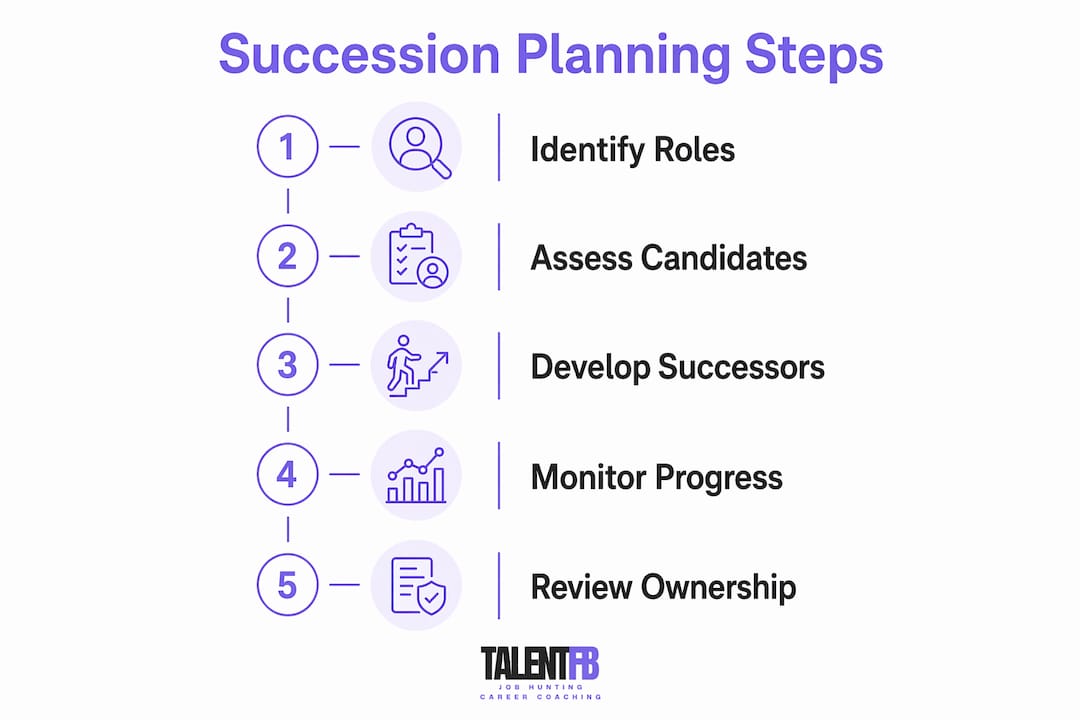
HR identifies critical roles by evaluating three factors: the difficulty of replacing the incumbent externally, the role’s direct impact on revenue or operations, and the knowledge concentration risk if the seat goes vacant. Most organizations start with the C-suite, but that is too narrow.

Succession pipelines should intentionally include revenue-critical and specialized roles beyond the executive suite. A senior sales director who owns a $50 million book of business, a principal engineer who holds the architecture knowledge for a core product, or a compliance lead in a regulated market: these roles carry the same continuity risk as a VP title.
HR uses several methods to assess successor readiness:
- Talent reviews: Structured annual or biannual sessions where HR facilitates candid conversations between business leaders about each employee’s readiness rating (typically “ready now,” “ready in 1–2 years,” or “ready in 3+ years”).
- 9-box calibration: Cross-functional calibration meetings that reduce manager bias and surface high-potential employees who might be invisible in a single department review.
- Individual Development Plan (IDP) tracking: HR monitors whether development commitments made during talent reviews are actually being executed, not just documented.
- Succession dashboards: Real-time data views that show bench strength by role, readiness distribution across the organization, and gaps that need immediate attention.
Pro Tip: Extend your succession focus to revenue-generating and technical specialist roles in your next talent review cycle. The operational disruption from losing a key account manager or a senior architect often exceeds the disruption of a C-suite transition.
How HR develops and prepares successors for leadership continuity
HR’s development role is to close the gap between where a successor is today and where they need to be when the role opens. Development programs typically span 12–24 months, with HR coordinating the activities and business leaders providing the sponsorship and real-world opportunities.
The most effective development approach combines four elements:
- Individual Development Plans (IDPs): Each identified successor gets a written IDP that specifies the competencies to build, the experiences needed, and the timeline. HR owns the template and the review cadence. The business leader owns the commitment to create the opportunities.
- Stretch assignments: Temporary roles, cross-functional projects, or expanded scopes that put successors in situations they have not navigated before. A finance director being groomed for CFO might lead an M&A integration project. A regional HR manager being developed for a global CHRO role might take on a global policy redesign initiative.
- Mentorship and executive sponsorship: HR matches successors with senior leaders who can provide access, visibility, and honest feedback. Sponsorship is more powerful than mentorship alone because sponsors actively advocate for the successor in rooms the successor is not in.
- Formal leadership programs: External programs like Harvard Business School Executive Education, INSEAD leadership courses, or internal leadership academies provide structured frameworks that complement on-the-job development.
HR monitors progress through quarterly IDP check-ins and adjusts plans when business priorities shift or when a successor’s readiness rating changes. The key discipline is treating these reviews as non-negotiable calendar commitments, not optional conversations.
Pro Tip: Embed succession development milestones directly into your performance management cycle. When IDP progress is reviewed at the same time as performance ratings, it signals to both managers and successors that development is a business priority, not an HR side project.
How should HR, business leaders, and executives share succession ownership?
Succession planning fails when one party tries to own it alone. Co-ownership by HR, business leaders, and the CEO or board is the defining factor between a program that produces ready successors and one that produces paperwork.
The table below clarifies who owns what in a well-functioning succession program:
| Party | Primary ownership | Key contribution |
|---|---|---|
| HR | Process design and coordination | Frameworks, dashboards, development tracking |
| Business leaders | Talent assessment and sponsorship | Candid ratings, stretch opportunities, advocacy |
| CEO and board | Strategic priorities and accountability | Culture alignment, CEO succession, final decisions |
When HR operates without CEO or board involvement, succession becomes a compliance exercise. Leaders complete the forms because HR asks them to, but no one acts on the results. Conversely, when business leaders run succession without HR structure, assessments become inconsistent and biased, and development plans never get written down or followed.
The most effective model gives HR the process authority and gives business leaders the talent authority. HR sets the rules of the game. Business leaders play it honestly.
Pro Tip: Present succession readiness data directly to your CEO and board at least once per year. When senior leaders see bench strength metrics alongside business risk data, succession planning shifts from an HR program to a board-level priority.
What are the biggest challenges in effective succession planning?
The most common reason succession programs fail is that HR treats them as an annual documentation exercise rather than a continuous management practice. Only 9% of UK businesses have fully integrated succession plans, which means the vast majority of organizations are one unexpected departure away from a leadership crisis. That number reflects a global pattern, not just a regional one.
The specific challenges HR leaders face most often include:
- Weak HR leadership capability: Strong HR leadership directly determines how effective succession programs are. When the CHRO or HR director lacks the credibility or capability to hold business leaders accountable, succession reviews become performative.
- Promoting internally without auditing capability: Promoting internal HR staff into leadership roles without assessing their strategic capability creates weak HR succession pipelines. Sometimes external executive search is the right answer for filling an HR leadership gap before building the broader pipeline.
- Scope that is too narrow: Organizations that focus only on CEO and C-suite succession miss the operational risks sitting in revenue-generating and specialist roles. A single departure in a business-critical technical role can set a product roadmap back by a year.
- No data discipline: Succession dashboards that are updated once a year are not dashboards. They are historical documents. HR must build a cadence of quarterly updates tied to talent reviews and performance cycles.
- Lack of manager engagement: When frontline and mid-level managers do not see succession planning as relevant to their teams, the pipeline below the executive level stays empty. HR must train managers to identify and develop high-potential employees at every level.
Building a strong talent pipeline requires HR to treat succession as a year-round discipline, not a once-a-year event. The organizations that do this well are the ones that never have to scramble when a critical leader leaves.
What I have learned about HR’s real influence on succession outcomes
After 15 years inside hiring rooms across tech, fintech, and maritime-tech in APAC, I have watched succession programs succeed and fail. The difference almost never comes down to the framework HR uses. It comes down to the credibility and courage of the HR leader running the process.
The CHROs and HR directors who build genuinely effective succession programs share one trait: they are willing to tell the CEO that the bench is thin, that a high-potential employee is being underdeveloped, or that a business leader is not being honest in talent reviews. That kind of candor requires HR leaders who have earned their seat at the table, not just been given a chair.
I also see too many organizations treat succession planning as something that starts at the VP level and above. The real risk often sits one or two levels below that, in the specialist and manager roles that hold institutional knowledge no one has bothered to document. Extending succession focus to those roles is not extra work. It is the work.
The other pattern I find consistently underestimated is the connection between HR leadership capability and succession program quality. Before you build a pipeline for the rest of the organization, audit your own HR team honestly. If your HR leadership bench is weak, fix that first. You cannot build a house on a cracked foundation.
Succession planning done well is one of the most powerful things HR can do for an organization. It reduces hiring costs, preserves institutional knowledge, and gives high-potential employees a reason to stay. Treat it as a strategic lever, and it will perform like one.
— Frederic Bonifassy
How TalentFB supports HR leaders and succession pipelines
HR leaders and emerging executives who want to strengthen their own leadership positioning have a direct path forward with TalentFB. Frederic Bonifassy has spent 15 years inside hiring rooms across APAC, coaching senior professionals through leadership transitions and helping organizations attract the right talent without relying on expensive executive search firms.
Whether you are an HR director building your own career case for a CHRO role, or a tech executive being developed as a successor, TalentFB’s career coaching for executives gives you the frameworks, positioning, and outreach strategy to move with confidence. For HR leaders specifically, the C-suite hiring guide offers practical insight on evaluating and attracting senior leadership talent when your internal pipeline needs reinforcement.
FAQ
What is the primary role of HR in succession planning?
HR designs and manages the succession planning process, including identifying critical roles, facilitating talent reviews, maintaining succession dashboards, and coordinating Individual Development Plans for identified successors.
Why does succession planning fail so often?
Succession planning fails most often when HR operates without CEO or board co-ownership, turning the process into a documentation exercise with no real accountability or follow-through on development commitments.
How long does succession planning development typically take?
Development programs for identified successors typically span 12–24 months, with HR coordinating stretch assignments, mentorships, and formal learning while business leaders provide sponsorship and real-world opportunities.
Should succession planning go beyond the C-suite?
Yes. Succession pipelines should include revenue-generating roles and technical specialists, not just executive positions. The operational disruption from losing a key specialist can be as severe as losing a senior leader.
How does HR measure succession planning effectiveness?
HR measures effectiveness through succession readiness ratings, bench strength ratios by role, IDP completion rates, and the percentage of critical roles filled internally versus externally over time.