

TL;DR:
- The hidden job market includes roles filled through referrals, internal promotions, and recruiter networks rather than public postings. Understanding its mechanics enables job seekers to focus on relationship-building, targeted outreach, and leveraging recruiters for increased opportunities. Combining active networking with traditional applications provides the most effective strategy for accessing both visible and hidden roles.
The hidden job market is the collection of job opportunities that employers never post publicly, filling them instead through trusted networks, referrals, and internal channels. If you have ever wondered why your applications on Indeed or LinkedIn Jobs seem to disappear into a void, this is a large part of the answer. The good news is that understanding how this market actually works gives you a real strategic edge. Most job seekers compete on the visible surface. You can learn to work beneath it.
What is a hidden job market, and how big is it really?
The hidden job market is defined as roles that are filled without ever appearing on a public job board. That definition sounds simple, but the concept gets distorted constantly, and the distortion costs job seekers real time and energy.

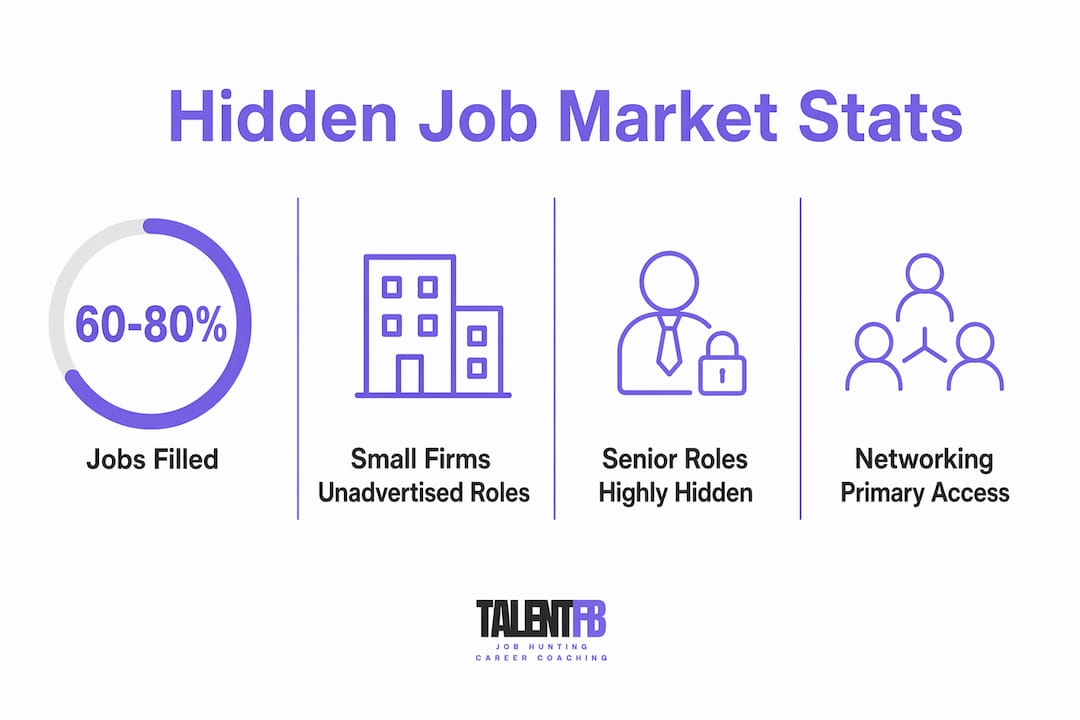
You have almost certainly heard the statistic that 60 to 80% of jobs are filled without public postings. That figure comes from studies referencing Bureau of Labor Statistics data, LinkedIn research, and recruiting industry surveys. The problem is that it bundles together referrals for posted roles, internal promotions, and recruiter placements, many of which are connected to a job posting somewhere. The number sounds dramatic, but it conflates very different hiring scenarios.
The more precise figure, based on 2026 hiring data, looks like this:
| Hiring channel | Share of all hires |
|---|---|
| Publicly posted jobs | 47% |
| Internal promotions | 19% |
| Referrals (usually for posted roles) | 16% |
| Recruiter or agency placements | 9% |
| Genuinely unposted roles | 6 to 10% |
“Separating genuinely unposted jobs from those filled through referrals or recruiter sourcing clarifies which tactics matter most to job seekers.” — Resumefast, 2026
So what does this mean for you? The truly hidden slice, roles that never appear anywhere publicly, is real but smaller than the myth suggests. The larger opportunity lies in the 16% referral channel and the 9% recruiter channel. Those roles often have a posting attached, but the hire is decided before most applicants ever see it. That is where your networking effort pays off most directly.
What channels actually create hidden job opportunities?
Understanding the mechanics behind unadvertised roles helps you target your energy correctly. There are four main pathways that bring a job into the hidden market.
- Internal promotions and role repurposing. When a senior leader leaves, companies often restructure rather than backfill. A VP of Engineering role might become two director-level positions, neither of which gets posted externally. These decisions happen in leadership meetings, not on job boards.
- Employee referrals. Employers prefer referred candidates because they ramp up faster and stay longer. Many companies run formal referral bonus programs specifically to fill roles before spending on advertising. If you are not in someone’s network, you are invisible to this channel.
- Recruiter and executive search placements. Recruiters frequently fill roles exclusively through their own networks, never posting publicly. This is especially true for senior technology and C-suite positions, where discretion matters.
- Roles created for outstanding candidates. This is rarer but real. A hiring manager meets someone impressive at a conference or through a mutual contact and creates a position that did not exist the week before. These are the most genuinely hidden job leads you will ever encounter, and they come entirely from relationship capital.
Jobs at very small companies and C-suite roles are the most consistently unadvertised. A 15-person startup does not post on Indeed for its next Head of Product. The founder calls three people they trust. That is the hidden market in its purest form.
Pro Tip: When you hear about a company expanding, hiring a new executive, or entering a new market, that is a signal that roles may be forming before any posting appears. Follow company news on LinkedIn and set Google Alerts for target employers.
How can job seekers effectively identify and access hidden job opportunities?
Accessing unadvertised roles is a skill, not luck. Here is a practical framework for how to find hidden jobs through deliberate relationship-building and outreach.
-
Treat networking as intelligence-gathering, not job-asking. Informational conversations should focus on learning about a team, a company’s direction, or an industry trend. When you ask for a job in a first conversation, you close doors. When you ask thoughtful questions, you open them. Request 20-minute calls with people in roles adjacent to where you want to be.
-
Build and maintain your professional network before you need it. Active relationship-building keeps you top of mind when a role opens before it is posted. Reconnect with former colleagues, attend industry events, and engage genuinely with content on LinkedIn. The goal is consistent presence, not a burst of activity when you are desperate.
-
Leverage LinkedIn with purpose. Your LinkedIn profile is your professional reputation made visible. Connect with hiring managers, team leads, and recruiters at target companies. Comment on their posts with genuine insight. A warm connection who recognizes your name is far more likely to think of you when a role opens than a cold applicant. Talentfb’s guide on LinkedIn networking for senior professionals covers this in depth.
-
Map the decision path before you reach out. Proactive outreach that identifies the hiring manager, relevant team members, and internal recruiters at a target company dramatically outperforms generic inquiries. A message that says “I noticed your team recently launched X product and I have led similar initiatives at Y company” is specific, relevant, and memorable. “Are there any openings?” is not.
-
Build recruiter relationships proactively. Identify three to five specialist recruiters in your field and reach out before you are actively searching. Share your career goals, your target companies, and your availability for future conversations. Recruiters who know you will call you first when an exclusive role lands on their desk.
Pro Tip: Keep a simple spreadsheet tracking your networking contacts, last conversation date, and any follow-up actions. Consistency is what separates people who access the hidden market from those who try once and give up.
Hidden job market vs. traditional job search: which approach wins?
The honest answer is that neither approach alone is optimal. Here is how the two strategies compare across the dimensions that matter most to senior professionals.
| Factor | Public job boards | Hidden job market tactics |
|---|---|---|
| Competition level | Very high (hundreds of applicants) | Low to moderate |
| Time to result | Often 3 to 6 months | Can be faster with warm connections |
| Effort required | Lower upfront, higher rejection rate | Higher upfront, better conversion |
| Role visibility | Fully transparent | Requires active discovery |
| Best for | Volume, junior to mid roles | Senior, niche, and leadership roles |
| Tools used | Indeed, LinkedIn Jobs, Glassdoor | LinkedIn networking, recruiter relationships, direct outreach |
Job seekers who rely solely on online applications miss a significant portion of opportunities that are accessible only through networks. At the same time, abandoning job boards entirely means ignoring 47% of available roles. The most effective approach, confirmed by research on hybrid strategies, combines targeted applications with active networking. Your network can even surface referrals for publicly posted roles, giving you an inside track on positions that technically are not hidden at all.
The industries where hidden market tactics matter most include enterprise technology, cybersecurity leadership, AI and data science, and executive general management. These are fields where reputation and relationships carry enormous weight, and where the best roles rarely need advertising.
What I have learned about the hidden job market after years of coaching senior professionals
I want to be honest with you about something most career advice glosses over. The hidden job market is not a secret club with a password. It is the natural result of how trust works in professional relationships. People hire people they know, or people vouched for by someone they trust. That is it.
Where I see senior professionals go wrong most often is treating networking as a transaction. They reach out when they need something, ask for introductions immediately, and then disappear when they land a role. That approach burns goodwill fast. The professionals who consistently access hidden job opportunities are the ones who give before they ask. They share useful articles, make introductions for others, and show up in conversations without an agenda.
I have also seen roles created specifically for candidates who made a strong impression through a series of thoughtful conversations. One senior engineering leader I worked with spent three months having informal calls with executives at a company he admired. No job was posted. By the time he expressed direct interest, the company had already started thinking about how to bring him in. That is not luck. That is what consistent, authentic relationship-building produces.
My honest recommendation: treat your professional network as something you tend year-round, not a tool you pick up when your current role feels uncertain. The patience required is real, but so is the payoff.
— Frederic
How Talentfb helps you unlock unadvertised roles faster

Accessing the hidden job market at a senior level requires more than good intentions. It requires a structured approach, the right messaging, and the confidence to reach out to decision-makers before a role is posted. Talentfb’s AI Job Search Accelerator is built specifically for senior technology professionals who want results within 90 days. The program covers LinkedIn profile optimization, targeted outreach frameworks, and recruiter relationship strategies, all designed to open doors that job boards cannot. If you are serious about accessing top AI-powered job search tools and a proven methodology for uncovering unadvertised roles, this is where to start.
FAQ
What is the hidden job market in simple terms?
The hidden job market refers to job openings that employers fill through referrals, internal hiring, or recruiter networks without ever posting them publicly. These roles represent roughly 6 to 10% of all hires at the genuinely unadvertised level, with a much larger share filled through semi-hidden channels like referrals.
How do I identify hidden job market opportunities?
You identify hidden job opportunities by building relationships with people inside target companies, maintaining active recruiter connections, and monitoring company signals like leadership changes or product launches. Informational conversations focused on learning rather than job-asking are the most reliable entry point.
Are hidden jobs more common in certain industries?
Yes. Senior technology roles, C-suite positions, and jobs at small companies are the most consistently unadvertised. Executive search firms and trusted recruiter networks handle the majority of these placements without any public posting.
Is networking really necessary for securing unadvertised jobs?
Networking is the primary mechanism for accessing unadvertised roles. Employers prefer referred candidates because they ramp up faster and stay longer, which is why referral programs are a standard part of corporate hiring. Without a network presence, you are invisible to this channel entirely.
Should I stop applying to job boards and focus only on the hidden market?
No. Public job boards account for 47% of all hires, so abandoning them entirely is a strategic mistake. The most effective job search combines targeted board applications with active networking, using your relationships to gain referrals even for roles that are publicly posted.