

TL;DR:
- A career pivot involves a strategic shift to a new problem domain while leveraging existing skills and professional momentum.
- Successful pivots require deliberate planning, skill mapping, financial preparation, and consistent storytelling to build credibility in the new field.
A career pivot is defined as a deliberate, substantive shift in occupational role or industry that redirects your professional focus to a different problem domain while retaining and reapplying your existing skills. This is not the same as accepting a promotion or moving to a competitor. A pivot changes the kind of work you do, not just where you do it. For senior professionals in technology and adjacent fields, understanding this distinction is the first step toward making a move with confidence rather than anxiety.
The concept has gained serious traction as workforce disruption accelerates. LinkedIn data consistently shows that professionals who proactively reposition their profiles toward new sectors receive significantly more recruiter outreach than those who stay static. Career capital, transferable skills, and narrative control are the three levers that determine whether your pivot lands or stalls.
What is a career pivot, and how is it different from a career change?
A career pivot is a substantive, deliberate shift that redirects you to a different problem domain, while a career change typically implies a more complete break from your professional past. The distinction matters because it shapes your strategy, your timeline, and your risk profile.
Here is a practical way to think about it. A software engineer who moves into product management is pivoting. She carries her technical fluency into a new function. A software engineer who leaves tech entirely to open a restaurant is making a career change. The pivot preserves career capital. The full change largely abandons it.
A routine job change, by contrast, involves moving to a similar role at a different company. The core problems you solve, the language you use, and the credibility signals you need remain the same. The decision criteria and risk profile of a pivot differ substantially from a routine job change precisely because of this discontinuity in purpose and function.
The table below summarizes the key differences:
| Dimension | Routine job change | Career pivot | Full career change |
|---|---|---|---|
| Problem domain | Same | New | Entirely new |
| Transferable skills | Fully applied | Partially applied | Rarely applied |
| Credibility rebuild | Minimal | Moderate | Significant |
| Financial risk | Low | Medium | High |
| Timeline | Weeks to months | 6 to 18 months | 1 to 3 years |
| LinkedIn repositioning | Minor updates | Significant reframing | Complete overhaul |
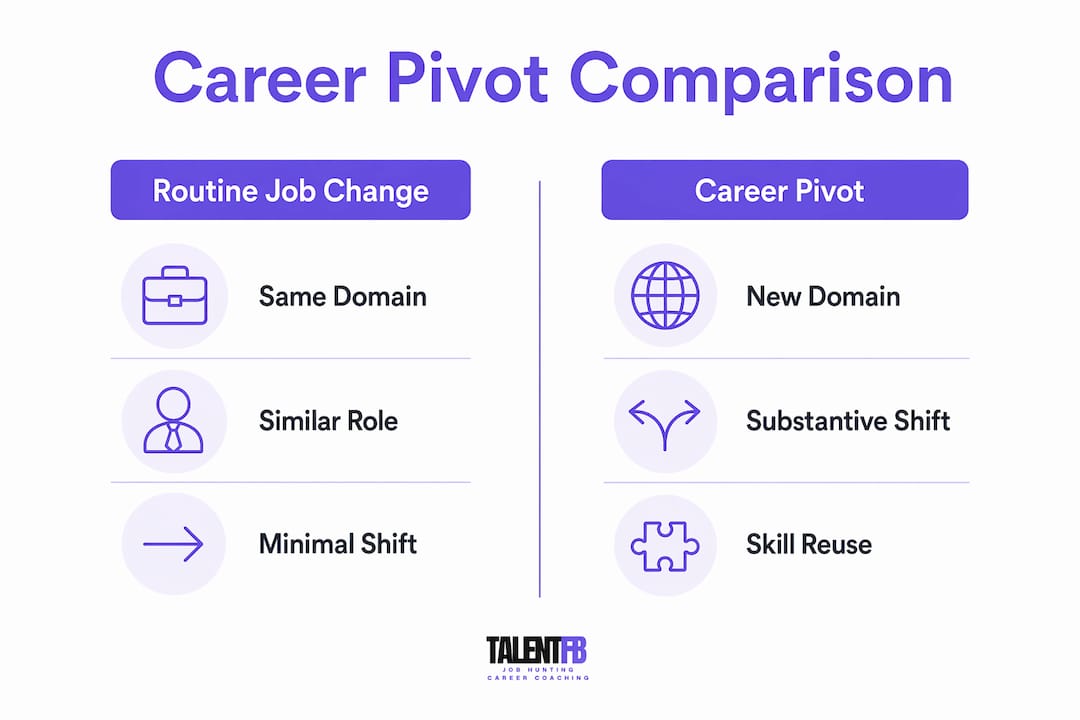
Understanding where your move falls on this spectrum helps you set realistic expectations and build the right plan from the start.
How can you realistically prepare and plan for a career pivot?
Preparation is where most pivot attempts succeed or fail. The professionals who land well do not simply update their resume and start applying. They treat the pivot as a structured process with defined phases.
Map your transferable skills first
Start by identifying which of your current skills translate directly to your target domain. A data analyst moving into UX research carries quantitative reasoning, stakeholder communication, and pattern recognition. Those skills need to be reframed, not abandoned. Mid-career pivot success depends on identifying transferable skills, closing skill gaps through learning or projects, and updating your resume to reflect the new direction. This means your resume should be forward-facing, not a historical archive.

Plan your finances before you move
Financial stress is the single biggest reason pivots stall. Anticipating income dips and creating a transition fund before you make any move is not optional. It is the foundation that gives you the freedom to take a lower-paying role while you build credibility in the new field. Reduce fixed costs where you can, and keep savings liquid. Your financial plan should be treated as a flexible instrument that adapts as your timeline shifts, not a rigid forecast you wrote once and never revisited.
Use informational interviews as intelligence gathering
Most professionals underestimate how much a 30-minute conversation with someone already working in their target field is worth. Informational interviews with practitioners in your target sector give you realistic salary expectations, required credentials, and the unwritten rules of how hiring actually works in that space. They also begin the relationship-building process that often leads directly to referrals.
Here is a practical preparation checklist:
- Audit your skills and map them against 10 to 15 job descriptions in your target role
- Identify two to three skill gaps and choose one learning path for each (online courses, certifications, or project-based learning)
- Build a transition fund covering three to six months of fixed expenses
- Schedule five informational interviews in the first 60 days
- Refresh your LinkedIn profile to reflect your new direction before you start outreach
- Draft a pivot narrative that connects your past accomplishments to your future goals in the new domain’s language
Pro Tip: Treat your pivot as a marathon, not a sprint. Georgia Tech’s professional education research confirms that the most successful mid-career pivots unfold over 12 to 18 months of deliberate preparation, not a sudden leap.
What are the common challenges and misconceptions about career pivots?
The biggest misconception about pivoting is that it requires a complete reset. It does not. You are not starting from zero. You are redirecting existing momentum toward a new destination. That reframe alone reduces the psychological weight of the decision considerably.
That said, the emotional journey is real and worth acknowledging. Many professionals experience a form of identity grief when they step away from a role or title they spent years building. A senior engineer who pivots into people operations may feel like she is giving something up, even when the move is entirely her choice. Releasing the need for full clarity before you act is one of the hardest and most necessary parts of the process.
“Testing new professional identities through action rather than introspection alone reduces pivot uncertainty. Experimenting with possible selves and portfolio careers opens pathways that no amount of reflection can reveal.” — How to Pivot Careers When the Old Rules Break
The financial stress compounds the psychological pressure. Many professionals delay their pivot for years because they cannot see a clear path to maintaining their current income during the transition. The honest answer is that a short-term income dip is often unavoidable. Planning for it removes the shock. Professionals who build side projects while still employed smooth the transition and reduce financial risk significantly.
Another common misconception is that a pivot produces immediate results. Pivot attempts fail when treated as a one-time job search rather than a process of gradual proof and capability building. Hiring managers in your new field need evidence, not just intention.
Pro Tip: When the uncertainty feels overwhelming, use a structured career pivot decision matrix to compare your current track against a specific alternative. Comparing two defined options is far less paralyzing than staring at an open field of possibilities.
What are the strategic steps to successfully execute a career pivot?
Execution is where preparation becomes visible. The professionals who pivot successfully share one common behavior: they build proof before they need it.
Adopt a test-and-learn approach
Experimenting with possible selves through portfolio careers and side projects reduces paralysis and opens real pathways. This means taking on a freelance project in your target field, volunteering for a cross-functional initiative at your current employer, or contributing to an open-source project that demonstrates your new skills. Each experiment generates evidence and builds your confidence simultaneously.
Here are the core execution steps in sequence:
- Define your target role with specificity. “Product manager at a Series B SaaS company” is a target. “Something in tech” is not.
- Close your top two skill gaps through a structured learning path, such as a Google certification, a Georgia Tech professional education course, or a project-based portfolio.
- Build one to two portfolio pieces that demonstrate your capability in the new domain before you apply anywhere.
- Redesign your LinkedIn profile to lead with your new direction, not your old title. Your headline, summary, and featured section all need to speak to where you are going.
- Activate your network with a clear, specific ask. “I am transitioning into product management and would love 20 minutes with someone who made a similar move” gets responses. Vague outreach does not.
- Apply with a pivot-specific cover letter that translates your past accomplishments into the language of the new sector.
Build visibility through consistent storytelling
Sharing consistent work proofs weekly on LinkedIn, whether that is a short post about a project, a lesson learned, or a perspective on your new field, builds the kind of visibility that passive applications never achieve. Frequency and authenticity matter more than polish. Hiring managers and recruiters notice professionals who show up consistently in their feed long before a job opening exists.
Narrative control is the highest-leverage tactic in your pivot toolkit. Translating your old accomplishments into the language of your new sector builds trust with hiring managers who might otherwise see your background as a mismatch. A former sales director pivoting into customer success does not say “I managed a $10M book of business.” She says “I built and retained long-term client relationships that generated $10M in recurring revenue.” Same fact, different frame, entirely different reception.
Pro Tip: Use the AI Job Search Playbook to align your LinkedIn profile and resume with your target role’s language. AI tools can accelerate the reframing process, but your authentic voice and real accomplishments must remain at the center.
Networking strategies that actually move the needle during a pivot include:
- Reconnecting with former colleagues who have already made a similar move
- Joining professional communities and Slack groups in your target field
- Attending industry events as a learner, not just as a job seeker
- Following and engaging with thought leaders like Kelli Vukelic who specialize in career transitions and professional networking
What I have learned from watching professionals pivot careers
I have worked with hundreds of senior professionals at various stages of career transition, and the pattern I see most often is this: the people who pivot successfully are not the ones with the most certainty. They are the ones who act despite uncertainty and build clarity through movement.
The emotional weight of leaving a well-established identity is real. A VP of Engineering who pivots into executive coaching is not just changing jobs. She is changing how she introduces herself at dinner parties, how she measures her own success, and how she thinks about her professional worth. That is significant, and it deserves acknowledgment rather than dismissal.
What I recommend, warmly and from experience, is to celebrate the small wins along the way. Your first informational interview. Your first portfolio project. Your first LinkedIn post in the new field. These are not minor milestones. They are proof that you are already in motion.
Patience is not passive. It is the discipline to keep building when results are not yet visible. The professionals I have seen succeed at pivoting share one more trait: they built a small, honest support network of people who understood what they were attempting. Not cheerleaders. Honest advisors who could tell them when their narrative was unclear or their target was too broad.
Lifelong learning is not a platitude here. It is the actual mechanism of a successful pivot. The willingness to be a beginner again, even briefly, is what separates professionals who pivot with confidence from those who stay stuck.
— Frederic
How Talentfb helps you accelerate your career pivot
Knowing what a career pivot requires and executing it effectively are two different challenges. Talentfb’s AI Job Search Accelerator is built specifically for senior professionals who are ready to make a deliberate move and want a structured, proven process to get there faster.
The Job Search OS Masterclass gives you a step-by-step framework for repositioning your resume, optimizing your LinkedIn profile for your new direction, and running a targeted outreach campaign that generates interviews within 90 days. It is not a generic job search course. It is a system designed for professionals who have real career capital and need to translate it into a new context with precision. If you are serious about your pivot, this is where to start.
FAQ
What is a career pivot exactly?
A career pivot is a deliberate shift to a different problem domain or function that reapplies your existing skills in a new context. It differs from a routine job change because it requires rebuilding credibility signals and reframing your professional narrative for a new audience.
How long does a career pivot typically take?
Most successful mid-career pivots unfold over 12 to 18 months of structured preparation, skill building, and targeted outreach. Treating it as a one-time job search rather than a gradual process is the most common reason pivots fail.
Do I need to go back to school to pivot careers?
Not necessarily. Closing skill gaps through certifications, portfolio projects, or cross-functional work within your current role is often more effective than a full degree program. Hiring managers in most fields prioritize demonstrated capability over credentials alone.
How do I explain a career pivot to hiring managers?
Narrative control is the key. Translate your past accomplishments into the language of your new sector, connecting your values and impact to the problems the new role solves. A coherent, authentic pivot narrative builds trust with hiring managers who might otherwise see your background as a mismatch.
What is the biggest financial risk of a career pivot?
The most common financial risk is an income dip during the transition period. Building a transition fund covering three to six months of fixed expenses before you move, and reducing fixed costs where possible, gives you the runway to accept a lower-paying role while you build credibility in the new field.