TL;DR:
- An executive resume is a strategic document that highlights leadership impact and business results. It must signal authority within seconds and be aligned with your broader leadership brand. Focusing on measurable outcomes and tailored messaging enhances your chances of success in a competitive, AI-assisted hiring landscape.
An executive resume is a strategic leadership document, not a career biography. It exists to position you as the answer to a board’s most pressing business challenges. Most senior leaders underestimate this distinction, and it costs them opportunities they never even knew existed. Understanding why executive resumes matter is the first step toward treating yours as the high-value career asset it truly is.
Recruiters and executive search consultants spend only 6–8 seconds scanning a resume before deciding whether it warrants further review. That window is not enough time to absorb a career history. It is only enough time to register impact. If your resume does not signal leadership outcomes within the first glance, it gets deprioritized by both humans and AI screening tools. Tools like LinkedIn Recruiter and applicant tracking systems parse for keywords tied to business results, not job titles.

Why executive resumes matter more than ever in 2026
The importance of executive resumes has grown sharply as hiring processes have become faster, more competitive, and increasingly AI-assisted. The standard Curriculum Vitae format that served you well at the manager level becomes a liability at the C-suite level. Boards and executive search firms are not reading your resume to understand what you did. They are reading it to decide whether you can solve their next big problem.
Executive resumes are read by boards and search firms who prioritize strategic business outcomes such as P&L responsibility, team leadership scale, and transformation success over task execution details. This audience thinks in terms of enterprise impact, not operational checklists. Your resume must speak that language from the first line.
The executive resume value lies in its ability to compress 20+ years of leadership into a document that communicates authority, scope, and results within seconds. That compression is itself a signal. It tells the reader you understand what matters at the top level, and that you can communicate with the clarity boards demand.
How do executive resumes differ from standard professional resumes?
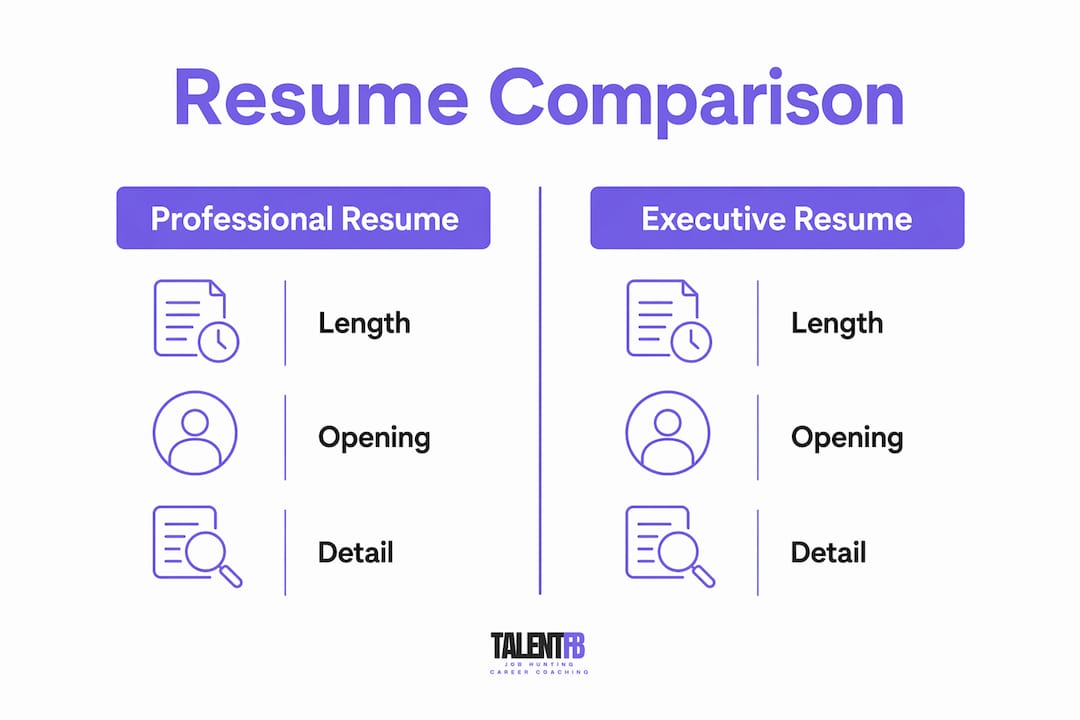
The differences between an executive resume and a standard professional resume are structural, strategic, and substantial. Understanding them helps you avoid the most common trap: submitting a senior-level version of a junior resume.
| Attribute | Professional resume | Executive resume |
|---|---|---|
| Length | 1–2 pages | 2–3 pages |
| Opening section | Objective or summary | 4–6 sentence executive summary |
| Focus | Roles and responsibilities | Outcomes and leadership impact |
| Metrics | Optional | Required (revenue, team size, growth %) |
| Audience | HR generalists | Boards, search firms, C-suite peers |
| Language | Task-oriented | Strategic and results-oriented |
| Branding | Job-seeker positioning | Leadership positioning |
Executive resumes in 2026 should run 2–3 pages for leaders with 20+ years of experience, featuring a 4–6 sentence executive summary that outlines leadership domain, scale, and signature capabilities. That summary is your business case at a glance. It must answer the question “Why this person?” before the reader reaches the first role.
The risk of ignoring this difference is real. A resume that reads like a career archive signals a lack of strategic self-awareness. Boards interpret verbose, duty-heavy resumes as a sign that the candidate cannot synthesize complexity. That is the opposite of what you want to communicate.
Pro Tip: Write your executive summary last. Once you have mapped your strongest outcomes across all roles, you will know exactly which three or four capabilities define your leadership identity. Lead with those.
What makes measurable results the core of executive resume value?
Companies hire executives to solve problems and drive business outcomes. The primary reason many executive resumes fail is treating them as career biographies instead of marketing collateral that prioritizes business results such as revenue growth or cost savings over roles and duties. This is the single most important shift you can make.
Here is what outcome-focused content looks like in practice:
- Revenue impact: “Grew APAC revenue from $40M to $112M in three years by restructuring the go-to-market model across Singapore, Australia, and Japan.”
- Team leadership scale: “Built and led a 200-person engineering organization across four countries, reducing attrition from 28% to 11% in 18 months.”
- Cost transformation: “Delivered $18M in annual savings through a cloud migration program that also reduced deployment time by 60%.”
- Market impact: “Launched three new product lines that captured 14% market share within 24 months of entering a competitive fintech segment.”
Generic descriptors like “results-driven leader” or “strategic thinker” carry zero weight with executive search firms. Every claim without a number is a missed opportunity to demonstrate credibility.
Effective executive resumes demonstrate how leaders set organizational direction, manage complexity, and drive transformation with examples tied to quantifiable outcomes. The difference between a good executive resume and a great one is specificity.
Pro Tip: For every role you list, ask yourself: “What would have been worse if I had not been there?” The answer to that question is your metric.
How does your resume fit into your broader leadership brand?
Your executive resume does not exist in isolation. It is one piece of a larger leadership presence that includes your LinkedIn profile, your thought leadership content, and your relationships with executive search firms. When these elements are misaligned, the result is a fragmented personal brand that undermines your credibility.
82% of consumers trust companies more when senior leaders are visibly active. That trust extends to hiring decisions. Boards and investors look up your LinkedIn profile, your public commentary, and your professional reputation before they ever read your resume in full. If your resume says one thing and your LinkedIn profile says another, the inconsistency raises questions you do not want to answer in an interview.
Failing to align resumes with LinkedIn profiles, thought leadership, and networking documents undermines leadership branding coherence and hurts AI and LLM parsing effectiveness. Modern applicant tracking systems cross-reference your resume against your public digital footprint. Inconsistencies in dates, titles, or scope create friction that can quietly eliminate you from consideration.
Think of your resume as a distilled leadership snapshot, not a standalone document. It should reinforce the same narrative that appears on your LinkedIn executive profile and in your conversations with search firms. Coherence across all channels signals that you know who you are as a leader and can communicate it clearly.
Consider these alignment checkpoints:
- Your LinkedIn headline and resume summary should reflect the same leadership positioning.
- The metrics you highlight in your resume should appear in your LinkedIn experience section.
- Any thought leadership articles or board roles should be visible on both platforms.
- Your executive headshot and professional presence should match the seniority your resume claims. A polished executive headshot is a small detail that reinforces the overall impression.
What are the most common executive resume mistakes?
Senior leaders make predictable mistakes on their resumes, and most of them stem from the same root cause: writing for the past instead of the future.
The most damaging mistake is the “career archive” trap. This is when a resume becomes a comprehensive record of everything you have ever done, organized chronologically, with equal weight given to every role. Executives often fall into this trap of creating resume archives rather than leadership narratives. Brevity and focused storytelling in 2–3 pages signal strategic capability. A 7-page resume does not signal thoroughness. It signals an inability to prioritize.
Other frequent mistakes include:
- Verbose executive summaries: A summary that runs 10 sentences forces the reader to infer your priorities. Brevity in the executive summary, typically 3–4 sentences, signals the strategic communication skills required at the board level.
- No strategic tailoring: Sending the same resume to every opportunity is a junior-level habit. Each application deserves a version of your resume that speaks directly to that organization’s stated challenges.
- Translating experience instead of narrating leadership: Listing what you managed is not the same as explaining what you changed. The former describes a job. The latter describes a leader.
- Neglecting resume maintenance: Many senior leaders fail to leverage ongoing updating and strategic tailoring of their resumes and relationships with executive search firms, missing quick-moving opportunities. Executive roles often fill within days of a search opening. A resume that is six months out of date is a real liability.
Pro Tip: Treat your resume like a living document. Set a quarterly reminder to update it with new outcomes, metrics, and any shifts in your leadership scope. The best time to update your resume is not when you need it.
What I have learned from 15 years inside the hiring room
I have reviewed thousands of executive resumes across tech, fintech, adtech, gaming, and maritime-tech in APAC. The pattern I see most often is not a lack of achievement. It is a failure to translate achievement into language that resonates with the people making hiring decisions at the top.
Most C-suite candidates I work with are genuinely exceptional leaders. They have built teams, turned around divisions, and delivered results that would impress any board. But their resumes read like internal performance reviews, written for people who already know the context. Boards and search firms do not have that context. They need you to give it to them, clearly and quickly.
The executives who move fastest in their searches are the ones who treat their resume as a leadership argument, not a career record. They ask: “What case am I making for myself?” and then they build the document around the answer. That mindset shift changes everything about how a resume reads.
I also want to be honest about something: condensing a 25-year career into 2–3 pages is genuinely hard. It requires you to make difficult choices about what to leave out. Those choices feel uncomfortable because every role mattered to you. But the reader does not need your full story. They need your best argument. Learning to make that distinction is one of the most valuable things you can do for your career at this level.
If you are struggling with that process, you are not alone. It is exactly why working with someone who has been on both sides of the hiring table can make a real difference. You can explore how TalentFB approaches this through the executive career roadmap we have built for senior tech leaders.
— Frederic Bonifassy
Ready to turn your resume into a leadership asset?
Your resume is often the first impression a board or search firm has of you. It deserves the same strategic attention you give to any high-stakes business decision.
TalentFB works with Directors, VPs, and C-suite leaders to build resumes that open doors to the right roles, not just any roles. The JobSearch/OS™ program has helped 350+ senior professionals land their next position within 90 days, often with a 20–30% salary increase. If you are ready to stop sending resumes into the void and start getting the conversations you deserve, the career coaching guide for tech executives is the right place to start. You have built the career. Now let your resume prove it.
FAQ
Why do executive resumes matter more than standard resumes?
Executive resumes function as strategic marketing documents that communicate leadership impact, business outcomes, and organizational fit to boards and search firms. Standard resumes focus on roles and responsibilities, which is not the language C-suite hiring decisions are made in.
How long should an executive resume be?
An executive resume should be 2–3 pages for leaders with 20+ years of experience, featuring a concise 4–6 sentence executive summary at the top. Anything longer risks signaling an inability to prioritize, which is a red flag at the senior level.
What should an executive summary include?
An executive summary should cover your leadership domain, the scale at which you have operated, your two or three signature capabilities, and the type of organizational challenge you are best positioned to solve. Keep it to 3–4 sentences to signal board-level communication skills.
How do I make my executive resume stand out to AI screening tools?
Align your resume language with your LinkedIn profile and use specific metrics tied to business outcomes, since AI and LLM parsing tools cross-reference your digital footprint for coherence and keyword relevance. Inconsistencies between platforms reduce your visibility in automated screening.
How often should I update my executive resume?
Update your executive resume at least quarterly, adding new outcomes, metrics, and any changes in leadership scope. Roles at the senior level move fast, and executive search firms source candidates from their existing networks before a position is ever posted publicly.