
TL;DR:
- Executive education offers targeted, short-term programs for working professionals seeking leadership growth and career advancement. It provides measurable impacts such as salary increases, organizational improvements, and valuable peer networks that support long-term success. Choosing the right program requires clear goals, timely enrollment, and active application of learned skills.
Executive education is a targeted learning pathway designed for working professionals who want to sharpen leadership skills, close specific competency gaps, and accelerate career growth without stepping away from their current role. Institutions like Harvard Business School, INSEAD, and Wharton have built entire divisions around this need. The evidence is compelling: over 80% of participants report direct career impact within 12 months of completing a program. If you are a Director, VP, or Senior Manager asking why pursue executive education, the short answer is this: it delivers measurable results, faster than most alternatives.
Why pursue executive education: the measurable career impact
The most direct reason to invest in executive education is the career return it produces. Participants see average salary increases of 10–20% within two years of completing a program. That is not a credential bump. That is the market recognizing a genuine shift in your capability and readiness for greater responsibility.

The organizational benefits are just as real. When you return from a program with new frameworks for decision-making and cross-functional collaboration, your team feels it. You start translating instinctive knowledge into repeatable processes others can follow. Formal programs help executives articulate tacit knowledge, scaling personal expertise into organizational capability. That is the difference between being a strong individual contributor and being a leader who multiplies the people around them.
Credentials also carry weight in rooms you may not be in yet. A recognized program from a top institution signals commitment to decision-makers like hiring committees and investors. It is a soft signal, but it is often the decisive one.
| Program type | Typical cost | Duration | Primary ROI |
|---|---|---|---|
| Certificate program | $5,000–$8,000 | 3–6 months | Skill gap closure, immediate application |
| Executive MBA (EMBA) | $80,000–$200,000 | 18–24 months | Leadership credentialing, promotion readiness |
| Open enrollment program | $3,000–$15,000 | Days to weeks | Specific skill or function focus |
| Custom corporate program | Varies | Flexible | Team-wide capability building |
Pro Tip: When requesting employer sponsorship, frame the investment around organizational outcomes, not personal salary growth. Proposals that highlight team performance, retention, and business results get approved far more often than those focused on your individual development.
How does executive education differ from an MBA or degree program?
The distinction matters because choosing the wrong format wastes both time and money. Executive education refers to short to medium-length programs, typically certificate courses or open enrollment offerings, built specifically for professionals already in leadership roles. A traditional MBA is a full degree program, usually requiring two years of full-time study and a career pause. An Executive MBA sits in between.
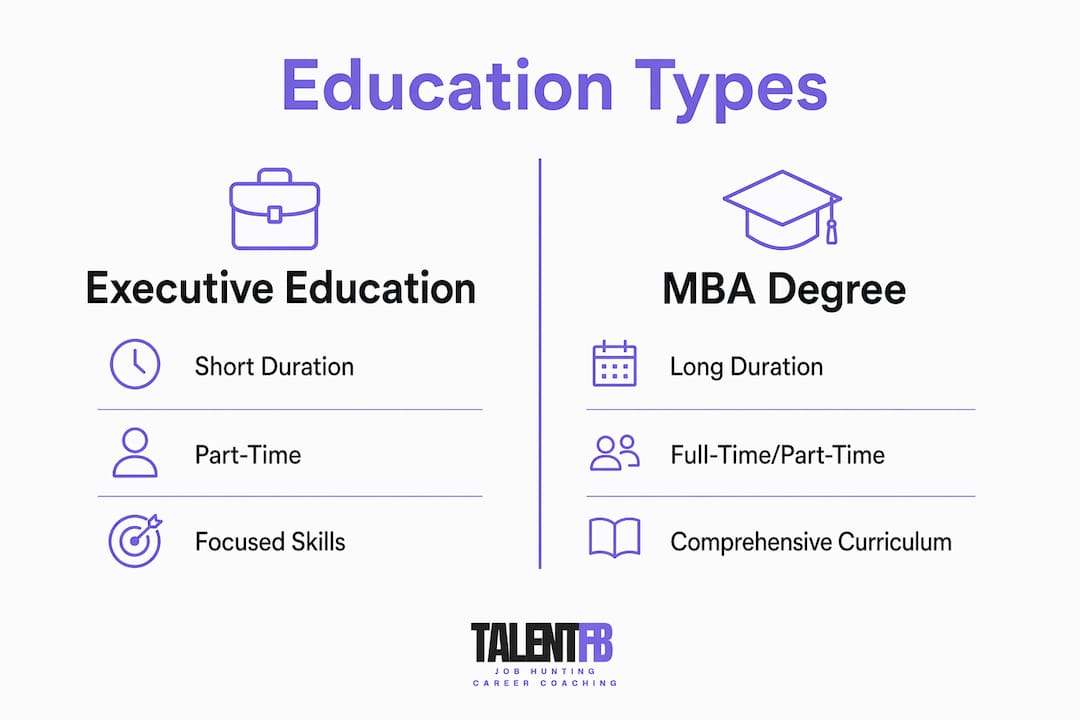
EMBA programs allow students to work full-time while building leadership skills and earning salary increases post-graduation. That is a significant advantage for senior professionals who cannot afford to step off the career ladder for two years.
| Format | Time commitment | Cost range | Best for |
|---|---|---|---|
| Executive education certificate | Part-time, weeks to months | $3,000–$15,000 | Targeted skill development |
| Executive MBA | Part-time, 18–24 months | $80,000–$200,000 | Full leadership credential |
| Traditional MBA | Full-time, 2 years | $60,000–$150,000+ | Career pivot or early-career transition |
The practical difference is focus. Executive education programs teach leadership, strategic thinking, and cross-functional decision-making. They do not spend time on foundational business theory. You walk in as a senior professional and the curriculum treats you that way. Smaller certificate programs priced between $5,000 and $8,000 address up to 80% of professional development gaps with better ROI than longer, more expensive alternatives. For most mid to senior-level professionals, a well-chosen certificate program delivers more practical value than a second degree.
What to watch out for when choosing an executive program
The biggest pitfall in executive education is enrolling without a clear, identified competency gap. Programs pursued purely for resume padding deliver poor ROI. You need to know exactly what you are trying to fix or build before you choose a format.
Here are the most common mistakes senior professionals make, and how to avoid them:
- Choosing prestige over fit. A Harvard program in the wrong subject area will not move your career forward. Match the program to your specific gap, whether that is financial acumen, people leadership, or global strategy.
- Failing to apply the learning. The value of executive education compounds when you put frameworks to work immediately. Professionals who return and change nothing see minimal return.
- Mistiming the investment. ROI is maximized when executive education is targeted 18–36 months before a planned career move or promotion. Starting too late means you cannot apply what you learned before the opportunity passes.
- Ignoring the network. The peer relationships you build during a program are often worth more than the curriculum itself. Treating class time as purely academic misses the point.
- Going in without a post-program plan. Know how you will use the credential, the network, and the new skills before you enroll. The plan does not need to be perfect. It needs to exist.
Pro Tip: Before you apply to any program, write down the three specific leadership behaviors or decisions you want to change within six months of graduating. If you cannot name them, you are not ready to choose a program yet.
How does networking through executive education build long-term career value?
The peer network you build in an executive program is categorically different from the connections you make at industry conferences or on LinkedIn. Every person in the room is a senior professional who has already earned their seat. The conversations are honest, the problems are real, and the relationships form under pressure.
That shared experience creates a different quality of trust. Networking through executive programs frequently creates client, co-founder, and board-level opportunities that are simply not available through standard professional networks. These are not accidental. They are the natural result of spending intensive time with high-caliber peers solving real business problems together.
Here is how those relationships tend to develop over time:
- During the program: You build credibility through contribution. Your peers see how you think, not just what your title says.
- In the first year after: Relationships convert into referrals, introductions, and informal advisory conversations.
- Over the long term: The network becomes a board of advisors you can call on for career decisions, business partnerships, and hiring.
Executive education now delivers sustained capability-building and adaptability, not just a credential you list on a CV. The peer network is a living part of that sustained value. To extend what you build in a program, pairing it with a strong LinkedIn presence makes the network visible and accessible. Practical guidance on LinkedIn networking for executives can help you maintain and grow those relationships well after graduation.
My honest take on executive education as a career investment
I have spent 15 years inside hiring rooms across tech, fintech, and adtech in APAC. I have reviewed thousands of profiles and sat across the table from candidates at every level. Here is what I have actually observed about executive education, not what the brochures say.
The professionals who get the most out of these programs are the ones who go in with a specific problem to solve. Not a vague desire to “grow as a leader.” A real, named gap. Maybe they have always been strong technically but struggle to influence at the board level. Maybe they are ready for a regional role but lack the financial literacy to hold their own in budget conversations. Those people come back transformed. The ones who enroll because it looks good on a CV come back with a line item and not much else.
The credential matters less than you think and the network matters more than you expect. I have seen Directors land VP roles not because of the program name on their profile, but because a classmate made an introduction three years later. That is the real return on investment, and it is almost impossible to quantify upfront.
My honest recommendation: choose a program that puts you in a room with people who are slightly ahead of where you want to be. The curriculum will teach you frameworks. The people will teach you what actually works. And if you want to make sure the investment translates into a concrete career move, pair it with a clear career advancement roadmap so the learning has somewhere to land.
— Frederic Bonifassy
Ready to turn your executive education into your next career move?
Executive education opens doors. What you do with those doors is where coaching comes in. TalentFB works with senior tech professionals, Directors, VPs, and Senior Managers, to build the career strategy that makes your education, credentials, and network work together.
If you have recently completed a program or are planning one, the right time to build your positioning is now, not after the next opportunity passes. TalentFB’s career coaching for tech executives covers personalized roadmap planning, LinkedIn profile positioning, and targeted outreach so your investment in executive education translates into the role and salary you are actually aiming for.
FAQ
What is executive education and who is it for?
Executive education refers to short to medium-length professional development programs designed for working managers and senior leaders. Programs are offered by institutions like Harvard Business School, INSEAD, and Wharton, and are built for professionals who want to grow without pausing their career.
Does executive education boost leadership skills?
Yes. Over 80% of participants report direct career impact within 12 months, including stronger decision-making, improved cross-functional collaboration, and greater readiness for senior roles.
Is executive education worth the cost?
For most senior professionals, yes. Certificate programs priced between $5,000 and $8,000 close up to 80% of professional development gaps, and participants see average salary increases of 10–20% within two years.
How is executive education different from an MBA?
Executive education programs are shorter, more focused, and designed for professionals already in leadership roles. An MBA is a full degree requiring two years of study, while executive programs run from a few days to several months without interrupting your income.
When is the best time to enroll in an executive program?
The optimal timing is 18–36 months before a planned promotion or career pivot. Starting earlier gives you time to apply the learning and build the network before the opportunity arrives.