TL;DR:
- Passive candidates make up 70–80% of the workforce and are not actively looking for new jobs.
- Recruiters should focus on relationship-building and targeted outreach to attract these high-performing professionals.
A passive candidate is defined as a professional who is currently employed, not actively searching for a new role, but who remains open to the right opportunity when it presents itself. Passive candidates represent approximately 70–80% of the global workforce. That single fact reshapes how you should think about talent acquisition. If your recruitment strategy focuses only on the 20–30% of people actively applying to jobs, you are competing for a small, crowded pool while the best talent sits untouched. Understanding passive candidates is not a nice-to-have skill for recruiters. It is the foundation of a high-quality hiring pipeline.
What are passive candidates and how do they differ from active job seekers?
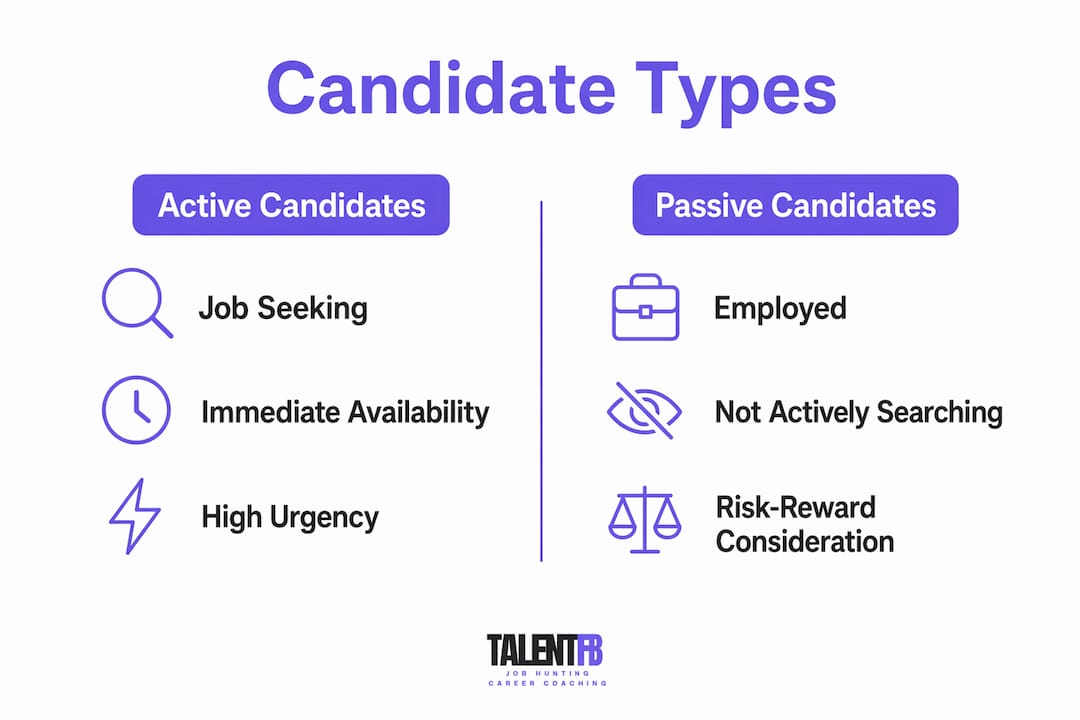
Passive candidates, sometimes called passive talent or latent candidates in HR literature, are professionals who are succeeding in their current roles and not sending out resumes. They are not browsing job boards. They are not updating their LinkedIn profiles with “Open to Work.” They are simply doing their jobs well, which is exactly what makes them valuable.

Active candidates, by contrast, are driven by immediate need. They may be unemployed, unhappy, or facing a deadline. That urgency shapes their behavior. They apply broadly, accept faster, and often take the first reasonable offer. Active job seekers constitute only about 20–30% of the talent market, and they are visible to every recruiter running the same searches.
The table below captures the core differences between the two groups.
| Factor | Active candidates | Passive candidates |
|---|---|---|
| Job search status | Actively applying | Not applying |
| Motivation | Urgency or dissatisfaction | Opportunity and growth |
| Response to outreach | High and fast | Selective and slow |
| Offer acceptance threshold | Lower | Significantly higher |
| Recruitment timeline | Shorter | Longer |
| Performance track record | Variable | Typically strong |
Passive candidates evaluate opportunities based on risk-adjusted upside. They are weighing what they stand to gain against what they stand to lose, including stability, relationships, and current compensation. That calculus means your outreach must offer something genuinely compelling, not just a job title and a salary range.
Pro Tip: When reaching out to a passive candidate, lead with what is unique about the role or company, not with the job description. Generic outreach gets ignored. Specific, relevant value propositions get responses.
Why are passive candidates often better hires?
Passive candidates bring a proven track record. They are currently performing well enough that no one is pushing them out. That is a meaningful signal. Passive candidates often score 120% higher on performance metrics than active applicants, according to ERE Media. That gap is not marginal. It reflects the difference between hiring someone who is thriving and someone who is available.
“Passive candidates often result in higher retention and better cultural fit due to their intentional career moves.” — Executive Scouting
The intentionality behind a passive candidate’s decision to move is a key advantage. When someone leaves a stable, successful role for your company, they have thought carefully about it. That deliberate choice tends to produce stronger engagement and longer tenure. Contrast that with an active candidate who accepted your offer because it was the first one that arrived.
The benefits of passive candidates extend beyond individual performance. They include:
- Higher retention rates. Passive hires who made a deliberate move are less likely to continue searching after joining.
- Stronger cultural alignment. Because they had options and chose you, the fit tends to be genuine rather than circumstantial.
- Reduced counter-offer risk. A passive candidate who has committed to moving has usually already resolved their internal conflict about leaving.
- Better leadership potential. Senior passive talent often brings institutional knowledge and cross-industry perspective that active candidates at the same level cannot match.
Passive candidate recruitment is not just about filling a role. It is about building the kind of team that compounds in quality over time.
How can recruiters effectively find and attract passive candidates?
Sourcing passive candidates requires a different mindset than posting a job and waiting. You are not fishing with a net. You are fishing with a line, one cast at a time, with patience and precision. Here is how to do it well.
-
Use LinkedIn strategically. LinkedIn remains the most accessible platform for passive candidate sourcing. Search by title, skills, company, and tenure. Candidates with 3–5 years in a role are often at a natural inflection point and more receptive to a conversation.
-
Go beyond LinkedIn. Niche platforms like GitHub reveal more accurate and current skills than polished LinkedIn profiles. For engineering roles, GitHub activity shows what a candidate actually builds. For other fields, Dribbble, Behance, niche Slack communities, and industry forums surface talent that never appears in traditional searches.
-
Activate your employee referral network. Your current team knows talented peers who are not on the market. A warm introduction from a trusted colleague carries far more weight than a cold InMail from a recruiter.
-
Build relationships before you need them. Building relationships before a vacancy exists is the most effective way to attract passive candidates when a role opens. Connect with strong profiles now. Engage with their content. Have a genuine conversation. When the right role appears, you already have a relationship to draw on.
-
Invest in employer branding. Passive candidates research companies before responding to outreach. A strong LinkedIn company page, visible leadership content, and authentic employee stories all reduce friction. If your brand is invisible or unappealing online, even a great opportunity will struggle to land.
-
Sequence your outreach with patience. A single message rarely converts a passive candidate. Plan a multi-touch sequence over several weeks. Each message should add value, share a relevant insight, or reference something specific about their work. Persistence with relevance builds trust. Persistence without relevance is spam.
Pro Tip: Your first message to a passive candidate should never feel like a job pitch. Frame it as a professional conversation. Ask for their perspective on an industry trend or acknowledge a specific achievement. The goal of the first message is a reply, not a hire.
For a detailed outreach framework, the step-by-step headhunter outreach guide from TalentFB walks through exactly how to structure each touchpoint.
What does a great candidate experience look like for passive talent?
Passive candidates hold the power in the hiring conversation. They have a job. They have income. They can walk away at any point without consequence. That reality should shape every stage of your process.
52% of candidates decline offers due to poor candidate experience, and 55% withdraw if the interview process is too slow or inefficient. For passive candidates, those numbers are likely higher. They have less tolerance for wasted time because they are sacrificing their evenings and lunch breaks to engage with you.
The table below shows what passive candidates expect versus what drives them away.
| What keeps passive candidates engaged | What causes passive candidates to withdraw |
|---|---|
| Fast, structured interview stages | Vague timelines and long silences |
| Clear communication after each step | Repetitive interviews with no clear purpose |
| Respect for their current schedule | Requests for excessive availability |
| A compelling value proposition | Generic job descriptions and salary ranges |
| Honest conversations about the role | Overselling or misrepresenting the opportunity |
Practical steps to protect the candidate experience include:
- Limit interview rounds to three or fewer. Every additional stage increases drop-off risk for passive candidates.
- Communicate within 48 hours after each stage. Silence reads as disorganization or disinterest.
- Prepare your hiring panel. Passive candidates notice when interviewers have not read their background. It signals that the company does not value their time.
- Present a complete offer. Passive candidates require total compensation packages that clearly exceed their current situation. A partial offer or a slow negotiation process gives them time to reconsider.
The candidate experience guide for tech hiring leaders at TalentFB covers this in depth, with specific frameworks for keeping senior passive talent engaged through the final offer stage.
The average time-to-hire has risen to about 42 days in 2026. That timeline is a liability when recruiting passive candidates. Speed and quality are not opposites here. A fast, well-organized process signals that your company respects talent, and that signal matters enormously to someone who did not need to be there in the first place.
What I have learned after 15 years on both sides of the hiring table
After spending 15 years inside hiring rooms across tech, fintech, adtech, gaming, and maritime-tech in APAC, I want to share something that most recruiter guides will not tell you directly.
The biggest mistake I see recruiters make with passive candidates is treating them like active ones. They send the same templated InMail, attach a job description, and ask for a CV. That approach fails almost every time. Passive candidates are not waiting for your job. They are waiting for a reason to care.
The second mistake is impatience. Recruiters under pressure to fill a role want a quick conversion. But effective engagement with passive candidates requires relationship-building over months. The best hires I have seen come from conversations that started six months before a role even existed. That is not slow recruiting. That is smart pipeline building.
What actually works is authenticity combined with specificity. Reference something real about their work. Acknowledge their current success. Make it clear that you are not reaching out because you have a vacancy to fill. You are reaching out because they specifically stood out. That distinction changes everything.
My honest recommendation: invest in building a talent pipeline before you need it. The recruiters who consistently land top passive talent are not the ones with the best job descriptions. They are the ones with the best relationships.
— Frederic Bonifassy
How TalentFB helps you hire and engage top passive talent
Recruiting passive candidates at the senior level requires a different playbook, and that is exactly what TalentFB was built to deliver.
TalentFB’s Talent/OS™ program helps CEOs and tech founders build a LinkedIn presence and content system that attracts senior passive talent organically, without paying executive search fees. When your brand speaks clearly to the right professionals, passive candidates come to you. For recruiters working with C-suite and VP-level passive talent, the C-suite hiring guide for HR leaders offers specific frameworks for engaging and converting senior passive candidates. You can also explore TalentFB’s career coaching resources for tech executives to better understand what motivates the passive candidates you are trying to hire.
FAQ
What is the passive candidates definition in recruiting?
A passive candidate is a professional who is currently employed and not actively seeking a new job, but who may be open to a compelling opportunity. They represent approximately 70–80% of the global workforce.
How do you identify passive candidates?
Passive candidates are identified through platforms like LinkedIn, GitHub, and niche professional communities where they leave professional signals without actively job searching. Recruiters also find them through employee referrals and industry events.
What are the main benefits of passive candidates over active ones?
Passive candidates typically bring stronger performance records, higher retention rates, and better cultural fit because their decision to move is deliberate rather than driven by urgency. ERE Media data shows they score 120% higher on performance metrics than active applicants.
How do you engage passive candidates without pushing them away?
Initial outreach should be strictly informational and low-pressure, focused on building trust rather than pitching a role. Treating the first conversation as a formal interview too soon causes disengagement.
How long does passive candidate recruitment typically take?
Passive candidate recruitment takes significantly longer than active hiring, often spanning several months of relationship-building before a formal process begins. Rushing the timeline is one of the most common reasons passive candidates withdraw.