TL;DR:
- Coaching improves employee retention by enhancing leaders’ communication, stress regulation, and trust-building. It works through leader behavior, employee engagement, and psychological safety, creating a system that discourages turnover. Investing in coaching within a supportive culture significantly reduces voluntary departures during organizational change.
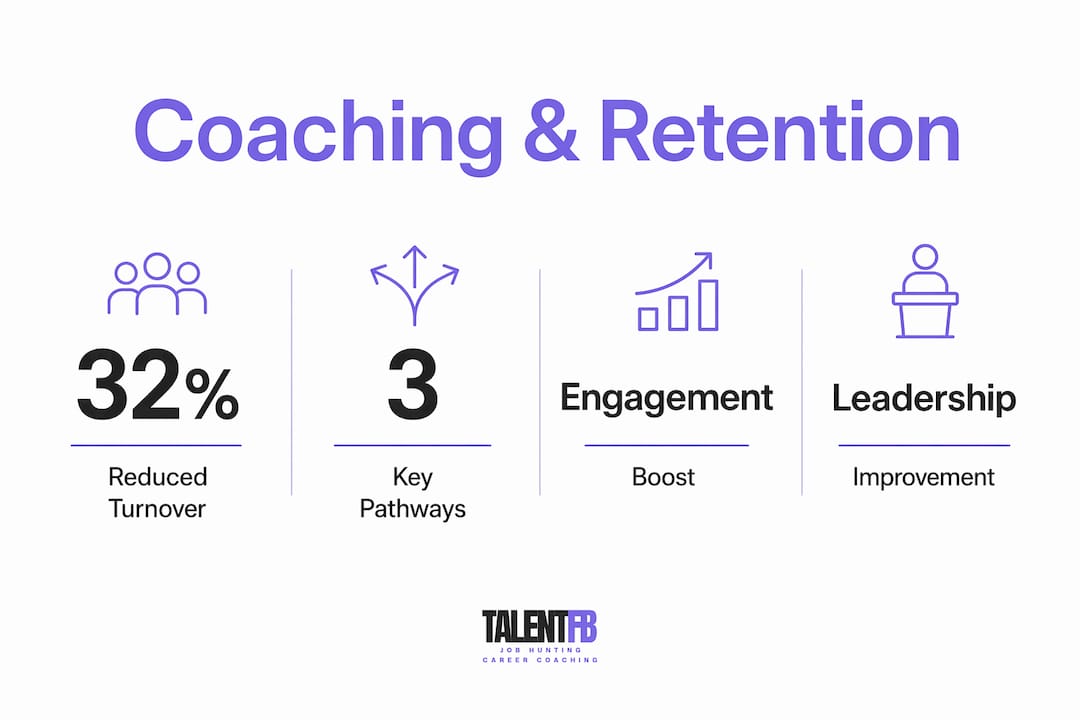
Coaching improves employee retention by changing the quality of leadership that people experience every day. When leaders receive coaching, they communicate more clearly, regulate stress better, and build the kind of trust that makes people want to stay. A field experiment on authentic leadership found that coaching-driven leadership behavior changes reduced turnover intention by 32% in just three months. That is not a marginal gain. For C-suite executives and HR leaders asking why coaching improves retention, the answer sits at the intersection of psychological safety, engagement, and person-job fit.
Why coaching improves retention: the core mechanisms
Coaching works on retention through three distinct pathways: leader behavior, employee engagement, and psychological safety. Each one reinforces the others, creating a system that is harder to disrupt than any single retention perk.
Leader behavior is the most direct pathway. Coached leaders communicate with more consistency, hold difficult conversations with less defensiveness, and regulate their own stress under pressure. Research confirms that coaching equips leaders with emotional regulation and communication skills that are pivotal for retaining talent. Employees who work under leaders with these skills experience fewer reasons to leave.
Person-job fit is the second pathway, and it is often overlooked. A study of 9,341 samples found that coaching strengthens engagement via improved person-job fit. When leaders coach their teams, they help people connect their work to their strengths and goals. That alignment reduces the quiet disengagement that precedes most voluntary departures.
Psychological safety is the third pathway. Coaching leadership fosters the cognitive conditions for retention through psychological safety. When people feel safe to speak up, ask questions, and admit mistakes, they invest more deeply in their work and their team. That investment is a powerful retention force.
- Coached leaders hold more productive one-on-one conversations
- Employees gain clearer visibility into their own growth paths
- Teams develop stronger norms around feedback and learning
- Psychological safety reduces fear-driven turnover decisions
- Engagement rises as people feel seen and supported
Pro Tip: Track person-job fit scores alongside standard engagement surveys. This combination gives HR a leading indicator of turnover risk before people start updating their LinkedIn profiles.
How does coaching leadership differ from traditional management in retaining talent?
Traditional management and coaching leadership are not simply different styles. They produce measurably different retention outcomes because they operate on different assumptions about people.

Traditional management tends to prioritize task completion, performance monitoring, and compliance. Coaching leadership prioritizes growth, listening, and empowerment. The distinction matters because coaching culture builds resilience, trust, and collaboration, which the International Coaching Federation (ICF) now classifies as a strategic retention advantage rather than a soft benefit.
| Behavior | Traditional management | Coaching leadership |
|---|---|---|
| Feedback style | Evaluative, periodic | Developmental, ongoing |
| Response to mistakes | Corrective, blame-focused | Curious, learning-focused |
| Employee voice | Limited, top-down | Encouraged, two-way |
| Stress response | Directive, controlling | Regulated, supportive |
| Retention outcome | Higher turnover risk | Lower turnover intention |
| Team climate | Compliance-driven | Trust-driven |
Post-pandemic data reinforces this contrast. Organizations that increased investment in coaching cultures after 2020 reported stronger staff resilience, higher trust, and better collaboration. These are not abstract qualities. They are the conditions under which people choose to stay. You can read more about how this plays out in tech environments in TalentFB’s guide on why companies hire coaches.
The practical implication for HR leaders is clear. Coaching leadership is not a personality trait you hire for. It is a set of behaviors that can be developed, measured, and reinforced through structured coaching programs.
What role does coaching play during organizational change?
Organizational change is the highest-risk period for voluntary attrition. Uncertainty triggers fear, and fear drives people toward the exit. Coaching is one of the most effective buffers against this dynamic.
Survival analysis research shows that coached teams have lower risk of employee departure over an observation period during organizational change. The mechanism is relational consistency. When a leader has been coached, they maintain steadier behavior under pressure. Employees experience less volatility from their manager, which reduces the anxiety that fuels departure decisions.
Coaching also prepares leaders to deliver difficult messages without triggering defensiveness or distrust. A restructure, a role change, or a strategic pivot lands very differently depending on how the leader communicates it. Coached leaders tend to frame these conversations with more empathy and clarity, which preserves the trust that retention depends on.
- Coaching stabilizes leader behavior during periods of high uncertainty
- Consistent leadership reduces the emotional volatility employees experience
- Coached leaders communicate change with more clarity and less defensiveness
- Relational trust built before a change event carries people through it
- Coaching protects the psychological safety that change tends to erode
Pro Tip: Do not wait for a change event to start coaching your leaders. The research is clear that coaching delivers the strongest retention results when it stabilizes leader behaviors before and during pressure, not only in stable conditions.
Coaching is not a complete solution on its own. It functions as one lever within a wider system. Pairing coaching with fair processes and genuine psychological safety is what converts leader behavior change into measurable retention outcomes. TalentFB’s guide on the role of coaching in change management covers this in more depth for leaders navigating active transitions.
How can companies design coaching programs that maximize retention benefits?
A coaching program that sits in isolation from the broader organizational climate will underdeliver. The design of the program matters as much as the coaching itself.
-
Target leaders who shape team climate first. Not every leader has equal influence on retention. Prioritize coaching for those who directly manage large teams or who lead functions with historically high turnover. Their behavior change creates the widest retention impact.
-
Measure engagement and person-job fit as leading indicators. HR should track improvements in person-job fit and engagement scores as the primary metrics for coaching ROI. These measures move before turnover data does, giving you time to intervene.
-
Integrate coaching with psychological safety initiatives. Coaching alone rarely prevents attrition. It requires a supportive environment to translate behavioral changes into retention outcomes. Pair coaching with team-level norms around feedback, voice, and fairness.
-
Build in behavioral consistency, not just insight. Many coaching programs produce good conversations but inconsistent follow-through. Structure the program to reinforce specific leader behaviors over time, not just during coaching sessions. Ongoing feedback loops and peer accountability make the difference.
-
Treat coaching as a culture investment, not a personal development perk. When coaching is positioned as a reward for high performers, it misses the systemic opportunity. Frame it as a leadership standard that every people manager is expected to develop and practice.
Leadership credibility strongly influences psychological safety and wellbeing, which in turn mediates turnover intention. That chain of cause and effect is the business case for designing coaching programs with culture change as the goal, not just individual skill development.
The uncomfortable truth about coaching programs I have seen fail
After 15 years inside hiring rooms across tech, fintech, adtech, gaming, and maritime-tech in APAC, I have watched organizations invest in coaching and still lose their best people. The pattern is almost always the same. The coaching was real, but it was isolated.
A VP gets six sessions with a great coach. Their communication improves. Their team notices. But the organizational climate around them, the unfair promotion processes, the lack of psychological safety at the senior level, the culture of blame during setbacks, stays exactly the same. The coaching creates a better leader inside a system that does not support what that leader is trying to build. People still leave.
The research backs this up. Coaching delivers its strongest retention results when it is paired with procedural fairness and a genuine culture of trust. That means HR and the C-suite have to do the harder work of examining the system, not just developing the individual. Coaching is not a substitute for that work. It is an accelerant for it.
What I recommend to every executive I work with is this: before you invest in a coaching program, audit the environment your leaders are returning to after their sessions. If that environment punishes vulnerability, ignores feedback, or rewards political behavior over performance, your coaching budget will produce better leaders who eventually leave for organizations that deserve them. The ICF’s position that coaching culture is a competitive advantage is correct. But a coaching culture is not the same as a coaching program. One is a system. The other is a service.
— Frederic Bonifassy
How TalentFB helps leaders build coaching-driven retention
For tech executives and HR leaders who want to move from insight to action, TalentFB offers coaching resources built specifically for the APAC leadership context.
TalentFB’s career coaching guide for tech executives covers the practical frameworks that connect coaching behaviors to measurable retention and leadership growth outcomes. Whether you are building a coaching culture from scratch or looking to sharpen your own leadership presence to attract and keep top talent, TalentFB’s approach is grounded in 15 years of direct experience inside the hiring room. Explore the talent management guide for tech leaders to see how coaching fits into a broader retention system that actually holds.
FAQ
Why does coaching reduce employee turnover?
Coaching reduces turnover by improving the quality of leadership that employees experience daily. Coached leaders build psychological safety, communicate more clearly, and help employees find stronger alignment between their work and their strengths, all of which reduce the intention to leave.
How quickly can coaching impact retention outcomes?
Research shows that leadership behavior changes driven by coaching can reduce turnover intention by 32% in as little as three months. The speed of impact depends on how consistently new behaviors are applied and whether the organizational climate supports them.
What is the difference between a coaching program and a coaching culture?
A coaching program is a structured intervention for specific leaders or teams. A coaching culture is an organizational norm where coaching behaviors, feedback, and psychological safety are practiced at every level. Retention benefits are strongest when both exist together.
How should HR measure the impact of coaching on retention?
HR should track person-job fit scores and work engagement as leading indicators, since these metrics shift before turnover data does. Improvements in these areas signal that coaching is working before anyone hands in their resignation.
Does coaching work during organizational change?
Survival analysis confirms that coached teams experience lower attrition during change periods. Coaching stabilizes leader behavior under pressure, which preserves the relational trust that keeps people from leaving when uncertainty peaks.