
TL;DR:
- Career transition involves moving from one career path to another and requires more than just updating a resume.
- For senior tech professionals, it entails strategic preparation, understanding the psychological identity shifts, and a timeline of 6 to 24 months.
Career transition is one of the most consequential moves a professional can make, yet it is widely misunderstood. Most people treat it as a job search with a new destination. It is not. A career transition is moving from one career path to another, and it demands far more than an updated resume. For senior technology professionals and executives in Singapore, the stakes are higher, the identity investment deeper, and the market expectations more specific. This guide covers what career transition actually means, what to expect psychologically and practically, and how to navigate it with the kind of clarity that produces real results.
Table of Contents
- Understanding career transition: types and timelines
- Navigating the psychological and identity shifts in career transitions
- Practical strategies for senior tech executives to manage effective career transitions
- Resources and support for career transitions in Singapore’s tech sector
- Why mastering the ‘identity shift’ is the most critical success factor in senior tech career transitions
- How TalentFB empowers senior tech leaders to navigate career transitions with confidence
- Frequently asked questions
Key Takeaways
| Point | Details |
|---|---|
| Career transition defined | Career transition involves moving to a new role, industry, or function requiring new skills and mindset. |
| Timeline varies | Transitions typically take between 6 and 24 months depending on transferable skills and credential needs. |
| Psychological impact | Identity shifts during transitions cause anxiety and must be managed alongside practical steps. |
| Skill translation is key | Reframing your experience using target-industry language improves hiring success. |
| Use available support | Leverage Singapore’s career guidance programs and professional coaching for a smoother transition. |
Understanding career transition: types and timelines
Before you can plan a transition, you need to know which type you are facing. Not all career changes carry the same weight, require the same preparation, or follow the same timeline. Treating them as equivalent is one of the most common planning errors senior tech professionals make.
Career transitions fall into four main categories, each with distinct demands:
- Industry change: Moving from, say, fintech to healthcare technology or from enterprise software to the public sector. The functional skills may transfer, but the language, buyer psychology, and sector norms are different.
- Functional change: Shifting from engineering to product management, or from individual contributor to a people leadership role. Here, the industry may stay the same but the core job changes significantly.
- Entrepreneurship: Leaving a corporate role to found or co-found a company. This is less a career change and more a complete reconfiguration of how you work, get paid, and define success.
- Career advancement: Moving into a more senior leadership position, often across a company boundary. This is the most common transition for experienced tech professionals and still requires deliberate repositioning.
Knowing your type matters because it determines your preparation strategy and your expected timeline. Transitions typically take 6 to 24 months from the point of decision to landing in a new role, depending on how transferable your skills are and whether the target role requires new credentials.
How the timeline breaks down
Here is a practical look at what each stage involves:
- Self-assessment (weeks 1 to 4): Identify your transferable skills, non-negotiable values, and the specific type of transition you are pursuing.
- Research and targeting (weeks 4 to 8): Narrow your focus to two or three target roles or sectors. Build a clear picture of what hiring managers in those spaces actually want.
- Credential and skills building (months 2 to 6): Fill the gaps. This may mean certifications, advisory roles, or side projects that demonstrate credibility.
- Active positioning (months 3 to 9): Rewrite your LinkedIn profile and resume for the target role. Begin networking with intention.
- Interview and offer stage (months 6 to 18+): Run a focused, metrics-driven job search. Negotiate your offer with full awareness of the new market rate.
The table below gives you a quick reference for the scope and complexity of each transition type.
| Transition type | Scope of change | Typical skill gap | Estimated timeline |
|---|---|---|---|
| Career advancement | Low to medium | Leadership, executive presence | 6 to 12 months |
| Functional change | Medium | New domain knowledge | 9 to 18 months |
| Industry change | Medium to high | Sector language, new networks | 12 to 24 months |
| Entrepreneurship | Very high | Business operations, funding | 18 to 36+ months |
The career transition process explained inside a structured playbook can cut months off this timeline because it removes the guesswork from each phase. The key variable most people overlook is transferable skills, which, when properly mapped and communicated, significantly reduce perceived risk for hiring managers.
Navigating the psychological and identity shifts in career transitions
Here is what most career transition guides skip entirely. The practical steps matter, but the internal work is what determines whether you finish the process or quietly retreat to a lateral move just to relieve the pressure.
Major career transitions involve identity shifts that can trigger significant anxiety, even when the change is entirely voluntary. For a VP of Engineering or a Chief Technology Officer, the job title is not just a line on a business card. It is tied to how you introduce yourself at a dinner party, how your peers perceive you, and frankly, how you see yourself. Removing that anchor creates a disorienting gap.

This is not weakness. It is the natural consequence of building expertise and identity in parallel over many years.
The psychological challenges you are likely to encounter include:
- Loss of status identity: Without the title, the corner office, or the team, your sense of professional self-worth can temporarily collapse.
- Fear of starting over: The thought of being a newcomer in a space where you were once an authority is genuinely uncomfortable.
- Uncertainty paralysis: Too many options, too much research, and no clear signal of what “right” looks like can lead to prolonged inaction.
- Isolation: Senior professionals rarely discuss career uncertainty with peers, which compounds the emotional burden.
The second critical insight from research is this: most career changers move away from dissatisfaction, not toward a specific goal. Moving away from a toxic culture or an exhausted career path is valid. But it is not enough. Without a clear target, you will drift, second-guess, and eventually settle for whatever presents itself.
“The professionals who complete career transitions successfully are not those who work hardest on their resumes. They are those who do the internal work of clarifying who they are becoming, not just what role they want next.”
Career coaching for identity shifts provides a structured space to work through this, separate from the tactical job search. And if you want to understand what the full psychological arc of a senior-level transition looks like, the executive career transition psychology behind leadership-level moves is worth studying before you begin.
Pro Tip: Find two or three peers who have already made a similar move. Their lived experience will do more for your confidence than any amount of reading. Executive peer circles and structured coaching cohorts serve this purpose well.
Practical strategies for senior tech executives to manage effective career transitions
Mindset sets the foundation. Tactics build the house. Here is what career transition planning actually looks like in practice for a senior tech professional.
The first and most important skill to develop is translation. Senior tech executives must reframe experience into the language of the target industry, emphasizing measurable impact rather than technical depth. A hiring manager in a new sector does not know what your technology stack means. They do know what “reduced infrastructure costs by 34%” or “led a team of 40 through a zero-downtime migration” means.
Steps to prepare for a career transition
- Conduct a transferable skills audit. List every competency you have used in the last five years. Then cross-reference against job descriptions in your target role. The overlap is your starting point.
- Choose credentials that signal, not just teach. Certifications and portfolio projects shorten perceived risk for employers. Pick certifications that hiring managers in your target sector actually recognize.
- Build visible proof of work. Write a LinkedIn article, contribute to an open-source project, or join an advisory board. The goal is public evidence of your interest and capability in the new space.
- Map your network to the target sector. Identify second and third-degree connections who are already working in your target role or company. Warm introductions remain the most effective job search channel for senior roles.
- Rewrite your resume and LinkedIn profile with the target role in mind. Every bullet point should answer the hiring manager’s implicit question: “What can you do for us?”
Ways to build credibility without leaving your current role
- Take on cross-functional projects that demonstrate skills relevant to your target function.
- Attend industry events, webinars, or conferences in your target sector.
- Pursue advisory or board roles at startups in the space you want to enter.
- Start writing publicly about the intersection of your current expertise and your target field.
Pro Tip: Use the hiring manager’s language before they ask. If a job description uses “P&L ownership” instead of “budget management,” match it precisely. Skepticism toward non-traditional candidates evaporates when your resume reads like you already belong.
The job search strategies that work for executives are fundamentally different from those used at mid-level. The volume-and-apply approach fails at this level. Targeted outreach, referral-led introductions, and personal branding do not. For a structured view of this, the career development checklist built specifically for tech leaders is worth reviewing before you finalize your plan.
Resources and support for career transitions in Singapore’s tech sector
Singapore’s career support ecosystem is more developed than most professionals realize. The government provides structured career support through channels designed specifically for mid-career professionals, covering everything from initial advisory conversations to personalized job matching.
Key programs and services available in Singapore include:
- Career advisory sessions through Workforce Singapore and the MyCareersFuture platform, offering personalized guidance on career direction and skill gaps.
- Job matching services that connect professionals with employers specifically seeking experienced candidates in their sector.
- Sector-specific networking facilitated through industry associations and government-linked programs targeting technology and innovation roles.
- Mentorship programs such as Polaris and the Ventures for Good Career Advisors program, which connect career changers with senior professionals who have made similar pivots.
- Virtual and in-person workshops on resume writing, interview preparation, and LinkedIn presence, tailored for professionals at the manager and director levels.
The career advice resources available through professional communities extend this support, particularly for those transitioning into adjacent sectors.
Beyond government programs, professional career coaches who specialize in technology leadership transitions offer something the public sector cannot: sector-specific insider knowledge, personalized strategy, and accountability over time. A coach who understands the Singapore technology hiring landscape can compress your timeline considerably. The free career transition resources available through platforms focused on tech leadership can serve as a strong starting point. And if you want to understand how coaching specifically accelerates growth for Singapore-based tech professionals, the career coaching in Singapore context is worth exploring further.
Why mastering the ‘identity shift’ is the most critical success factor in senior tech career transitions
Most career transition guides, including good ones, spend 80% of their advice on skills, resumes, and networking. That content is valuable. But it addresses the 20% of the transition that most people already know they need to work on.
The 80% that actually derails senior tech professionals is internal. It is the slow erosion of confidence that happens when your title disappears and your professional identity has no container to live in. It is the paralysis that sets in when you realize that the credentials making you excellent in your current role do not automatically translate into credibility in the new one. It is the quiet question: “If I am not the CTO anymore, who am I?”
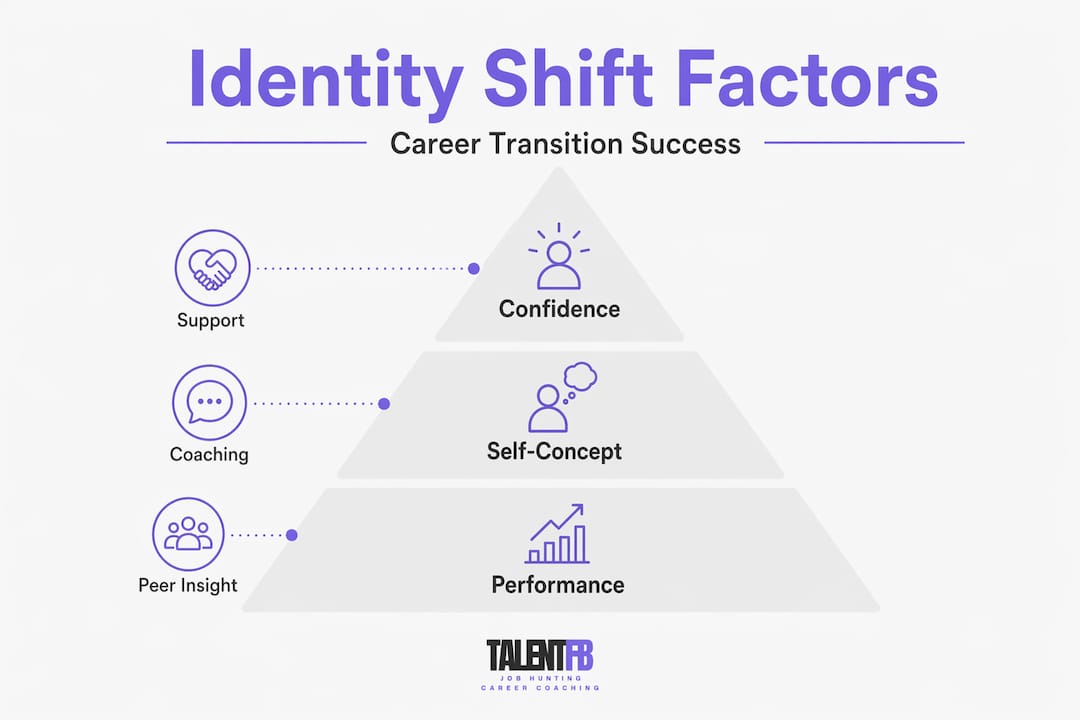
Unresolved identity conflict does not just feel bad. It actively degrades your performance in interviews, your clarity in networking conversations, and your ability to negotiate with authority. Hiring managers read hesitation. They cannot always name what they are sensing, but candidates who have not resolved their own story tend not to inspire confidence, regardless of their actual capability.
The executives who transition most successfully are not those who move fastest. They are those who invest deliberately in reconnecting with their core value proposition, separate from any title or company. They can articulate what they do, what they have built, and where they are going with the same ease whether they are currently employed or between roles.
Executive coaching insights consistently show that the identity dimension is the work most clients resist initially and value most retrospectively. Building a new professional narrative is not a soft, optional exercise. It is the foundation on which everything else, the resume, the LinkedIn profile, the interview performance, actually stands.
Pro Tip: Before you rewrite your resume, write two paragraphs answering this question: “What do I want my next chapter to stand for?” If you cannot answer that clearly, your resume will feel scattered even if the formatting is perfect.
A practical plan for an executive transition
- Check your readiness. Be honest about why you want to move, your financial runway, and whether your family and current commitments allow it now.
- Map your options. List the roles, sectors and company types where your experience transfers. Include options beyond full time employment, such as interim, fractional or advisory work.
- Test before you commit. Talk to people already doing the roles you are considering. Ten conversations will tell you more than any report.
- Get support. A mentor who has made a similar move, a peer group or a coach shortens the learning curve and keeps you accountable.
- Run a focused search. Pick your target, update your CV and LinkedIn to match it, and reach decision makers directly rather than waiting for postings.
How TalentFB empowers senior tech leaders to navigate career transitions with confidence
Understanding what a career transition truly involves is the first step. Taking structured, supported action is what turns that understanding into results.
TalentFB is built specifically for senior technology professionals and executives who are ready to move with intention. Whether you are targeting a leadership role in a new sector, repositioning for an executive title, or simply tired of navigating the job market alone, the platform combines expert career coaching for tech executives with AI-driven tools that accelerate every stage of the process. The AI-powered job search playbook gives you a practical, step-by-step system designed to produce interview opportunities in weeks, not months. And if you are just beginning to explore your options, the free career transition resources are a no-risk starting point. You do not have to figure this out alone.
Frequently asked questions
What does career transition mean for senior tech professionals?
It means moving deliberately from one career path or role to another. For senior tech professionals, this often involves changing careers intentionally, whether across industries, into leadership, or toward entrepreneurship, requiring both new skills and significant mindset work.
How long does a typical career transition take?
Transitions generally take 6 to 24 months, depending on how well your existing skills transfer and whether the target role requires additional credentials or demonstrated experience.
What support is available for career changers in Singapore?
Singapore offers a strong infrastructure for mid-career transitions, including government career advisory services, personalized job matching, and mentorship programs connecting professionals with senior leaders who have navigated similar moves.
What is the biggest challenge in a career transition?
Beyond skills, the biggest challenge is managing the identity shift that accompanies the loss of a senior title, alongside the need to define a specific, compelling target rather than simply moving away from dissatisfaction.
How can senior tech professionals make their career transitions easier?
By translating their experience into the language and metrics of the target sector, building visible credibility through certifications or projects, and engaging professional coaching or structured support to accelerate both the tactical and psychological dimensions of the transition.