
TL;DR:
- CEOs must shift from practicing recruitment to designing scalable systems that drive long-term organizational success.
- Implementing structured scorecards, clear decision rights, and outcome-focused KPIs enables effective governance and talent quality.
- Building evidence-based evaluation frameworks and strategic oversight during initial days helps shape a strong leadership team and organizational culture.
In a scaling tech company, the CEO is the most effective recruiter in the building, whether they like it or not. Senior candidates want to know who they will work for, what you believe, and whether you will back them. No recruiter or careers page can answer that for you. Yet many founders hand hiring to HR the moment they can afford to, and quality drops.
This guide is for founders and CEOs who want to own the parts of recruitment that only they can own: the hiring system, the scorecards, the metrics, the partnership with their first HR leader, and the personal reputation that makes strong people take the call.
Table of Contents
- Why CEOs must treat recruitment as a strategic system
- Measuring recruitment success: the right KPIs for CEOs
- Scientific approaches to CEO and executive hiring
- The CEO’s first 100 days: assessing and shaping the executive team
- Navigating unofficial networks and decision rights in executive hiring
- Why recruiting governance — not micromanagement — is the CEO’s most powerful leverage
- Enhance your CEO recruitment strategy with expert coaching and resources
- Frequently asked questions
Key Takeaways
| Point | Details |
|---|---|
| CEO as recruitment architect | CEOs design and govern recruitment systems to scale talent acquisition without micromanaging every hire. |
| Focus on outcome KPIs | Recruitment metrics should measure long-term success and quality, not just hiring speed or volume. |
| Use scientific hiring methods | Structured behavioral assessments and scenario interviews improve accuracy in executive selection. |
| Assess leadership early | New CEOs should strategically evaluate inherited executives in their first 100 days for effective team shaping. |
| Govern decision rights | Clear roles and escalation rules prevent bias and maintain consistent hiring standards. |
Why CEOs must treat recruitment as a strategic system
The most important shift in thinking is this: your job is not to conduct every interview. It is to design the recruiting system your talent team and hiring managers operate within. That distinction changes everything about how you spend your time and where you apply your judgment.
CEOs who approach the executive role in recruitment as architects, rather than practitioners, create something that scales. You set the scorecard criteria, define the interview loops, write the escalation rules, and establish hiring KPIs. Your people execute within that structure. When a critical hire stalls or a candidate profile creates debate, that is when your judgment gets called in.
Here is what a well-governed hiring framework looks like in practice:
- Structured scorecards that translate your cultural values into assessable criteria, so every interviewer is evaluating the same dimensions
- Interview loop design that specifies who assesses what, eliminating redundancy and ensuring coverage of technical, leadership, and culture indicators
- Escalation rules that define when a hiring decision requires CEO sign-off versus when it can be delegated cleanly
- Hiring KPIs reviewed quarterly as a leadership metric, not just an HR report
- Cultural translation that converts abstract values like “moves fast” or “owns outcomes” into behavioral evidence interviewers can actually observe
When you build a C-suite recruiter strategy around these elements, you stop being a bottleneck and start being a force multiplier.
Pro Tip: Write one hiring “constitution” document per role level (individual contributor, manager, director, VP, C-suite). It takes a few hours upfront and saves hundreds of hours in misaligned candidate debates later.
Measuring recruitment success: the right KPIs for CEOs
Most recruiting dashboards are built to satisfy HR operations, not CEOs. They track time-to-fill and number of applicants. Those numbers feel productive. They rarely predict whether the person you hired will succeed.
For executive recruitment in tech, outcome-oriented metrics are the ones worth watching. The distinction matters because activity metrics measure your recruiting machine’s pace, while outcome metrics measure its quality.
The metrics that belong in your dashboard:
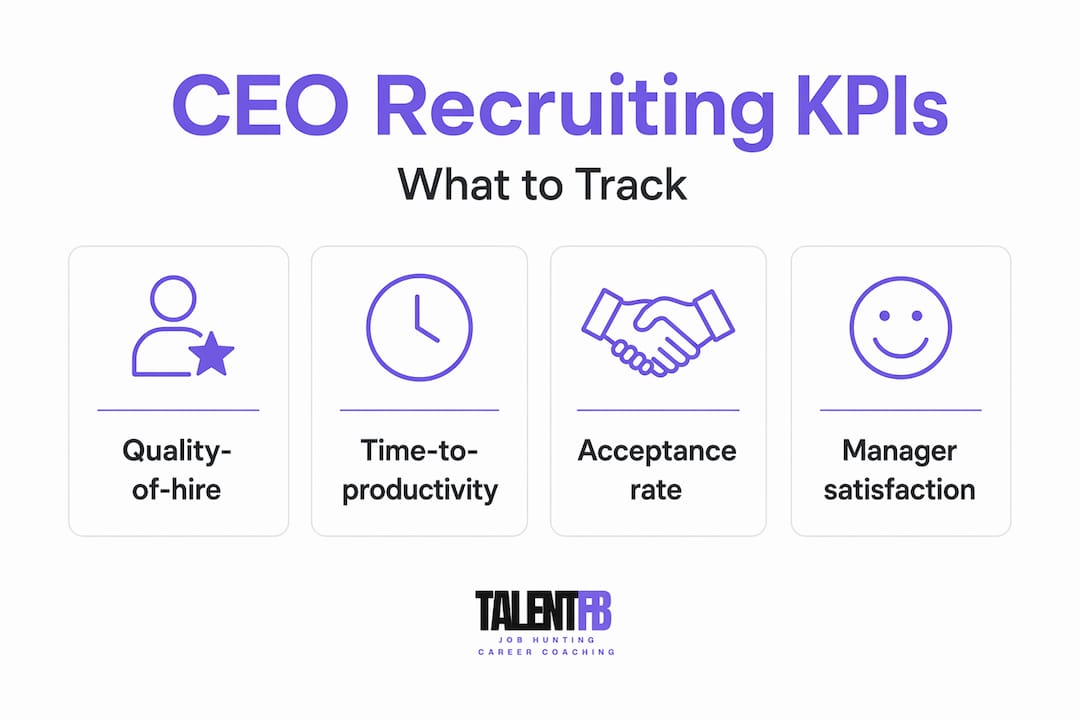
- Quality-of-hire scored at 90 days and 12 months, using manager assessment against the original scorecard criteria
- Time-to-productivity tracking how quickly a new executive is operating independently in their role
- Offer acceptance rate for critical roles, which is a direct signal of your employer brand strength
- Hiring manager satisfaction collected 60 days post-hire as a process quality indicator
- Source-of-hire effectiveness showing which channels produce your strongest performers, not just your most applicants
| KPI | What it measures | Why it matters for CEOs |
|---|---|---|
| Quality-of-hire | Performance at 90 days vs. scorecard | Validates the entire hiring process |
| Time-to-productivity | Days until full role autonomy | Measures onboarding and fit effectiveness |
| Offer acceptance rate | Accepted offers vs. total offers | Signals competitive positioning |
| Hiring manager satisfaction | Post-hire process rating | Reveals where the system breaks down |
| Source-of-hire effectiveness | Performance by candidate source | Guides recruiting investment decisions |
The impact of CEO on workforce planning becomes concrete when these metrics are reviewed in your quarterly leadership operating rhythm, not buried in an HR slide deck. Connect them to business outcomes: a VP of Engineering with a 90-day quality score below threshold should trigger a process review, not just a performance plan.
Pro Tip: Ask your talent team to build a single-page executive hiring scorecard that maps each metric to a business outcome. If they cannot make that connection, your KPIs need rethinking.
Good talent development guidance reinforces why tracking quality-of-hire over 12 months is more valuable than tracking how quickly you filled the seat.
Scientific approaches to CEO and executive hiring
The instinct to hire the person who “feels right” in the room is one of the most expensive habits in executive recruitment. It prioritizes confidence over capability, presence over pattern, and pedigree over actual decision-making quality.
Boards increasingly use structured, scenario-based evaluation methods combined with psychometric tools precisely because the “whole-person impression” approach produces inconsistent results. A charismatic candidate is not the same as a high-performing one.
Applying hiring science to executive selection means building evaluations around these elements:
- Structured scenario interviews that present real business situations (a sudden product pivot, a team performance crisis, a board conflict) and assess the candidate’s decision logic, not just their answer
- Psychometric assessments that measure cognitive style, risk tolerance, and emotional regulation, particularly relevant for CEOs and C-suite roles where stress calibration matters
- Decision-style profiling that reveals how a candidate processes ambiguous information and builds alignment, which are two of the most critical and least visible leadership skills
- Multi-evaluator frameworks where independent assessors score the same competency dimensions, reducing any single interviewer’s unconscious bias
- Behavioral evidence requirements that ask candidates to describe specific past actions, not hypothetical future intentions
The CEO involvement in the hiring process at this level is not about attending more interviews. It is about ensuring the evaluation architecture is genuinely diagnostic. Many organizations stop at two rounds of unstructured conversation. The ones that build lasting leadership teams invest in structured evidence. You can explore more on this through our executive career transitions resource, which covers how leadership candidates prepare for exactly these kinds of assessments.
The CEO’s first 100 days: assessing and shaping the executive team
For a new CEO, the first hundred days function as a diagnostic window. The decisions you make during this period about who belongs on your leadership team will define your first year more than any product or market decision.

The first 100 days is when the inherited executive team gets assessed through structured interactions. Reactive decisions during this period — removing someone because of one difficult conversation, or retaining someone because they are likable — create the churn and instability that derails early momentum.
Here is a structured process for navigating this assessment effectively:
- Schedule individual one-on-ones with each direct report in the first two weeks. Use a consistent framework: where do they see the business, what are the team’s strengths and gaps, what would they change, and where do they feel stuck.
- Observe executive committee dynamics before changing them. Watch how leaders interact, who defers to whom, where conflict gets avoided, and where the real decisions get made.
- Review each leader’s performance data from the previous 12 months, including their team’s output metrics, retention numbers, and any major project outcomes.
- Benchmark each leader against your incoming strategic priorities. The CFO who was effective in a growth-at-all-costs environment may not be the right person for a profitability-focused next chapter.
- Make retention, development, or replacement decisions by day 90 based on structured evidence, not accumulated impressions.
This approach keeps the importance of CEOs in talent acquisition at the center of early leadership. It also models for your entire organization that talent decisions are made with rigor, not politics. Pairing this process with solid talent development guidance helps you distinguish between leaders who need development and leaders who need replacing.
Navigating unofficial networks and decision rights in executive hiring
Here is something most executive hiring guides will not tell you plainly: hiring decisions are frequently made through network reputation and references long before a formal evaluation begins. By the time a candidate sits in the interview room, the informal consensus is often already forming.
This is not inherently wrong. Reputation matters. But it creates real risk when informal signals carry more weight than structured assessment, particularly in homogeneous networks that consistently surface the same candidate profiles.
As a CEO, your job is to build a decision rights model that keeps informal signals in their proper place:
- Define who can approve hires at each level. A hiring manager should be able to close a senior individual contributor role. A VP hire should require two executive approvals. A C-suite hire requires CEO sign-off with board visibility.
- Separate reference feedback from evaluation scoring. References inform context. They should not override structured scorecard data.
- Build an escalation path for cases where a hiring team is split, or where a candidate comes with strong informal advocacy but weak formal scores.
- Audit your candidate pipelines for source diversity. If 80% of executive candidates come from one network, you are not assessing the full talent market.
| Decision model | Strengths | Risks |
|---|---|---|
| Centralized CEO approval | High consistency, strong standards | Slows hiring, creates bottleneck |
| Delegated with escalation rules | Scales well, maintains accountability | Requires clear documentation |
| Fully delegated | Fast, empowers managers | Standards drift, inconsistency risk |
The most effective C-suite hiring strategy combines delegated execution with CEO-governed standards. You own the rules of the game. Your team plays it.
Pro Tip: Create a one-page decision rights map for your recruiting process and share it with every hiring manager. Ambiguity about who can approve what is one of the most common reasons good candidates are lost to slower-moving competitors.
Why recruiting governance — not micromanagement — is the CEO’s most powerful leverage
Here is the view that most leadership conversations miss entirely: the CEOs who are genuinely excellent at talent are rarely the ones attending every interview. They are the ones who have made it nearly impossible to make a bad hire without the system catching it.
CEO involvement in recruiting is most powerful when it functions as governance of standards, because that is the only form of involvement that scales. A CEO who personally approves every VP hire can get away with it at 50 employees. At 500, that approach becomes a liability.
Governance means something specific. It means your hiring scorecards reflect your three-year strategy, not last year’s job description. It means your escalation rules are written down and understood by every hiring manager. It means you review hiring outcome metrics in your quarterly operating review the same way you review revenue.
What boards expect, and what top executive candidates look for when evaluating a company, is a CEO who demonstrates talent leadership as organizational discipline. Not someone who just talks about culture, but someone who has built the systems that protect and reinforce it at every hire.
The CEOs who micromanage interviews tend to produce inconsistent results because their instincts are the only quality control. The ones who govern through frameworks produce compounding results because every hiring manager operates with the CEO’s judgment built into the process. That is what an executive talent operating system looks like in practice.
Build the framework. Review the outcomes. Let your people execute. That is the highest-leverage version of your role in talent.
Enhance your CEO recruitment strategy with expert coaching and resources
If this article has clarified where you want to raise your game as a talent leader, the next step is moving from insight to action.
TalentFB provides coaching and resources specifically designed for senior technology leaders who want to build stronger hiring frameworks, lead executive teams with more precision, and position themselves as the kind of talent-driven CEO that boards and organizations trust. From career coaching for tech executives to understanding the value of coaching for tech leaders, the platform gives you the practical tools to turn recruiting intent into measurable results. Explore the full job search strategy guide to align your personal leadership positioning with the talent standards you are building inside your organization.
Your first HR leader: what to hand over and what to keep
Hiring your first head of people or CHRO changes how recruitment works, but it does not remove you from it. The partnerships that work split the job clearly.
- Hand over: process design, hiring tools, interview training, offer mechanics, onboarding and compliance.
- Keep: the final decision on senior hires, the story of why someone should join, the relationships with your top external candidates, and the culture you are building.
- Share: workforce planning. Your HR leader should translate your roadmap into a hiring plan, but you set the priorities.
Meet your HR leader weekly on hiring, review the pipeline for senior roles together, and ask them to tell you when you are the bottleneck. You often will be.
Your visibility is part of your hiring system
When a senior candidate hears your company name, the first thing they do is look you up. If your LinkedIn profile is a job title and a two line About section, you are asking them to take a career risk on someone they cannot read. Founders who post regularly about the problems they are solving, the team they are building and how they make decisions get warmer replies to outreach and more referrals. Building that presence is exactly what The LinkedIn/OS helps founders and CEOs do.
Frequently asked questions
Why is the CEO’s role critical in recruitment?
The CEO is the only executive who can translate a three-year ambition into a present-day talent standard, which means HR alone cannot set the quality bar that determines long-term organizational health. When the CEO owns recruitment governance, every hire reflects strategic intent rather than operational convenience.
What recruitment metrics should CEOs focus on?
CEOs should prioritize quality-of-hire, time-to-productivity, offer acceptance rates for critical roles, and hiring manager satisfaction. These outcome-oriented KPIs connect recruiting activity to business performance rather than measuring speed alone.
How do scientific hiring methods improve CEO selection?
Structured, scenario-based methods replace surface-level impressions with consistent behavioral data, reducing unconscious bias and revealing how a candidate actually makes decisions under pressure. Psychometric tools add a further dimension by measuring cognitive style and emotional regulation.
What should new CEOs do during their first 100 days regarding the executive team?
New CEOs should use structured one-on-ones and executive committee observation to build an evidence-based picture of each inherited leader before making retention or replacement decisions. Acting from structured data rather than first impressions significantly reduces costly, disruptive churn in the leadership team.