TL;DR:
- B2C coaching is a structured approach that develops professionals’ skills in engaging individual consumers quickly and authentically. It emphasizes emotional intelligence, rapid trust-building, and behavioral change through personalized, AI-supported reinforcement over time. Implementing sustained coaching programs improves conversion, loyalty, and marketing alignment, with measurable results typically visible within 60 to 90 days.
Most people assume B2C coaching is just sales training with a friendlier name. That assumption costs businesses real money. What is B2C coaching, at its core? It is a structured approach to developing the skills, behaviors, and mindset that professionals need to connect with individual consumers, earn trust fast, and guide purchasing decisions. It goes far beyond scripts and closing tactics. When applied well, it reshapes how your entire team thinks about customer engagement, marketing alignment, and the psychology of the people you serve.
Table of Contents
- What is B2C coaching: core concepts and how it differs
- How B2C coaching works in practice
- Benefits of B2C coaching for individuals and businesses
- How to start implementing B2C coaching
- My honest take on what most people get wrong
- Take your next step with Talentfb
- FAQ
What is B2C coaching: core concepts and how it differs
B2C coaching stands for business-to-consumer coaching. It focuses specifically on the skills needed to engage individual buyers rather than organizational procurement teams. The consumer market moves fast, decisions are often emotional, and the window for making an impression is narrow. Coaching in this space is designed to match that reality.
The most useful way to understand it is by comparing it directly to what most people already know about business coaching.
| Dimension | B2C coaching | B2B coaching |
|---|---|---|
| Buyer type | Individual consumer | Business stakeholder group |
| Decision speed | Rapid, often impulse-driven | Long, multi-stage approval |
| Primary focus | Emotional engagement, empathy | ROI, logic, consultative selling |
| Relationship duration | Often transactional | Long-term relationship |
| Coaching emphasis | Speed, rapport, emotional triggers | Patience, multi-threading, data |
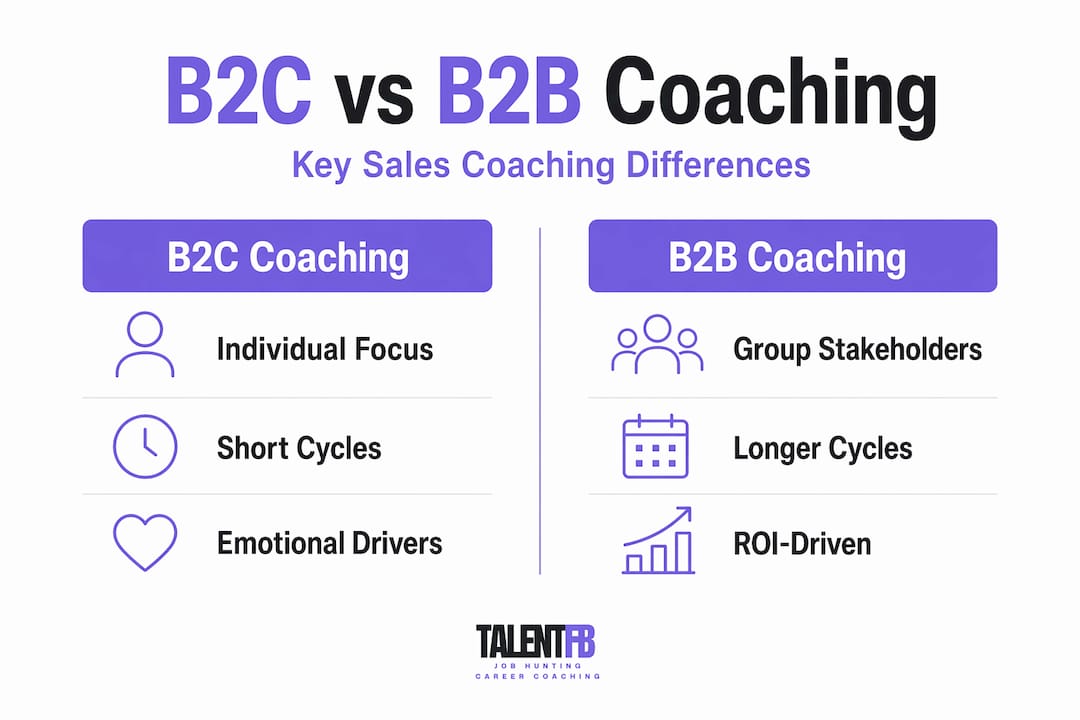
B2B sales training centers on consultative, ROI-driven relationship-building with extended sales cycles, while B2C prioritizes emotional engagement and quick conversions. That distinction shapes everything about how coaching is delivered and what skills it targets.
It also helps to separate B2C coaching from life coaching and personal coaching. Life coaching typically spans months to years and focuses on holistic life satisfaction. Personal coaching is shorter term and project-based, targeting specific measurable outcomes in weeks or months. B2C coaching sits in a professional performance category with clear business metrics attached: conversion rates, customer satisfaction scores, and average transaction values.
There is one more distinction worth making. B2C coaching is not just for salespeople. Marketing strategists, customer success managers, retail floor staff, and even product teams benefit from understanding consumer behavior at the level B2C coaching teaches.
Pro Tip: If your team struggles with customer retention more than acquisition, the root cause is almost always a gap in emotional intelligence skills. B2C coaching addresses this directly, not as a soft skill exercise but as a measurable performance lever.
How B2C coaching works in practice
The practical mechanics of B2C coaching have changed significantly in recent years. Traditional coaching relied on observation, shadowing, and weekly feedback sessions. That still works, but modern programs have added a layer of precision that was not possible before.
Here is how a well-structured B2C coaching engagement typically operates:
- Role-play simulations. Coaches recreate real consumer scenarios, from a customer walking into a retail store to someone calling a support line with a complaint. The rep practices their response, and the coach provides immediate behavioral feedback.
- AI-powered behavioral analysis. AI platforms analyze verbal and non-verbal behavior in real time, providing immediate and scalable feedback aligned with company scripts and buyer personas.
- The 70/30 listening rule. Effective coaches listen 70% and speak only 30% of the session, which keeps the focus on the client uncovering their own insights rather than receiving advice.
- Daily micro-coaching. Short, targeted exercises that build one skill at a time over weeks rather than overloading reps in a single training day.
One framework gaining traction in B2C coaching is the Warmth and Competence model. It teaches professionals to signal both trustworthiness and capability within the first moments of a consumer interaction. Research consistently shows that consumers decide whether they like and trust someone within seconds. Coaching that does not address this window is leaving performance on the table.
Pro Tip: Ask your coaching provider whether their simulations are based on your actual customer profiles and product scenarios. Generic role-plays build generic skills. You want your team practicing the exact conversations your customers are having.
The data table below shows how AI-enhanced B2C coaching compares to traditional methods across key performance areas.
| Performance area | Traditional coaching | AI-enhanced B2C coaching |
|---|---|---|
| Feedback speed | Days to weeks | Immediate |
| Scalability | Limited by coach availability | Scales across entire team |
| Behavioral tracking | Subjective observation | Data-driven, measurable |
| Skill retention | Varies widely | Higher with spaced repetition |
| Personalization | General frameworks | Tailored to individual rep data |
Modern B2C sales coaching blends personalized experience with AI-supported continuous practice to build measurable skills. That is a meaningful shift from coaching as an event to coaching as an ongoing system.

Benefits of B2C coaching for individuals and businesses
The benefits of B2C coaching are specific, not vague. Understanding them helps you decide where coaching investment will generate the strongest return for your context.
-
Faster trust-building. Effective B2C coaching teaches professionals to build trust in under 60 seconds, which is essential when consumer attention is fragmented and patience is short. This directly improves first-impression conversion rates.
-
Higher emotional intelligence. Consumers buy from people they feel understood by. Coaching that builds emotional intelligence allows your team to read buying signals, manage objections without pressure, and guide decisions naturally. The result is higher satisfaction and fewer refunds.
-
Improved marketing alignment. When your consumer-facing team genuinely understands buyer psychology, marketing strategy sharpens. Messaging becomes more specific, campaigns resonate more deeply, and the gap between what marketing promises and what sales delivers closes substantially.
-
Stronger customer loyalty. 1 in 3 high-value purchases correlate with personal milestones like promotions or bonuses. Coaching your team to recognize and respond to these life moments turns a single transaction into a long-term customer relationship.
-
Measurable performance gains. Elite business coaching combines behavioral psychology with operational rigor, delivered through structured frameworks like AOR and OKRs for measurable growth. These are not soft outcomes. They are documented shifts in behavior tied to specific revenue metrics.
One area businesses consistently underestimate is how coaching affects average basket size. When a team member is trained to have genuine, curiosity-driven conversations with customers rather than transactional exchanges, customers naturally explore more products and spend more per visit. That is not upselling technique. That is relationship quality, and it is teachable.
If you want to understand why organizations invest heavily in this kind of development, the value for tech leaders piece from Talentfb offers a clear picture of the broader organizational case.
How to start implementing B2C coaching
Getting started is less complicated than most people expect. The challenge is usually not access to coaching resources. It is the discipline to implement them with structure.
Here is a practical sequence to follow:
- Audit your current approach. Review recent customer interactions, sales call recordings, or support tickets. Look for patterns in where conversations break down. That is your starting point for coaching focus areas.
- Choose a provider with consumer-specific experience. Not all coaching translates across contexts. A provider with B2C coaching strategies specific to your industry will produce faster, more relevant results than a generalist program.
- Integrate technology. Look for platforms that offer role-play simulation with behavioral feedback. The ability to practice and receive immediate analysis between coaching sessions accelerates skill development significantly.
- Set measurable goals. Use frameworks like OKRs and 360-degree feedback loops to track behavior change over time. Without measurement, coaching becomes an expense instead of an investment.
- Build accountability into the program. Assign ownership of specific skill development areas using AOR frameworks. When people know they are responsible for measurable outcomes, the follow-through rate on coaching commitments rises sharply.
The most common mistake organizations make is treating coaching as a one-time event. A two-day workshop can introduce concepts. It cannot change habitual behavior. Real B2C coaching operates as a sustained practice over weeks and months, with regular touchpoints that reinforce and deepen skills over time.
Pro Tip: Start with your highest-volume customer touchpoints first. Improving the quality of your most frequent interactions produces the fastest measurable return, and it creates visible wins that build internal support for broader coaching investment.
My honest take on what most people get wrong
I have seen a lot of organizations invest in B2C coaching and get frustrated when results come slowly. In my experience, the frustration almost always traces back to one misunderstanding. People treat coaching like training. They expect a curriculum to be delivered, a box to be checked, and behavior to change automatically.
What I have learned is that real coaching is a behavioral partnership. The 70/30 listening rule is not just a technique coaches use. It reflects something deeper about how people change. You cannot talk someone into performing differently. You have to help them discover why they want to. That takes time, and it takes a coach who is genuinely invested in the individual.
I also think the emotional intelligence component of B2C coaching gets undervalued because it sounds soft. It is not soft. B2C coaching succeeds by prioritizing emotional intelligence and persuasive empathy because that is what drives consumer decisions. Dismissing that reality is what separates teams that improve and teams that plateau.
The other thing I would push back on is the idea that technology replaces the coaching relationship. AI tools are genuinely powerful for providing scale and data. But elite coaching integrates rigorous frameworks with direct, experience-based human insight. The technology amplifies the coaching. It does not replace it. Treat the two as partners, not substitutes.
If you are serious about this, commit to at least 90 days of structured coaching before evaluating results. That is the minimum timeline for behavioral change to become visible in performance data.
— Frederic
Take your next step with Talentfb
If this article has helped clarify what B2C coaching looks like in practice, the next step is putting that understanding to work. Talentfb works with professionals who are ready to move from knowing to doing. Whether you are looking to sharpen your customer engagement approach or you want a structured, AI-supported coaching program that delivers measurable results, Talentfb has resources built for exactly this. Explore the Job Search OS Masterclass for a structured approach to behavioral and professional skill development. You can also review the top coaching alternatives to find the program that fits your goals and timeline. Start where you are, and build from there.
FAQ
What is B2C coaching in simple terms?
B2C coaching develops the communication, emotional intelligence, and sales skills that professionals need to engage individual consumers effectively. It focuses on fast trust-building, empathy, and the behavioral patterns that drive purchasing decisions.
How does B2C coaching differ from B2B coaching?
B2C coaching is built for rapid, emotionally driven consumer interactions, while B2B coaching focuses on consultative, multi-stakeholder relationships with longer decision cycles. The skills, tools, and pacing of each are meaningfully different.
What are the main benefits of B2C coaching for businesses?
B2C coaching improves conversion rates, builds customer loyalty, aligns marketing with consumer psychology, and creates measurable performance gains through structured behavioral frameworks like OKRs and 360-degree feedback.
How long does it take to see results from B2C coaching?
Most structured B2C coaching programs show measurable behavioral shifts within 60 to 90 days, provided coaching is ongoing rather than delivered as a single training event.
Can AI tools replace traditional B2C coaching?
AI platforms enhance coaching by providing immediate, scalable behavioral feedback through role-play simulations. However, they work best as a complement to human coaching rather than a replacement, since sustained behavior change requires genuine relational investment.