TL;DR:
- Leadership coaching is a confidential, goal-oriented process where a trained coach helps leaders develop specific behaviors and achieve measurable performance outcomes. It involves structured assessments, biweekly sessions guided by models like GROW, and focuses on self-awareness, reflection, and real-world application to produce lasting behavioral change across all leadership levels. Unlike mentoring, training, or therapy, coaching emphasizes personalized, forward-focused development driven by powerful questions and the leader’s own insights.
Leadership coaching is a structured, one-on-one developmental process where a trained coach helps a leader build specific skills, shift behaviors, and achieve measurable performance outcomes. It is not advice-giving, mentoring, or therapy. It is a confidential partnership built around the leader’s own goals, using frameworks like the GROW model and techniques like active listening and powerful questioning to drive real, sustained change. Coaching applies across all leadership levels, from first-time managers to C-suite executives, and typical engagements run 3 to 6 months with sessions every two weeks.
What is leadership coaching and how is it defined?
Leadership coaching is a confidential, goal-focused process that distinguishes itself from every other development method by one defining feature: the coach does not tell you what to do. Instead, the coach creates the conditions for you to figure it out yourself. That distinction sounds subtle, but it changes everything about how the process works and why it produces results that training alone rarely achieves.
A leadership coach works with you to identify specific behavioral targets, not vague aspirations. You do not walk into a session saying “I want to be a better leader.” You walk in saying “I need to stop avoiding difficult conversations with my team” or “I want to make faster decisions without second-guessing myself.” That specificity is what makes coaching measurable and what separates it from a motivational talk.
The process typically involves 6 to 12 sessions over the engagement period, often anchored by a 360-degree feedback assessment at the start. That assessment gives both coach and leader a data-driven baseline, showing how the leader is perceived by peers, direct reports, and senior stakeholders. From there, every session builds toward closing the gap between current behavior and the target state. This is why coaching produces behavioral change at a level that classroom training simply cannot replicate on its own.
How does leadership coaching work in practice?
The mechanics of a coaching engagement follow a clear arc, even if the content of each session is entirely personalized. Here is how a standard engagement unfolds:
- Assessment and goal-setting. The engagement opens with a structured assessment, often a 360-degree feedback tool, a personality profile like Hogan or DiSC, or a combination of both. This data shapes the coaching contract: the specific, observable behaviors the leader commits to changing.
- Biweekly sessions. Sessions run 60 to 90 minutes, typically every two weeks. The gap between sessions is intentional. It gives the leader time to apply insights in real situations before the next conversation.
- Framework-guided conversations. Most coaches use a structured model to keep sessions productive. The GROW model is the most widely used: Goal, Reality, Options, Will. It moves a conversation from “what do you want?” to “what will you actually do?” in a single session, and it can be completed in as little as 20 minutes when used by experienced coaches.
- Reflection and accountability. Between sessions, the leader practices agreed behaviors, tracks outcomes, and brings real examples back to the next session. The coach holds the leader accountable without judgment.
- Progress review. At the midpoint and close of the engagement, coach and leader review progress against the original behavioral targets, often using a second round of 360-degree feedback to measure change objectively.
The role of the coach throughout this process is to ask, not tell. Powerful questions like “What would you do if you knew you could not fail?” or “What is the cost of not acting?” create the self-awareness that drives genuine behavior change.
Pro Tip: If your commitment to a planned action feels below an 8 out of 10, do not push forward. Revisit the goal itself before committing to action. Low commitment almost always signals a misaligned goal, not a motivation problem.

What are the key leadership coaching techniques?
Effective coaching rests on a set of principles that distinguish it from consulting, advising, or managing. The Center for Creative Leadership identifies six core coaching principles that underpin successful engagements, whether delivered by an external coach or a leader coaching their own team:
- Create a safe and challenging environment. The leader must feel psychologically safe enough to be honest about failures, blind spots, and fears. Without that safety, the coaching conversation stays surface-level and produces nothing useful.
- Work within the coachee’s agenda. The coach does not impose a development plan. The leader sets the direction. This preserves autonomy and builds genuine ownership of the change process.
- Facilitate, do not direct. A coach’s job is to expand the leader’s thinking, not to provide the answer. The moment a coach starts solving problems for the leader, the process shifts from coaching to consulting.
- Build self-awareness. Most leadership failures trace back to blind spots. Coaching surfaces those blind spots through reflection, feedback, and honest conversation.
- Model coached behaviors. The best coaches demonstrate the same curiosity, openness, and accountability they ask of their clients. Credibility is built through behavior, not credentials.
- Encourage learning from experience. Real-world application between sessions is where the actual development happens. Sessions are the processing space; the workplace is the laboratory.
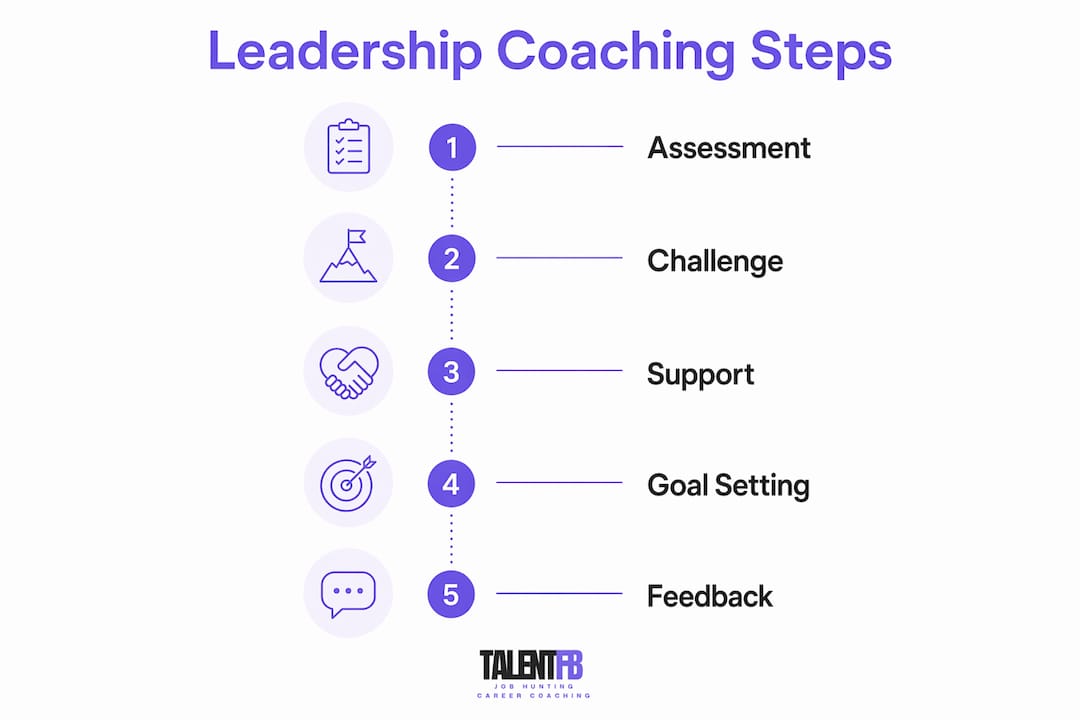
The ACS framework, which stands for Assessment, Challenge, and Support, adds another layer of structure. Assessment identifies the starting point. Challenge pushes the leader beyond their comfort zone. Support provides the safety net that makes risk-taking possible. Together, these elements create the conditions for sustained growth rather than a temporary performance spike.
Pro Tip: Adapting your coaching style between directive teaching and open-ended questioning is not inconsistency. It is skill. New leaders often need more direction early in an engagement, while experienced leaders benefit more from facilitative questioning that builds independent problem-solving.
How does leadership coaching differ from mentoring, training, and therapy?
These four development methods are frequently confused, and the confusion leads to mismatched expectations. Each serves a distinct purpose, and the most effective organizations use them in sequence rather than treating them as interchangeable.
| Method | Focus | Approach | Duration | Outcome |
|---|---|---|---|---|
| Leadership coaching | Behavioral change and goal attainment | Non-directive, one-on-one | 3 to 6 months | Measurable behavior shifts |
| Mentoring | Career guidance and long-term development | Advice-based, experience-driven | Months to years | Expanded perspective and networks |
| Training | Knowledge and skill acquisition | Group-based, structured curriculum | Hours to days | Increased capability |
| Therapy | Psychological healing and emotional processing | Clinical, licensed practitioner | Ongoing | Mental health and wellbeing |
The most important distinction for professionals is between coaching and training. Training builds knowledge. Coaching produces behavioral change by personalizing the application of that knowledge to the leader’s specific context. A manager who attends a negotiation skills workshop learns the theory. A manager who then works with a coach applies that theory in their actual conversations, processes what worked and what did not, and adjusts their approach in real time. The combination produces far stronger results than either method alone.
Therapy is worth addressing directly because the line between coaching and therapy sometimes blurs. Coaching is forward-focused and performance-oriented. Therapy addresses psychological conditions, trauma, and clinical mental health needs. A skilled coach recognizes when a conversation is moving into therapeutic territory and refers the client to the appropriate professional. That boundary protects both the leader and the coach.
What are the measurable benefits of leadership coaching?
The evidence base for leadership coaching has grown substantially, and the outcomes are specific enough to justify organizational investment.
| Outcome area | What the research shows |
|---|---|
| Work engagement | Coaching boosts engagement via improved person-job fit across 9,341 professionals studied |
| Behavioral change | Meta-analyses confirm moderate-to-substantial behavioral shifts following coaching |
| Innovation motivation | Coaching increases psychological states that drive motivation for innovation and adaptation |
| ROI on training | Coaching following formal training produces the strongest return on investment compared to training alone |
| Goal attainment | Leaders with coaches consistently outperform peers on goal-focused leadership metrics |
The person-job fit finding deserves particular attention. When a leader’s coaching work improves their clarity about their role, their strengths, and their contribution, they become more engaged and more effective. That engagement cascades to their teams. A study of 9,341 professionals confirmed that coaching behavior strengthens the link between goal-focused leadership and employee work engagement. This means the benefits of leadership coaching extend well beyond the individual leader being coached.
The innovation finding is equally significant. Leadership coaching changes not just skills but also the psychological states of leaders, increasing their motivation to try new approaches and adapt to change. For organizations operating in fast-moving sectors like tech, fintech, and adtech, that psychological shift is as valuable as any technical skill.
The strongest returns come when coaching is used as a reinforcement layer following formal training, not as a standalone solution. Organizations that sequence training and coaching, with clear behavioral targets connecting the two, see the most durable results. This is the model TalentFB recommends to every senior professional it works with, and the evidence fully supports it.
What I have learned about leadership coaching after 15 years in hiring rooms
I have sat across the table from hundreds of senior leaders in APAC, and I can tell you with confidence that the ones who grow fastest are not the ones with the most impressive credentials. They are the ones who are genuinely coachable. That quality, the willingness to be honest about what is not working and to act on that honesty, is rarer than most people admit.
One thing I see consistently is that leaders underestimate how much their blind spots cost them. Not in abstract terms, but in concrete outcomes: the promotion that did not come through, the team that quietly disengaged, the negotiation that fell apart. Coaching surfaces those blind spots in a way that no performance review ever will, because the conversation is confidential and the agenda belongs entirely to the leader.
I also want to be honest about what coaching is not. It is not a quick fix, and it is not magic. I have seen leaders enter coaching with false commitment, going through the motions because their organization required it. That produces nothing. The leaders who get real value are the ones who come in with a specific problem they genuinely want to solve and the willingness to be uncomfortable in the process.
My strongest recommendation is this: if you are considering coaching, pair it with a formal assessment first. The 360-degree feedback process is not comfortable, but it gives you a factual starting point rather than a feeling. And if you are a manager thinking about why senior leaders need coaching, the answer is simple. The higher you go, the less honest feedback you receive. Coaching fills that gap.
— Frederic Bonifassy
Ready to take your leadership development further?
If this article has clarified what leadership coaching is and how it works, the natural next step is understanding how it applies to your specific situation as a tech leader.
TalentFB works with Directors, VPs, and Senior Managers across tech, fintech, and adtech in APAC who are ready to grow into their next leadership level or secure a role that reflects their actual value. The career coaching guide for tech executives walks you through the frameworks TalentFB uses to help senior professionals advance with clarity and confidence. If you want to understand how coaching unlocks tech leadership growth in a market as competitive as Singapore, that resource is worth your time.
FAQ
What is leadership coaching in simple terms?
Leadership coaching is a structured, one-on-one process where a trained coach helps a leader identify specific behavioral goals and achieve them through guided reflection, feedback, and real-world practice. It is confidential, forward-focused, and distinct from mentoring or training.
How long does a leadership coaching engagement last?
Standard engagements run 3 to 6 months, typically involving 6 to 12 sessions held every two weeks. The spacing between sessions gives leaders time to apply insights before the next conversation.
What is the GROW model in leadership coaching?
The GROW model stands for Goal, Reality, Options, and Will. It is the most widely used coaching framework, guiding a conversation from goal clarity to committed action, and can be completed in as little as 20 minutes.
How is leadership coaching different from mentoring?
Coaching focuses on measurable behavior change through non-directive questioning and is time-bound. Mentoring provides career guidance and advice drawn from the mentor’s own experience, and typically runs over a longer, less structured period.
Why is leadership coaching important for managers?
Coaching improves work engagement, goal attainment, and person-job fit, with research across 9,341 professionals confirming that leader coaching behavior strengthens the connection between goal-focused leadership and employee performance. For managers, it translates directly into more effective teams.