TL;DR:
- A B2B LinkedIn engagement strategy involves optimizing profiles, curating networks, commenting deliberately, and creating content consistently to generate qualified leads and conversations. Success depends on building a strong foundation first, focusing on profile clarity, targeted connections, and active commenting before posting content. Personal profiles outperform company pages, and a comment-first approach over 8–12 weeks significantly boosts visibility and engagement.
A B2B LinkedIn engagement strategy is defined as a structured system combining profile optimization, targeted network curation, deliberate commenting, and consistent content creation to convert LinkedIn connections into real business opportunities. This is not about vanity metrics or follower counts. The core outcome is generating high-intent interactions that lead to qualified conversations, partnerships, and leads. Personal profiles drive 5× more engagement than company pages in 2026. That single fact should reshape how every B2B marketer and business leader approaches the platform. The professionals winning on LinkedIn right now are not the ones posting the most. They are the ones who built the right system first.
How to build a b2b LinkedIn engagement strategy that works
Your LinkedIn profile is the foundation of everything. Before you post a single piece of content or send one connection request, your profile must communicate clearly who you help, what problem you solve, and why someone should trust you. Think of it as your digital storefront. If the window display is confusing, no one walks in.
Here are the key profile elements to optimize before anything else:
- Headline: State your value proposition in plain language. “CEO helping fintech founders hire senior engineers without agency fees” beats “Founder | Leader | Innovator” every time.
- Summary (About section): Write in first person. Address your reader’s pain point in the first two lines. The rest of the summary should explain your method and your proof.
- Experience section: Frame each role around outcomes, not responsibilities. Numbers and results earn attention.
- Custom banner: Use this space to reinforce your positioning. A clean visual with a short tagline works well.
- Professional photo: A high-quality headshot builds immediate trust. Research on professional LinkedIn headshots confirms that profile photos significantly influence first impressions and connection acceptance rates.
Profile optimization also has a direct algorithmic effect. LinkedIn’s system uses your profile keywords to determine who sees your content in their feed. A well-optimized profile signals relevance to the algorithm and attracts the right audience organically. For a deeper breakdown of each profile element, the TalentFB guide on executive LinkedIn profile optimization covers every section in detail.
Pro Tip: Write your headline and summary as if your ideal client is reading them cold, with no prior knowledge of you. If they cannot understand your value within five seconds, rewrite it.

Does your network quality determine your reach?
The short answer is yes. Audience-aligned network curation is one of the most overlooked factors in LinkedIn content performance. When you post, LinkedIn first distributes your content to a small sample of your existing connections. If those connections engage, the algorithm expands the reach. If they do not, the post dies quietly.
This means your network composition directly controls your content’s ceiling. Connecting with everyone who sends a request, or chasing follower counts, actively works against you.
Here is a practical process for curating your network with intention:
- Define your audience persona. Write down the job titles, industries, company sizes, and geographies of the people you want to reach. Be specific. “Tech founders in Southeast Asia with 50–200 employees” is a persona. “Business professionals” is not.
- Audit your existing connections. Use LinkedIn’s search and filter tools to identify how many of your current connections match your persona. This gives you a baseline.
- Set a weekly connection target. Aim to send 10–20 personalized connection requests per week to people who match your persona. Personalize every request with one specific reason for connecting.
- Engage before you connect. Comment on a target connection’s post before sending a request. This warms the relationship and dramatically increases acceptance rates.
- Prune selectively. You do not need to remove connections aggressively, but stop accepting requests from people who are clearly outside your target audience.
Building your network this way takes longer than mass-connecting. The payoff is a feed full of relevant people who are genuinely likely to engage with your content. For tech executives specifically, the TalentFB resource on LinkedIn networking tactics offers a more detailed framework for this process.
What is the comment-first approach and why does it work?
The comment-first approach is a deliberate tactic where you prioritize leaving substantive comments on other people’s posts before focusing on your own content creation. Comments weigh 12× more than likes in LinkedIn’s algorithm. That gap is enormous. A single thoughtful comment does more for your visibility than a dozen passive likes.
The logic is straightforward. When you comment on a target connection’s post, three things happen. Your name appears in their notifications, which builds familiarity. Their audience sees your comment, which expands your reach beyond your own network. And LinkedIn’s algorithm registers you as an active, high-quality participant, which boosts the distribution of your own future posts.
Here is how to execute this well:
- Add genuine insight. A comment like “Great post!” contributes nothing. Share a specific observation, a counterpoint, or a relevant experience from your own work.
- Ask a follow-up question. This extends the thread and signals to the algorithm that your comment generated further conversation. The Reply-With-Question method is one of the most effective ways to sustain dialog and deepen relationships.
- Be consistent for 8–12 weeks. Consistent commenting over this period increases outreach response rates by 3–5×. You are not just building visibility. You are building recognition.
- Target the right posts. Focus your commenting on posts by people who match your audience persona or who are influential within your target industry.
- Respond to replies on your own comments. Every reply you receive is another signal to the algorithm. Do not leave them unanswered.
Pro Tip: Block 20 minutes each morning specifically for commenting. Treat it like a meeting you cannot skip. Consistency over 60 days will produce more inbound connection requests than any cold outreach campaign.
Which content formats drive the most b2b LinkedIn engagement?
Content format matters as much as content quality. LinkedIn’s algorithm prioritizes dwell time, rewarding posts that keep users reading, watching, or scrolling for longer. This is why a well-constructed carousel or a detailed case study consistently outperforms a quick text post with a link.
The table below compares the main content formats by engagement type and business objective:
| Format | Primary Engagement Type | Best Business Objective | Dwell Time |
|---|---|---|---|
| Carousel (PDF) | Saves, shares, comments | Education, lead generation | High |
| Long-form post | Comments, profile views | Thought leadership, trust-building | High |
| Native video | Views, reactions, comments | Brand awareness, storytelling | Very high |
| Text-only post | Quick reactions, comments | Opinion sharing, conversation | Medium |
| Infographic (image) | Reactions, shares | Data communication, reach | Medium |
| Article (LinkedIn) | Saves, external shares | SEO, deep expertise | High |
A few principles to guide your content planning:
- Rotate formats deliberately. Posting the same format consecutively can reduce reach by 20%. Alternate between carousels, text posts, and videos across your weekly schedule.
- Post 2–3 times per week. This frequency produces 2× higher engagement compared to posting less often. Daily posting does not improve results and can suppress reach.
- Solve narrow pain points. Content that addresses one specific problem for one specific audience consistently outperforms broad, general posts. “How I reduced our engineering hiring time by 40% without an agency” will always beat “5 tips for better hiring.”
- Respond to comments within 60–90 minutes. Timely, substantive replies in the first hour after posting activate broader content distribution. This is one of the highest-leverage habits you can build.
For a detailed breakdown of optimal posting schedules and timing, the TalentFB guide on LinkedIn visibility in 2026 is worth reading alongside this section.
What are the most common LinkedIn engagement mistakes?
Most B2B marketers and business leaders do not fail on LinkedIn because of bad content. They fail because of bad habits that quietly suppress their reach over time.
- Posting too frequently. Posting multiple times per day signals low quality to the algorithm. One post per 24 hours is the maximum. Two to three posts per week is the proven sweet spot.
- Hit-and-run posting. Publishing a post and then logging off is one of the most damaging habits on the platform. The first hour after posting is critical. Stay present, respond to early comments, and keep the conversation alive.
- Generic commenting. Leaving one-line reactions on other people’s posts does not build relationships. It creates noise. Every comment you leave is a public representation of your expertise.
- Over-relying on AI-generated content. AI tools can support your workflow, but they cannot replace your voice. Authentic human presence is the biggest competitive advantage on LinkedIn in 2026. Readers recognize templated content quickly, and it erodes trust.
- Ignoring your own comment section. When someone takes the time to comment on your post, a non-response is a missed opportunity. Every reply extends the thread and signals quality to the algorithm.
“LinkedIn engagement should be viewed as a demand generation lever, focusing on driving high-intent actions rather than vanity metrics like impressions.” Directive Consulting
That framing changes everything. When you measure success by conversations started and meetings booked rather than impressions and follower growth, your entire approach shifts toward what actually produces business results.
What i have learned from watching b2b leaders win on LinkedIn
After 15 years inside hiring rooms across tech, fintech, and adtech in APAC, and now working directly with CEOs and founders through TalentFB’s Talent/OS™ program, I have seen one pattern repeat itself without exception. The leaders who generate real business from LinkedIn are not the ones with the best content. They are the ones with the best system.
Most people start with content. They write posts, get inconsistent results, and conclude that LinkedIn does not work for them. What they actually built was a content habit without a foundation. No profile clarity, no curated network, no commenting routine. The content had nowhere to land.
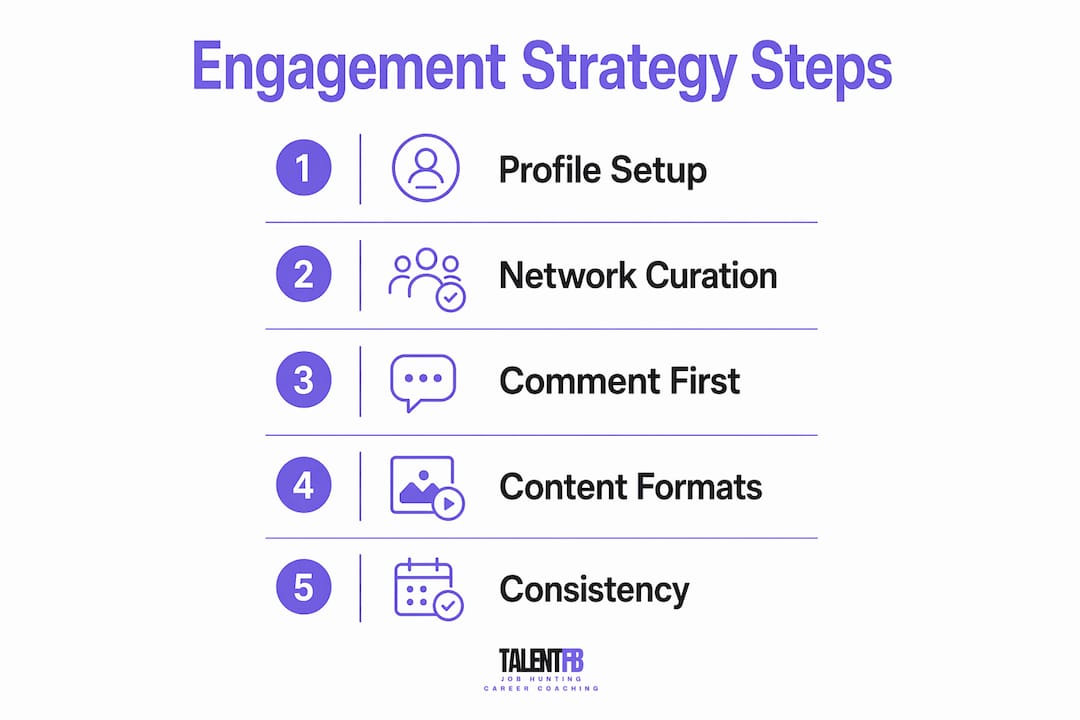
The clients I have seen transform their LinkedIn presence most dramatically all followed the same sequence: profile first, network second, comments third, content fourth. That order is not arbitrary. Each layer amplifies the one that follows. When you get that sequence right, even an average post reaches the right people and generates real conversations.
I also want to be direct about AI content tools. I use them. My clients use them. But the executives who stand out are the ones who use AI to organize their thinking, not to replace it. A post that sounds like it was written by a language model gets scrolled past. A post that sounds like a real person sharing a hard-won observation gets saved and shared.
My honest recommendation: spend the first 30 days doing nothing but optimizing your profile and commenting. Do not post a single piece of original content. Build the foundation first. You will be surprised how much inbound interest that alone generates.
— Frederic Bonifassy
Ready to turn your LinkedIn profile into a business asset?
If this article gave you a clearer picture of what a real LinkedIn engagement system looks like, the next step is putting it into practice with the right support. Building a profile that attracts the right people, curating a network that amplifies your content, and developing a consistent engagement habit are all learnable skills. They go faster with a structured approach.
TalentFB’s Talent/OS™ program is built specifically for CEOs and tech founders who want to rebrand their LinkedIn presence and build a content system that attracts top talent and business opportunities organically. No executive search fees, no advertising spend. Just a clear, proven system applied to your profile and your voice. If you are ready to see what that looks like for your situation, explore the executive LinkedIn coaching program and take the first step toward making LinkedIn work the way it should for your business.
FAQ
What is a b2b LinkedIn engagement strategy?
A B2B LinkedIn engagement strategy is a structured system that combines profile optimization, network curation, deliberate commenting, and consistent content creation to generate qualified business conversations and leads on LinkedIn.
How often should b2b professionals post on LinkedIn?
Posting 2–3 times per week produces the highest engagement results. Posting more than once per day can suppress reach due to LinkedIn’s algorithm penalizing high-frequency posting.
Why do personal profiles outperform company pages on LinkedIn?
Personal profiles generate 5× more engagement and 2.75× more impressions than company pages because LinkedIn’s algorithm favors person-to-person interactions over branded content distribution.
How long does it take to see results from a comment-first strategy?
Consistent commenting for 8–12 weeks significantly increases outreach response rates and builds the network recognition needed for content to gain traction. Results compound over time rather than appearing overnight.
What content format works best for b2b lead generation on LinkedIn?
Carousels and long-form posts consistently perform best for B2B lead generation because they maximize dwell time, which LinkedIn’s algorithm directly rewards with broader distribution.