TL;DR:
- Team coaching involves a coach partnering with a team as a single system to enhance collective dynamics and performance. It focuses on systemic patterns and relationships, with the team generating its own solutions rather than relying on individual interventions or external experts. Most organizations now see team coaching as essential for sustainable growth, especially when lasting improvements are desired.
Team coaching is defined as a structured process in which a professional coach partners with an intact team, treating the group as a single client and system, to strengthen collective dynamics, shared purpose, and overall performance. This is distinct from individual coaching, facilitation, training, or consulting. The ICF defines team coaching as a reflective process that supports team dynamics, relationships, and purpose in ways group training simply cannot replicate. Over 60% of organizations now consider team coaching vital for lasting performance gains. If you lead a team and want to understand what this practice actually involves and whether it is right for your group, this guide gives you the full picture.
What is team coaching and why does it matter?
Team coaching is the practice of working with a group as a unified system rather than coaching each person separately. The coach’s attention goes to patterns, relationships, and collective behaviors, not individual performance gaps. This is the foundational shift that separates team coaching from everything else you may have tried.

The team-as-entity paradigm means the coach treats the team itself as the client. The team does the diagnostic work. The team generates its own solutions. The coach holds the process, not the answers. This matters because most performance problems in teams are systemic, not individual. Fixing one person rarely fixes the team.
Organizations adopt team coaching for a clear reason: individual coaching and one-off workshops produce limited results when the real issue lives in how people work together. A cross-functional product team at a tech company, for example, might have talented individuals who consistently miss deadlines because of unclear decision-making norms, not skill gaps. Team coaching addresses that root cause directly.
The practice has grown significantly in professional coaching circles. The International Coaching Federation (ICF) now publishes dedicated team coaching competencies, which signals how seriously the profession takes this discipline. For managers, understanding this foundation is the first step toward using it well.
What are the core principles of effective team coaching?
Effective team coaching rests on a set of principles that differ meaningfully from one-on-one coaching. Understanding these helps you recognize quality coaching when you see it and set realistic expectations for your team.
The team is the client, not the individuals. This sounds simple, but it changes everything. The coach does not take sides, advocate for any one member, or focus on personal development goals. The coach holds the team’s collective purpose and helps the group see its own patterns more clearly.
Neutrality is non-negotiable. Professional team coaches must balance neutrality with active facilitation of group dynamics, a skill that goes well beyond typical one-on-one coaching. A coach who takes sides, offers opinions on team decisions, or becomes an advocate for a particular outcome has crossed into consulting territory.
Systemic awareness drives the work. The coach tracks energy, alliances, silence, and conflict in real time. These are signals about the system, not just individual behavior. A skilled team coach notices when a team avoids a topic repeatedly and names that pattern without judgment.
Here are the core competencies ICF identifies for qualified team coaches:
- Establishing and maintaining team coaching agreements
- Cultivating trust and psychological safety within the group
- Maintaining presence and active listening across multiple voices
- Facilitating team learning and growth
- Managing group dynamics and interpersonal tension
- Designing team coaching practices and exercises that build capacity
Pro Tip: Many managers confuse team coaching with team building. Team building is an event. Team coaching is an ongoing process. If someone offers you a one-day team coaching workshop, ask hard questions about what happens after day one.
Team coaching vs. facilitation, training, and consulting
Choosing the wrong intervention is expensive. Many organizations spend money on facilitated workshops or consultant-led diagnostics when what they actually need is team coaching, and vice versa. The table below clarifies the key distinctions.
| Method | Who Holds the Content? | Primary Goal | Duration |
|---|---|---|---|
| Team Coaching | The team | Build team capacity and self-sufficiency | Ongoing (months) |
| Facilitation | The facilitator | Guide a specific meeting or session | Single session |
| Training | The trainer | Transfer knowledge or skills | Fixed program |
| Consulting | The consultant | Diagnose problems and prescribe solutions | Project-based |
Consulting diagnoses problems and prescribes solutions. Team coaching facilitates team-generated diagnosis and solutions without the coach controlling the content. That distinction is critical. A consultant tells your team what is wrong and how to fix it. A team coach helps your team figure that out for themselves, which means the insight sticks.
Facilitation sits closer to team coaching but remains event-driven. A skilled facilitator runs a great strategy session. A team coach works across multiple sessions to shift how the team operates at a systemic level. Training transfers knowledge. Team coaching builds the team’s capacity to apply and adapt that knowledge together.
Understanding this difference protects your budget. If your team needs to learn a specific skill, buy training. If your team needs to make a single decision together, hire a facilitator. If your team’s underlying dynamics are limiting performance over time, that is when team coaching delivers real value.
What are the proven benefits of team coaching?
The benefits of team coaching concentrate in five measurable outcome areas: communication quality, decision-making speed, productivity, cross-functional collaboration, and the team’s capacity to generate new ideas. These are not soft outcomes. They show up in project timelines, retention rates, and revenue results.
Here is what organizations consistently report after sustained team coaching engagements:
- Clearer communication norms. Teams develop shared language and agreements about how they give feedback, raise concerns, and escalate decisions.
- Faster, more confident decisions. When roles and authority are clear, teams stop waiting for permission and start acting.
- Higher productivity. Reduced friction in meetings and handoffs translates directly into time saved and output increased.
- Stronger collaboration. Cross-functional teams, which often struggle with competing priorities, build genuine working relationships rather than transactional ones.
- More consistent innovation. Psychological safety, a direct product of good team coaching, is the single biggest predictor of team-level creativity according to Google’s Project Aristotle research.
Over 60% of organizations now view team coaching as vital for lasting performance gains. That adoption rate reflects a broader recognition that one-off interventions do not produce durable change. You can read more about why companies hire coaches and the measurable value they seek from these engagements.
Leadership teams benefit particularly strongly. When the people at the top of an organization model healthy group dynamics, those patterns cascade downward. A leadership team that communicates openly and decides clearly sets the standard for every team below it.
How to implement team coaching that actually lasts
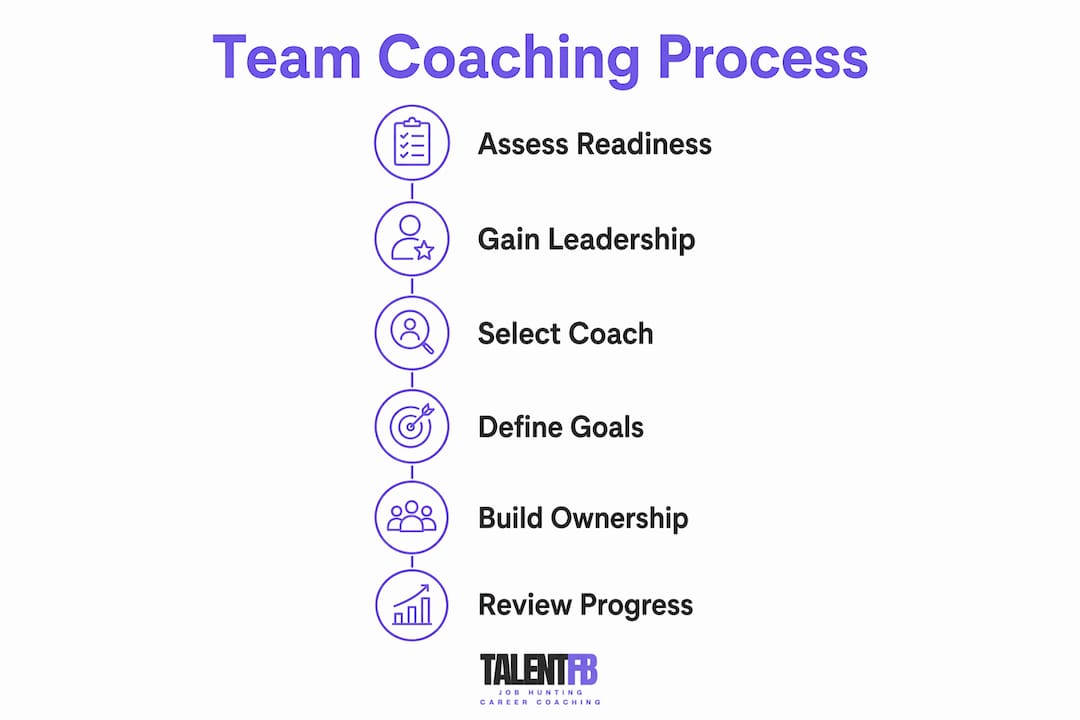
Knowing the theory is one thing. Getting team coaching to work inside a real organization with real pressures is another. Here is a practical sequence that gives you the best chance of sustainable results.
1. Assess team readiness honestly. Team coaching requires a stable group. High turnover and lack of continuity undermine the systemic work team coaching requires for long-term impact. If your team is in the middle of a major restructure, wait. Start when you have a core group that will stay together for at least six months.
2. Secure genuine leadership support. Sustainability of team coaching depends heavily on organizational culture and ongoing leadership support. This means more than budget approval. Leaders need to give teams permission to challenge norms, surface conflict, and experiment with new ways of working. Without that permission, coaching results dissipate quickly.
3. Select a qualified team coach. Look for coaches with specific team coaching credentials, not just individual coaching certifications. ICF’s team coaching competency framework is a useful benchmark. Ask candidates how they handle conflict between team members during a session. Their answer tells you a great deal about their actual skill level.
4. Define the engagement clearly. Set a clear contract that covers the team’s goals, the coach’s role, confidentiality boundaries, and how progress will be measured. Ambiguity here creates problems later.
5. Build team ownership from session one. The team must generate its own insights and commitments. A coach who arrives with a pre-built agenda and a set of prescribed exercises is not doing team coaching. The team’s voice drives the work. You can explore executive coaching methods to understand how structured coaching frameworks support this kind of ownership.
6. Review and sustain. Schedule regular check-ins between formal coaching sessions. Encourage the team to apply what they learn in real work, not just in coaching conversations. The goal is a team that eventually does not need the coach.
Pro Tip: Avoid treating team coaching as a one-time fix for a specific crisis. Teams that enter coaching only when things are broken tend to use sessions for venting rather than growth. The best results come when coaching starts before the crisis hits.
What i’ve learned about team coaching after 15 years in hiring rooms
Here is my honest take: most managers I have worked with across tech, fintech, and adtech in APAC underestimate how much team dynamics shape individual performance. They spend significant energy coaching their best people one-on-one, then wonder why the team still underperforms. The issue is almost never the individuals. It is the system those individuals operate inside.
The biggest shift I have seen in leaders who embrace team coaching is that they stop trying to fix people and start getting curious about patterns. Why does this team always defer to one voice? Why does conflict get avoided until it explodes? Those questions live at the team level, not the individual level.
I have also seen team coaching fail, and it almost always fails the same way. Leadership approves the budget, the coach runs a few sessions, and then the organization returns to business as usual. The team made progress in the room but had no permission to apply it outside. Without real leadership support allowing teams to challenge norms, coaching results dissipate quickly. That is not a coaching problem. That is a culture problem.
My recommendation to any manager considering this: start by reading about senior leaders and coaching to understand your own role in the process. You are not a passive sponsor. You are a participant in the system your team coach is trying to shift. The more clearly you understand that, the better the outcomes for everyone.
Team coaching is not a quick fix. It is a partnership. And like any good partnership, it requires honesty, commitment, and patience from both sides.
— Frederic Bonifassy
Ready to strengthen your leadership impact through coaching?
Understanding team coaching is the first step. Applying it as a leader is where the real growth happens. TalentFB works with senior tech professionals and executives across APAC to build the leadership presence and career clarity that makes coaching investments pay off.
Whether you are a Director, VP, or Senior Manager looking to lead more effectively or advance your career, TalentFB’s structured approach gives you a clear path forward. Explore the career coaching guide built specifically for tech executives, or discover why coaching unlocks leadership growth for leaders operating in competitive markets. The teams that perform best are almost always led by people who invest in their own development first.
FAQ
What is the team coaching definition in professional practice?
Team coaching is a reflective, ongoing process in which a qualified coach works with an intact team as a single system to improve dynamics, relationships, and collective performance. The ICF distinguishes it from group training by its focus on the team’s own capacity to generate solutions.
How does team coaching differ from facilitation?
Facilitation guides a specific meeting or session, while team coaching spans multiple sessions to shift how a team operates at a systemic level. A facilitator manages a process for one event. A team coach builds the team’s long-term capacity to manage its own processes.
What are the main benefits of team coaching for organizations?
The five core benefits of team coaching are improved communication, faster decision-making, higher productivity, stronger collaboration, and greater capacity for innovation. These outcomes are most durable when coaching is sustained over several months with consistent leadership support.
How long does a typical team coaching engagement last?
Most effective team coaching engagements run for six months to a year, with regular sessions spaced across that period. Shorter engagements rarely produce systemic change because the team needs time to practice new behaviors between sessions.
What makes a team ready for coaching?
A team is ready for coaching when it has a stable membership, a genuine performance challenge to work on, and leadership support that gives the team permission to surface conflict and challenge existing norms. Teams in the middle of major restructuring or with high turnover are not yet ready for this work.