TL;DR:
- Change management coaching develops leaders and employees by fostering psychological safety, reflection, and accountability during organizational change. It supports every phase of the change process, from pre-launch to sustainment, by adapting to individual needs and building lasting behaviors. Research confirms coaching significantly enhances performance, emotional competence, and transformation success.
Change management coaching is the practice of developing leaders and employees through organizational transformation by building psychological safety, reflection, and accountability to achieve sustained success. Unlike consulting, which delivers structured plans, or training, which transfers skills, coaching works on the person executing the change. The role of coaching in change management is to close the gap between knowing what needs to happen and actually doing it under pressure. Research across 54 studies and 11 randomized controlled trials confirms coaching produces a moderate positive effect on professional performance, emotional competence, and goal attainment. That evidence base makes coaching one of the most defensible investments an executive can make during a transformation.
How coaching integrates across the change management lifecycle
Coaching is not a one-time event. It is a thread woven through every phase of a change initiative, from the first planning meeting to the final sustainment review.
The Association of Change Management Professionals (ACMP) model identifies distinct stages: pre-launch, implementation, and sustainment. Coaching serves a different function at each stage, and embedding it early across all three phases produces the strongest results.
Here is how that integration works in practice:
-
Pre-launch. Coaching builds the leadership habits and mindset that change requires before pressure arrives. A VP leading a digital transformation, for example, benefits from coaching on how to communicate vision credibly and hold space for team uncertainty before the rollout begins.
-
Mid-initiative. Adoption slowdowns and resistance spikes are predictable. Coaching at this stage shifts leaders from reactive problem-solving to reflective sense-making. Instead of asking “Why are people pushing back?” a coached leader asks “What unmet need is this resistance pointing to?”
-
Sustainment. Behavior change regresses without reinforcement. Coaching during sustainment keeps leaders accountable to new ways of working and prevents the drift back to old habits that derails so many transformations.
The critical distinction from consulting is adaptability. A consultant follows a structured framework. A coach adapts to the person and the moment. Both are necessary, but only coaching addresses the relational and behavioral conditions that determine whether change actually sticks.
Pro Tip: Schedule coaching touchpoints at what practitioners call “behavioral inflection points,” the moments just before a major milestone or decision. These are the highest-leverage times to reinforce new behaviors and prevent regression under pressure.
What mechanisms make coaching so effective during change?
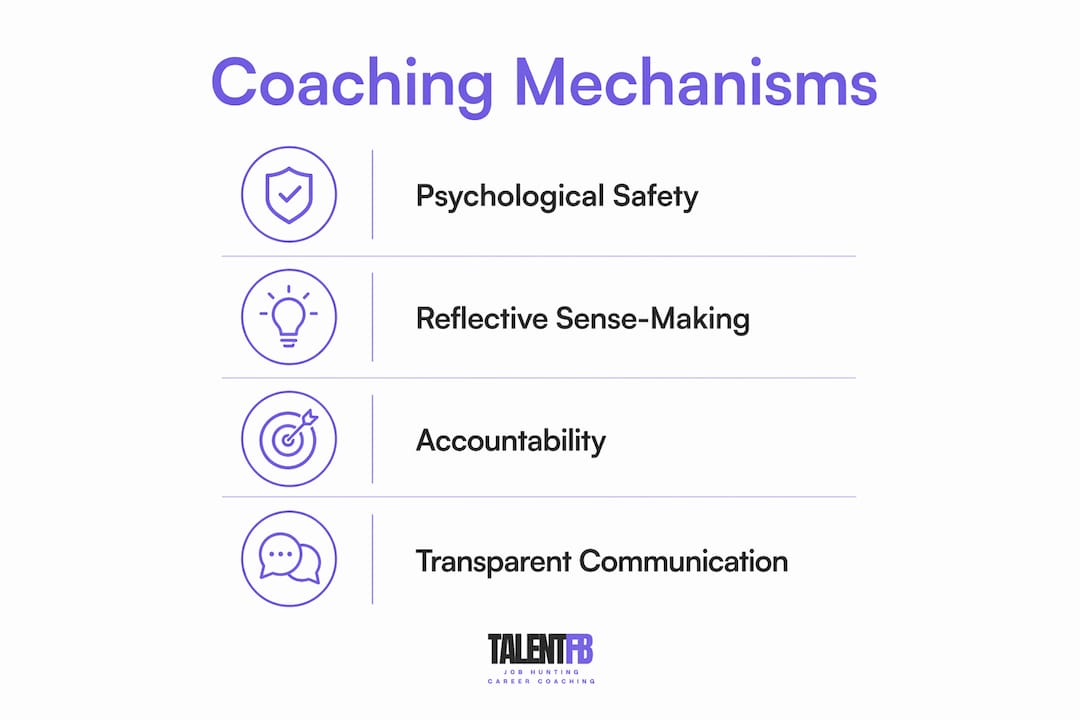
Coaching works through three interconnected mechanisms: psychological safety, reflective sense-making, and accountability. Understanding these helps you invest in coaching with clarity rather than faith.

Psychological safety is the foundation. A meta-synthesis of 35 studies identifies trust and psychological safety as the essential enabling conditions for deep change through coaching. Without them, leaders and employees protect themselves rather than grow. Coaching creates a confidential, non-evaluative space where honest reflection becomes possible.
Reflective sense-making is what happens inside that safe space. Change generates ambiguity, and ambiguity generates anxiety. Coaching gives leaders a structured way to process uncertainty, interpret resistance constructively, and reconnect their decisions to the organization’s purpose. This is not therapy. It is disciplined thinking with a skilled partner.
Accountability converts reflection into action. A coaching relationship creates a recurring commitment loop. You articulate what you will do differently, and you return to report what actually happened. That loop builds the self-awareness and decision-making discipline that change demands.
The organizational outcomes are measurable. Research shows leadership coaching competencies strengthen psychological empowerment and organizational agility, both of which mediate improved transformation performance. Agility here means the capacity to adjust course quickly when conditions change, which is exactly what complex transformations require.
“The critical factor making coaching effective in change is not just labeling it coaching, but the quality of relational conditions — trust and psychological safety — that enable reflection to translate into action.” (Source)
One more mechanism deserves attention: the pairing of coaching with transparent communication. Employees’ affective commitment to change increases most when they receive clear, timely information about what is happening and why. Coaching amplifies that commitment but does not replace the need for honest, direct communication from leadership.
Coaching vs. consulting vs. training: what is the real difference?
Executives often treat coaching, consulting, and training as interchangeable. They are not. Each serves a distinct purpose, and confusing them leads to misallocated budgets and disappointing results.
| Dimension | Consulting | Training | Coaching |
|---|---|---|---|
| Primary purpose | Deliver expert recommendations | Transfer knowledge and skills | Develop adaptive leader behavior |
| Direction of expertise | Consultant to organization | Trainer to participant | Co-created between coach and leader |
| Timing | Project-based, front-loaded | Event-based, scheduled | Ongoing, lifecycle-aligned |
| Output | Plans, frameworks, reports | Competency gains, certifications | Behavioral change, self-awareness |
| Best for | Diagnosing problems, designing solutions | Building specific capabilities | Sustaining change and leadership growth |
Consulting delivers the map. Training teaches the skills to read it. Coaching builds the leader who can navigate when the map runs out. All three matter in a serious transformation, but only coaching addresses the relational and behavioral conditions that determine whether change sustains beyond the project close date.
The Coach Approach framework from the International Coaching Federation (ICF) captures this distinction clearly. It shifts leaders from giving answers to asking questions, from directing to listening, and from managing compliance to building ownership. That shift is not soft. It is the difference between a team that executes because they are told to and a team that executes because they understand why.
Pro Tip: If your organization has invested heavily in consulting and training but change adoption is still lagging, the missing piece is almost certainly coaching. Bring a coach in at the mid-initiative phase and focus specifically on the leaders who are closest to the resistance.
Practical coaching techniques for executives and managers during change
You do not need to be a certified coach to apply coaching principles in your leadership. The following techniques are grounded in evidence and immediately applicable.
-
Adopt the Coach Approach mindset. Stop leading every conversation with answers. Ask reflective questions instead. “What do you think is driving the resistance here?” generates more useful information than “Here is how we handle resistance.” The ICF Coach Approach shows this shift builds trust, clarity, and ownership across change models.
-
Listen at the level of meaning, not just content. When a team member says “I am not sure this will work,” they are often communicating fear, not skepticism. Coaching-informed listening means hearing the emotion beneath the words and responding to both.
-
Treat resistance as diagnostic data. Resistance during change signals unmet needs, not opposition. When you approach a resistant employee with curiosity rather than pressure, you often discover a legitimate concern that, once addressed, removes the obstacle entirely.
-
Time your coaching conversations strategically. Repeatable cycles of reflection and behavioral adjustment at key inflection points prevent regression to old habits. Build brief coaching check-ins into your regular one-on-ones, especially in the weeks before and after major milestones.
-
Integrate coaching with your change artifacts. Do not treat coaching as a separate activity. Connect it directly to your readiness assessments, vision narratives, and implementation plans. When a leader’s coaching goals map to the change management artifacts your team is already using, coaching gains credibility and traction.
-
Pair coaching with transparent communication. Coaching builds emotional resilience. Clear information builds cognitive commitment. You need both. Leaders who coach their teams while also keeping them fully informed see the strongest gains in employee commitment to change.
The research is clear on timing: sustained, individualized coaching aligned with change phases outperforms short-term, generic coaching programs. Invest in depth, not breadth.
What i have learned about coaching and change after 15 years in the room
After spending 15 years inside hiring rooms across tech, fintech, and adtech in APAC, I have watched more transformations succeed and fail than I can count. The pattern is almost always the same. Organizations invest heavily in the strategy and the process. They hire consultants, run training programs, and build detailed change plans. Then they wonder why adoption stalls six months in.
The answer, almost every time, is that they treated coaching as optional. They brought in a coach for the CEO and called it done. The middle layer of directors and senior managers, the people who actually translate strategy into daily behavior, never received the same support.
Here is what I believe, based on what I have seen: coaching is not a luxury for the top of the house. It is a necessity for every leader who carries change accountability. And the biggest mistake I see is waiting until resistance becomes visible before starting coaching. By then, you are managing a crisis instead of building capability.
The other pitfall I see constantly is separating coaching from the actual work of change. Coaching conversations that happen in isolation from readiness assessments, vision documents, and implementation plans feel abstract to leaders under pressure. When you connect coaching directly to the artifacts your team is already using, it becomes practical and credible.
My honest recommendation: build a coaching culture, not just a coaching program. That means training your senior managers to use coaching behaviors in everyday conversations, not just in formal sessions. It means rewarding curiosity and reflection as leadership competencies. And it means starting early, before the pressure peaks, so your leaders have the capacity to hold space for their teams when things get hard. If you want to understand how coaching drives leadership growth in high-stakes environments, that investment pays back in ways that no consulting engagement can replicate.
— Frederic Bonifassy
Ready to build your leadership capacity for change?
If this article has confirmed what you already suspected, that your organization’s change results depend more on leader behavior than on strategy quality, then the next step is getting the right coaching support in place.
TalentFB works with senior tech executives and managers who are navigating exactly this challenge. Whether you are leading a transformation, preparing for a leadership transition, or building the capability to drive change at scale, the executive coaching guide for tech leaders is a practical starting point. You can also explore why companies hire coaches to understand the business case in concrete terms. The leaders who invest in coaching before the pressure peaks are the ones who deliver change that actually lasts.
FAQ
What is the role of coaching in change management?
Coaching in change management develops the leaders and employees who execute transformation by building psychological safety, reflective thinking, and accountability. It closes the gap between knowing what change requires and actually sustaining new behaviors under pressure.
How does coaching differ from consulting in a change initiative?
Consulting delivers expert recommendations and structured plans. Coaching unlocks leaders’ own insights through reflective questioning, building the adaptive behavior and ownership that sustains change after the consultant leaves.
When should coaching be introduced during a change program?
Coaching produces the strongest results when introduced at pre-launch and maintained through implementation and sustainment. Starting early prevents resistance from becoming entrenched and builds leadership capacity before pressure peaks.
What coaching techniques work best for managing resistance to change?
Treating resistance as diagnostic feedback rather than opposition is the most effective technique. Coaching-informed leaders ask what unmet need the resistance signals, then address that need directly through reflective conversation and transparent communication.
Does coaching actually improve organizational performance during change?
Yes. A meta-review of 54 studies covering 15,278 participants found coaching produces a measurable effect on professional performance, emotional competence, and goal attainment, with the strongest results from sustained, individualized programs aligned with organizational timelines.