TL;DR:
- Digital skills for executives include understanding technology, leading change, and communicating effectively. These skills directly influence organizational transformation and AI governance. Building continuous learning habits helps leaders adapt and align digital initiatives with strategic goals.
Digital skills for executives are defined as the competencies that enable senior leaders to guide technology adoption, make informed decisions about digital investments, and build organizations that adapt to change. The role of digital skills for executives goes far beyond knowing how to use software. MIT Sloan research shows that CEO-led digital transformation efforts reach progress levels 5–6 on a 1–6 scale at a meaningfully higher rate than those without C-suite ownership. That finding tells you something direct: your personal digital dexterity shapes your organization’s results. A KPMG 2025 survey of 1,350 CEOs found that 71% name AI as a top investment priority, yet only 23% identify digital literacy as a core leadership skill. That gap is where transformation stalls.
What is the role of digital skills for executives?
Digital skills for executives are not a single capability. They form a three-part framework, and understanding all three parts is what separates leaders who drive change from those who watch it happen.
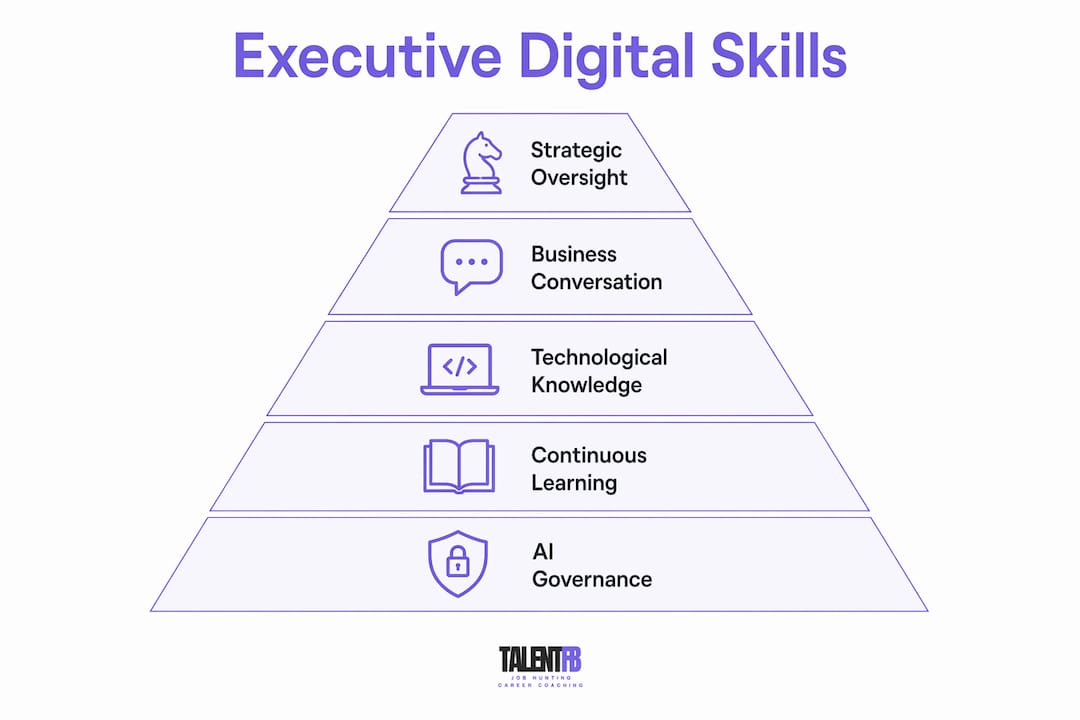
Springer Nature research published in 2026 identifies three interconnected pillars of digital managerial competence:
- Technological knowledge: Understanding how digital tools, AI systems, data platforms, and automation work at a conceptual level. You do not need to write code. You do need to know what these systems can and cannot do.
- Management and leadership skills: The ability to set a digital vision, manage change, allocate resources toward technology initiatives, and hold teams accountable for digital outcomes.
- Soft skills: Communication, ethical decision-making, and the ability to build trust in digital environments. These matter especially when managing distributed or hybrid teams.
The research is clear that technological knowledge alone is not enough. Leaders who combine all three pillars outperform those who focus on technical knowledge in isolation. A VP who understands AI capabilities but cannot communicate the business case or manage the cultural resistance will fail at implementation just as surely as one who has never heard of machine learning.
Pro Tip: Map yourself against these three pillars honestly. Most executives are strong in one, adequate in another, and weak in the third. Knowing your gap is the first step to closing it.

How do digital skills shape executive decision-making and AI leadership?
The most consequential application of digital skills at the C-suite level is not tool selection. It is judgment. LSE Executive Education is direct on this point: effective AI leadership focuses on informed oversight and strategic judgment, not technical coding ability.
What does that look like in practice? It means asking the right questions before approving an AI initiative:
- Does the data used to train this model reflect our actual customer base?
- What are the failure modes, and who owns accountability when they occur?
- How does this initiative connect to a measurable business priority?
- What governance structure ensures ongoing oversight rather than a one-time review?
Egon Zehnder’s research on board-level AI governance makes a distinction that every executive should internalize: strategic oversight and operational execution are different responsibilities. Confusing the two produces governance failures. The board sets the guardrails. The operating team runs within them. When executives blur that line, they either micromanage implementation or abdicate responsibility for outcomes.
The practical implication is that your highest-value digital skill is the ability to conduct a rigorous business conversation about a digital investment. Research from TheCaseHQ confirms that executives assessed for digital readiness perform best when they can question business value, ROI assumptions, and data quality. Product knowledge is secondary. Decision quality is primary.
Pro Tip: Before approving any digital project, require a one-page brief that answers three questions: What is the measurable outcome? What data proves the assumption? Who owns the result? If the team cannot answer all three, the project is not ready.
What organizational outcomes are linked to executive digital skills?
The business case for building digital competencies at the top is well supported by data. MIT Sloan’s findings show that 35% of companies had CEO-led digital transformation, and those companies reached the highest progress levels on a 1–6 scale at a rate of 30%. That is not a coincidence. It reflects the direct influence of executive digital dexterity on organizational momentum.
The picture gets more complex when you look at AI specifically. Accenture’s 2025 survey of 3,450 C-suite leaders across 22 industries found that 54% see strong potential value in generative AI, but 28% cite data or infrastructure limitations as the primary barrier to scaling. That gap between ambition and execution is a digital skills problem as much as a technology problem. Leaders who cannot diagnose infrastructure constraints cannot fix them.
| Outcome area | What the research shows |
|---|---|
| Transformation progress | CEO-led efforts reach top progress levels at 30% (MIT Sloan) |
| AI investment | 71% of CEOs prioritize AI; only 23% prioritize digital literacy (KPMG) |
| GenAI scaling barriers | 28% of C-suite cite data/infrastructure limits (Accenture) |
| Sustainable growth | Digital leadership dimensions correlate with platform digitization capability (Scientific Reports) |
Scientific Reports research published in 2026 identifies five dimensions of digital leadership that connect directly to sustainable growth: digital communication, motivation, team building, technical expertise, and trust. The same research notes that investments in digital infrastructure and talent development amplify the benefits of strong digital leadership. In other words, a digitally skilled executive who also invests in their team’s capabilities produces compounding returns.
“Digital leadership and sustainable growth are not separate agendas. The data shows they reinforce each other when executives build both their own skills and their organization’s infrastructure simultaneously.” — Scientific Reports, 2026
How can executives build and sustain their digital skills?
Digital skill development is not a training event. MIT Sloan is explicit that culture change requires ongoing commitment and leadership modeling sustained over time. The executives who build lasting digital capability treat learning as an operating rhythm, not a quarterly program.
Here is a practical sequence for building that rhythm:
- Audit your current competencies. Use the three-pillar framework from Springer Nature as your checklist. Be honest about where you rely on others to translate technical concepts for you.
- Participate in hands-on learning. Attend internal hackathons. Sit in on data reviews. Use the AI tools your teams use, even briefly. Direct exposure builds intuition that briefings cannot replicate.
- Make data-driven decisions visibly. When you base a decision on data, say so explicitly in team meetings. This models the behavior you want to see across the organization.
- Build digital capability into your talent management approach. Upskilling your team is not separate from your own development. Leaders who invest in their people’s digital skills create environments where their own judgment improves through better information.
- Review and revise regularly. Set a quarterly check-in to assess which digital skills are becoming more relevant to your business and adjust your learning priorities accordingly.
The digital transformation guide from TandT LLC reinforces that leaders who model continuous learning create organizations that adapt faster. The modeling effect is real. When your team sees you asking hard questions about data quality and ROI, they start asking the same questions.
Pro Tip: Integrate digital skill criteria into your leadership development reviews. Ask every direct report: “What digital capability have you built this quarter?” It signals that digital learning is a leadership expectation, not an optional extra.
For executives thinking about how to position their digital competencies externally, optimizing your LinkedIn profile to reflect your digital leadership experience is a practical first step. The way you present your skills shapes how the market perceives your readiness for the next level.
What I have learned about digital skills after 15 years in hiring rooms
After spending 15 years evaluating executives across tech, fintech, adtech, and maritime-tech in APAC, I have a clear opinion on this: the executives who struggle most with digital transformation are not the ones who lack technical knowledge. They are the ones who confuse confidence with competence.
I have seen C-suite leaders approve AI initiatives because a vendor demo looked impressive, without ever asking about data provenance or failure scenarios. I have also seen technically sophisticated executives who could not communicate a digital vision to their board or their frontline teams. Both types fail, just in different ways.
The executives who succeed share one habit: they stay genuinely curious. They ask questions that feel uncomfortable. They admit when they do not understand something and then go learn it. That posture, more than any specific technical skill, is what separates the leaders who drive transformation from those who delegate it and hope for the best.
My honest recommendation is this: do not wait for your organization to build a digital skills program for you. Take ownership of your own development. Read the research. Sit with your data teams. Question your own assumptions about what AI can deliver. The importance of digital skills for leaders is not a future concern. It is a present-day competitive reality.
The executives I coach who advance fastest are the ones who treat their digital literacy as a leadership asset, not a technical checkbox. They build it deliberately, model it visibly, and embed it into how their organizations make decisions.
— Frederic Bonifassy
How TalentFB helps tech executives build digital leadership
Senior tech executives navigating career transitions or leadership growth need more than general advice. They need a structured approach that connects digital competencies to real career outcomes.
TalentFB works with Directors, VPs, and Senior Managers who want to position their digital leadership skills as a competitive advantage in the market. The career coaching guide for tech executives covers how to articulate your digital competencies in ways that resonate with hiring managers and boards. With 350+ professionals coached and a track record of helping leaders land roles with a 20–30% salary increase within 90 days, TalentFB brings a hiring-room perspective that most coaching programs simply do not have. If you are ready to turn your digital leadership experience into your next career move, the 2026 career advancement roadmap is a strong place to start.
FAQ
What are digital skills for executives?
Digital skills for executives, also called digital dexterity, are the competencies that enable senior leaders to guide technology adoption, govern AI initiatives, and make data-informed decisions. They span technological knowledge, leadership skills, and soft skills like communication and ethical judgment.
Why do digital skills matter for C-suite leaders?
CEO-led digital transformation efforts reach the highest progress levels at a significantly higher rate than those without C-suite ownership, according to MIT Sloan research. Digital skills directly determine how effectively executives can drive organizational change.
Do executives need to know how to code?
No. LSE Executive Education confirms that effective AI leadership at the executive level is about informed oversight and strategic judgment, not technical coding ability. The priority is asking the right questions, not building the technology.
How does digital literacy affect AI governance?
Egon Zehnder’s research shows that effective AI governance requires a clear separation between strategic oversight and operational execution. Executives who blur these roles create governance failures that undermine AI initiatives.
How can executives develop digital skills continuously?
MIT Sloan recommends treating digital skill development as an ongoing operating rhythm rather than a one-time program. Practical methods include participating in data reviews, attending hackathons, and embedding digital learning expectations into leadership development processes.