Culture fit is whether a person’s core values and working behaviors align with how your organization actually operates — not whether they remind you of your best employee. If you want to act on this today, do two things right now: write down your top three organizational values in plain language, and add one behavioral question to your next interview panel that asks for evidence of those values in action. The sample questions, scoring rubric, and post-hire measurement tools are all further down in this article.
Table of Contents
- What “culture fit” really means in hiring
- Why culture fit matters for retention and team performance
- Where traditional “culture fit” goes wrong
- Culture fit vs. values fit vs. culture add: which one to use
- How to assess values fit in interviews
- How to operationalize values-based hiring across your process
- How to measure and monitor culture fit after hire
- Research and expert takeaways that support values-based hiring
- Practical safeguards to reduce bias and stay compliant
- My honest take on what actually moves the needle
- TalentFB helps hiring teams and senior professionals get this right
- Frequently asked questions about culture fit
- Sources
What “culture fit” really means in hiring
Culture fit describes the degree to which a candidate’s values, decision-making habits, and working style align with the norms and expectations that define how your organization functions. It is not about personality, background, or whether someone laughs at the same jokes as the hiring manager.
The confusion comes from conflating two very different things: values fit and sameness fit. Values fit asks whether a person will thrive under your operating principles. Sameness fit asks whether they feel familiar. One predicts performance; the other predicts comfort.
| Dimension | Values/Role Fit | Sameness-Based Fit |
|---|---|---|
| Core question | “Do their values match how we work?” | “Do they feel like one of us?” |
| What it measures | Documented behaviors tied to stated values | Rapport, shared background, gut instinct |
| Bias risk | Low when structured | High — favors the familiar |
| Diversity impact | Supports inclusion | Undermines it |
| Predictive validity | Stronger for retention and integration | Weak; correlates with homogeneity |
A good values fit looks like this: a candidate for a senior product role describes a time they pushed back on a feature request with data, even when leadership disagreed. If your organization values evidence-based decision-making, that story is concrete behavioral evidence of alignment. A misleading rapport fit looks like this: an interviewer walks out of a room saying “I just really liked them” — with no behavioral evidence to back it up. Academic research on matching people to organizations documents exactly this trade-off: better integration when fit is values-based, reduced creativity and inclusion when fit is used to enforce sameness.

Why culture fit matters for retention and team performance
When values alignment is real, people stay longer, collaborate more naturally, and reach full productivity faster. When it is absent, the cost shows up quickly. Candidates who feel disconnected from a company’s culture are significantly more likely to leave within the first year, which drives up recruitment and onboarding costs before a new hire has delivered any meaningful output.
The business case is not abstract. A peer-reviewed review of organizational culture and employee outcomes finds consistent links between culture, engagement, and performance. Teams with strong values alignment tend to resolve conflict faster, share information more openly, and require less managerial intervention to stay on track.
Statistic to know: Research consistently links poor organizational culture fit to elevated turnover and lower engagement scores, two of the most expensive line items in any HR budget.
The benefits compound over time. A new hire who understands and shares your operating norms onboards faster because they are not spending energy decoding unwritten rules. They contribute to team cohesion rather than disrupting it. And when performance issues do arise, values-aligned employees tend to respond better to feedback because they understand what the organization is trying to achieve. For deeper context on diversity in tech talent acquisition, the same logic applies: teams built on shared values, not shared demographics, outperform on both cohesion and innovation.
Where traditional “culture fit” goes wrong
The problem is not the concept. The problem is how most hiring teams apply it.
- Rapport-based hiring: Interviewers confuse “I liked talking to them” with evidence of values alignment. Behavioral rapport is a poor predictor of long-term job performance.
- Homophily: Hiring managers tend to prefer candidates who are similar to themselves in background, communication style, or social cues. Research cited by the BBC confirms this pattern is widespread and largely unconscious.
- Vague values: When an organization’s values are generic (“we value integrity, teamwork, excellence”), interviewers fill the gap with subjective impressions. Without behavioral anchors, “fit” becomes a mirror for bias.
- Proxy discrimination: Rejecting a candidate for “not being a culture fit” without documented behavioral evidence can mask discrimination based on protected characteristics. This is a legal and ethical liability.
The legal guardrail is straightforward: never use culture fit as a reason to reject a candidate unless you can point to a specific, documented behavioral gap tied to a stated organizational value. Asking candidates about their hobbies, family situation, or social habits to assess “fit” creates discrimination risk under Title VII of the Civil Rights Act and equivalent statutes. The constructive alternative is not to abandon fit assessments — it is to replace gut-based fit with values-fit and culture-add frameworks, which the next section covers directly. HBR’s analysis makes the case plainly: unstructured fit hiring thwarts diversity efforts, while structured, values-aligned assessments protect inclusion.
Culture fit vs. values fit vs. culture add: which one to use
These three terms are often used interchangeably, but they describe meaningfully different hiring lenses.
Culture fit (traditional) asks whether a candidate resembles the existing team. It is the most common framing and the most prone to bias.
Values fit asks whether a candidate’s core principles align with the organization’s documented values. It is the most defensible and the most predictive when applied with structure.
Culture add reframes the question entirely: instead of “Are they like us?”, it asks “What perspective, skill, or working style does this person bring that our team currently lacks?” This is the approach that protects against homogenization while still maintaining alignment on what matters most.
The field is shifting toward values fit and culture add for good reason. Here is a practical decision guide:
- Early-stage startup: Prioritize values fit above all. With a small team, misaligned values create friction that slows everything down. Culture add is secondary but worth considering for founding team diversity.
- Scaling tech company (50–500 people): Balance values fit with culture add. You need alignment on operating principles, but you also need people who challenge the existing playbook.
- Regulated industry (finance, healthcare, legal): Role fit and values fit take precedence. Compliance-driven environments need people who respect process. Culture add is still valuable, but within tighter behavioral parameters.
- Senior or C-suite hire: Culture add often matters more than fit. Leaders are supposed to shift culture, not just reflect it. See TalentFB’s C-suite hiring tips for HR leaders for how to navigate this balance at the executive level.
How to assess values fit in interviews
Structured behavioral interviews are the most reliable tool you have. The goal is to collect specific, past-behavior evidence tied to each of your documented values, not general impressions.
Behavioral question bank (mapped to values)
- Transparency: “Tell me about a time you shared bad news with your team before you had a solution. What did you say, and how did the team respond?”
- Accountability: “Describe a project where something went wrong because of a decision you made. What did you do next?”
- Collaboration: “Give me an example of a time you had to work with someone whose approach was very different from yours. How did you handle it?”
- Intellectual honesty: “Tell me about a time you changed your position on something important because of new evidence. What convinced you?”
- Customer focus: “Describe a situation where you had to balance what a customer wanted with what was actually feasible. How did you decide?”
- Resilience: “Walk me through a period when your work environment was highly uncertain or unstable. How did you stay effective?”
- Initiative: “Tell me about something you built or changed at work that nobody asked you to do. What drove you to act?”
- Feedback orientation: “Describe the most useful piece of critical feedback you have received. How did you apply it?”
- Ethical judgment: “Tell me about a time you were asked to do something that felt wrong. What did you do?”
- Speed vs. quality trade-off: “Give me an example of a time you had to ship something imperfect to meet a deadline. How did you decide where to draw the line?”
Pro Tip: Map each question to one specific organizational value before the interview. If you cannot name which value a question tests, cut it. Unmapped questions drift toward rapport.
Scoring rubric (1–4 scale)
| Score | Label | Behavioral anchor |
|---|---|---|
| 4 | Strong evidence | Specific situation, clear action, measurable outcome; behavior directly reflects the stated value |
| 3 | Adequate evidence | Situation described but outcome vague; behavior partially reflects the value |
| 2 | Weak evidence | Generic or hypothetical answer; no clear behavioral link to the value |
| 1 | No evidence | Deflects, gives non-answer, or describes behavior that contradicts the value |
Calibration tip: Before the panel debrief, have each interviewer score independently. Only then compare scores. This prevents the first voice in the room from anchoring everyone else’s judgment.
Panel interview checklist
- Assign each interviewer a specific value to probe — no overlap, no gaps.
- Brief the panel on the rubric before the interview, not after.
- Debrief within 24 hours while behavioral evidence is still fresh.
- Psychometric assessments can complement behavioral interviews, especially for senior roles where self-report bias is higher.
How to operationalize values-based hiring across your process
Getting this right takes more than good interview questions. It requires a process that holds across every hire, every panel, and every recruiter.
- Document your values. Write down no more than five core values in behavioral terms. “We value transparency” becomes “We share information proactively, even when it is uncomfortable.” This is the foundation everything else rests on.
- Map values to roles. Not every value is equally critical for every role. A customer-facing role weights customer focus heavily; an internal engineering role may weight intellectual honesty and initiative more. Build a role-specific values map for each job family.
- Update job description language. Describe the working environment and decision-making norms in the JD. Candidates self-select more accurately when they understand what the culture actually demands.
- Build scorecards. A usable scorecard includes: candidate name, role, interviewer name, date, values assessed, question asked, candidate response summary, score (1–4), and a one-sentence behavioral justification for the score.
- Train interviewers. Cover three things: how to ask behavioral questions without leading, how to score against anchors rather than impressions, and how to run a calibration debrief. Harvard DCE’s guidance on workplace culture reinforces the operational point: aligning hiring and reward systems to the same values is what makes the whole system coherent.
- Run calibration sessions. Take a past hire (good or poor outcome) and have the panel score them retrospectively using the new rubric. Compare scores and discuss gaps. This is the fastest way to align interviewer judgment before it matters.
For teams scaling this across many hires, TalentFB’s guide to scalable hiring covers how to maintain structured reliability as volume grows.
How to measure and monitor culture fit after hire
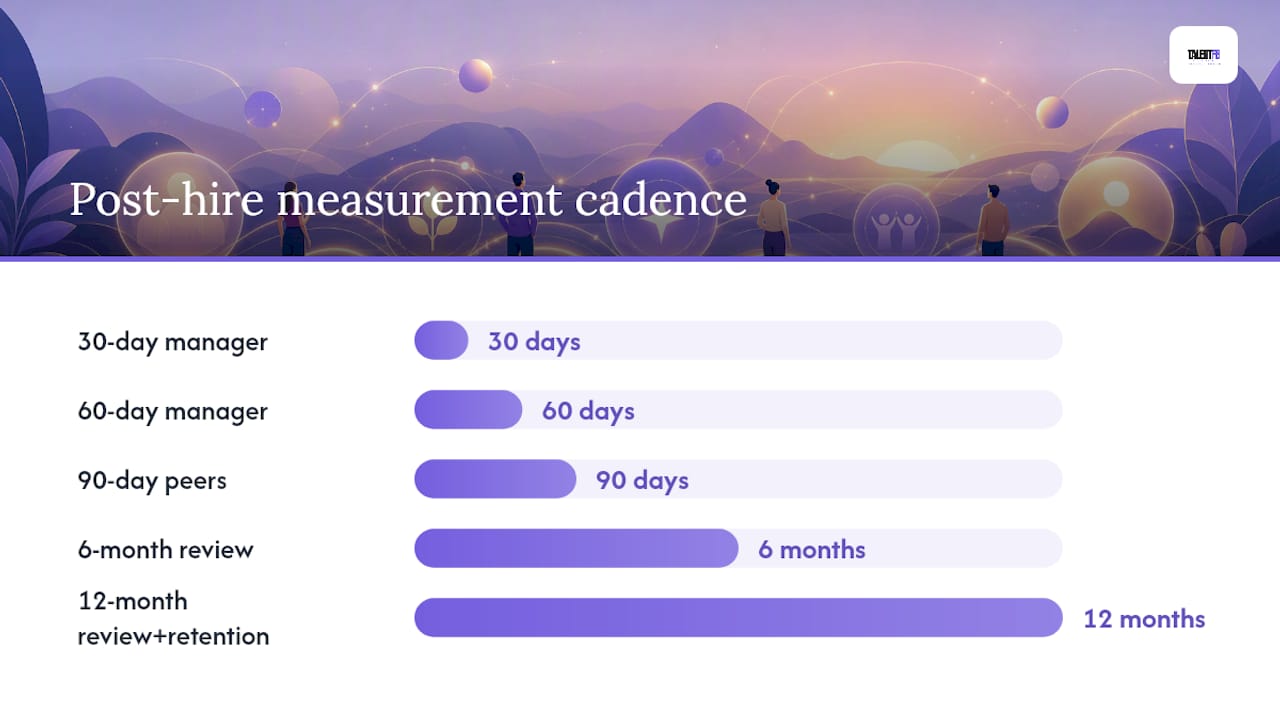
Hiring well is only half the equation. Tracking values alignment after someone joins tells you whether your assessment process is working and catches problems before they become turnover.
Key metrics and signals to track:
- 30/60/90-day manager check-ins: Ask the manager three questions at each milestone: Is the new hire operating in line with our stated values? Are there any behavioral signals that concern you? What support does this person need to integrate well?
- Peer feedback themes: At the 90-day mark, gather informal feedback from two or three teammates. Look for patterns around collaboration, communication style, and how the new hire handles disagreement.
- Engagement indicators: Participation in team rituals, willingness to raise concerns, and proactive communication are early signals of values alignment. Withdrawal, silence in meetings, or frequent escalations can indicate the opposite.
- Retention at 12 months: Track first-year attrition by hiring cohort and by which interviewer or panel made the hire. Patterns here reveal where your assessment process has gaps.
- Performance review alignment: Compare values-fit scores from the interview with performance review ratings at 6 and 12 months. Over time, this tells you which values and which questions are actually predictive.
Stanford GSB research on person-culture fit documents that fit influences group processes and cohesion, which means post-hire signals are not just HR metrics — they are leading indicators of team effectiveness. Pair this measurement cadence with employee retention strategies that reinforce values alignment through onboarding and early development.
Red flags and what to do:
- A new hire who avoids team interactions in the first 30 days: schedule a direct conversation, not a performance review.
- Repeated feedback that someone “doesn’t communicate the way we do”: check whether the issue is values misalignment or onboarding failure. These require different responses.
- A manager who says “they’re technically great but something feels off”: push for behavioral specifics before acting. Vague discomfort is not a values-fit gap; it may be bias.
Research and expert takeaways that support values-based hiring
The shift from gut-based fit to structured values assessment is not a trend. It is backed by a consistent body of research.
Wharton professor Sigal Barsade’s work makes the operational case clearly: when organizational values are written down and tied to strategy, they can be assessed through behavioral evidence. Without that structure, “fit” reflects bias or vague gut instinct. Her recommendation is practical: limit your core values to a small, memorable set, and build every interview question around behavioral evidence of those values.
Organizational psychologist Gemma Leigh Roberts, cited by the BBC, identifies homophily as the central mechanism behind biased fit assessments. Interviewers prefer people who are similar to themselves, often without realizing it. Values-fit replaces that preference with a documented standard.
Jennifer Chatman’s foundational research at Berkeley Haas on matching people to organizations shows that fit produces real integration benefits, but only when it is used to assess alignment with values, not to enforce demographic or stylistic sameness. The distinction is not semantic. It determines whether your hiring process builds a stronger team or a more uniform one.
For teams that use automated screening tools, understanding how LLM recruiter bots score candidates is worth reading before you embed any AI layer into your values-fit process. Automated tools can amplify bias if they are trained on historical hiring data that already reflects sameness-based decisions.
Practical safeguards to reduce bias and stay compliant
Structured values assessment reduces bias, but it does not eliminate it automatically. These safeguards close the remaining gaps.
Bias-mitigation checklist:
- Use the same behavioral questions for every candidate in the same role.
- Score independently before the panel debrief.
- Include at least one interviewer who is not from the immediate hiring team.
- Anonymize résumés at the screening stage where your ATS allows it.
- Review your values language for coded terms that may signal demographic preferences (“culture of hustle,” “work hard, play hard”).
Questions to avoid (discrimination risk):
- Anything about family status, marital status, or plans to have children.
- Questions about religious observance, national origin, or native language (unless directly job-relevant and legally permitted).
- “Where do you see yourself in five years?” framed as a loyalty test rather than a career development conversation.
- “What do you do outside of work?” used to probe social habits or lifestyle.
- Any question that cannot be tied directly to a documented organizational value.
Documentation and audit guidance:
- Keep completed scorecards for every interviewed candidate for a minimum of one year.
- Record the specific behavioral evidence that justified each score, not just the score itself.
- Audit your hire/no-hire decisions quarterly: if rejected candidates cluster by demographic group, your values definitions or questions may carry hidden bias.
- Ethical AI guidelines for recruitment are worth reviewing if your team uses any AI-assisted screening, since automated tools require the same documentation standards as human interviewers.
| Safeguard | Owner | Frequency |
|---|---|---|
| Standardized question set per role | HR / Talent Lead | Per job opening |
| Independent scoring before debrief | Each interviewer | Every interview |
| Diverse panel composition | Hiring Manager | Every panel |
| Scorecard retention | HR | Minimum 12 months |
| Demographic audit of decisions | HR Analytics | Quarterly |
My honest take on what actually moves the needle
The single change I recommend most strongly to any hiring team is this: stop asking interviewers what they thought of a candidate, and start asking them what the candidate did in a specific situation. That one shift, from impression to evidence, changes the entire quality of a hiring debrief.
Most teams spend months debating whether to adopt a new ATS or redesign their employer brand. Those things matter. But the highest-leverage change is almost always simpler: write down three values in behavioral terms, build one good question per value, and score every candidate the same way. You can do that in a week.
For the next 30 days, here is the minimum viable action plan:
- Day 1–3: Draft your top three organizational values in behavioral language. Share them with two or three managers for a gut-check.
- Day 4–7: Write one behavioral interview question per value. Test them in your next interview.
- Day 8–14: Build a one-page scorecard using the 1–4 rubric from this article.
- Day 15–30: Run one calibration session with your panel using a past hire as the test case.
That is it. You do not need a new tool or a six-month project. You need a documented standard and the discipline to apply it consistently. The teams I have seen get this right are not the ones with the most sophisticated process. They are the ones who made the implicit explicit and held the line on behavioral evidence.
TalentFB helps hiring teams and senior professionals get this right
If you are a hiring manager or HR leader who wants to build a values-fit process that actually holds up under pressure, or a senior tech professional trying to understand how to position yourself for roles where culture alignment matters, TalentFB’s executive coaching program gives you a structured, practical playbook built from 15 years inside hiring rooms across tech, fintech, and adtech.
The coaching covers how to assess and articulate values alignment from both sides of the table: for hiring managers, that means building defensible, structured processes; for senior professionals, it means knowing how to demonstrate values fit without sounding rehearsed. Over 350 professionals have worked through this system. If you want to see what that looks like in practice, the TalentFB success stories page shows real outcomes from real engagements. Book a discovery call to find out whether the program fits your situation.
Frequently asked questions about culture fit
What is the simplest definition of culture fit for hiring?
Culture fit is whether a candidate’s values and working behaviors align with how your organization actually operates, assessed through behavioral evidence rather than gut instinct.
How is culture fit different from culture add?
Culture fit asks whether someone aligns with existing values. Culture add asks what perspective or skill a candidate brings that the team currently lacks. Both matter; culture add is especially important for senior hires and teams that need to grow beyond their current thinking.
Can assessing culture fit lead to discrimination?
Yes, if it is unstructured. Rejecting a candidate for “not fitting” without documented behavioral evidence tied to stated values creates legal and ethical risk. Structured, values-based assessments reduce that risk significantly.
How many values should we assess in an interview?
Three to five. More than five dilutes focus and makes scoring inconsistent. Pick the values that are most predictive of success in the specific role.
What is the best way to measure culture fit after someone is hired?
Manager check-ins at 30, 60, and 90 days, combined with peer feedback themes and first-year retention tracking by hiring cohort. Compare interview scores to performance ratings over time to validate which questions are actually predictive.
How do we involve current employees in defining culture fit?
Run a structured workshop with a cross-functional group of high performers. Ask them to describe specific situations where they saw the organization’s values in action, then extract the behavioral patterns. Those patterns become your values definitions and your interview anchors.
Sources
The research behind this article draws on peer-reviewed organizational psychology, management commentary from HBR and Wharton, and foundational academic work on person-organization fit. The most important sources are cited inline throughout the article with direct links.
For deeper study, start with Jennifer Chatman’s matching people to organizations paper from Berkeley Haas — it is the most rigorous academic treatment of fit trade-offs available. Follow that with the Wharton piece on cultural fit and bias for the practitioner-facing implications, and the NCBI PMC review for the broader evidence base on culture and employee outcomes. The Stanford GSB research on fitting effects is the best source for understanding how fit shapes team dynamics specifically, not just individual retention.
If you are building a diversity-conscious hiring process alongside your values-fit work, the HBR piece on cultural fit and diversity and TalentFB’s own diversity hiring guide for tech are the two most practical starting points.
- Is Cultural Fit a Qualification for Hiring or a Disguise for Bias? – Knowledge at Wharton
- Why Hiring for Cultural Fit Can Thwart Your Diversity Efforts – HBR
- Peer-reviewed article on organizational culture and outcomes – NCBI PMC
- Fitting effects: relational demography, person-culture fit, and group process – Stanford GSB
- Matching People and Organizations (Chatman) – Haas faculty