
TL;DR:
- Most senior tech roles are filled through private networks before being publicly advertised.
- Reverse job search involves active marketing of your profile by specialized services to access hidden opportunities.
- Success depends on thorough preparation, selecting reputable providers, and maintaining personal branding efforts.
Most senior tech executives spend months applying to posted roles, only to find the best opportunities were never advertised at all. Most executive roles are filled through private networks, quiet conversations, and confidential outreach long before a job description ever appears online. That means if you’re relying solely on job boards, you’re working with roughly 10% of the actual market. The reverse job search method flips this dynamic entirely. In this guide, you’ll learn what the method is, how to prepare, and how to run it step by step so you can access more opportunities, negotiate from strength, and land your next leadership role faster.
Table of Contents
- What is the reverse job search method?
- Preparation: Tools and mindset for a successful reverse job search
- Step-by-step process: How to run a reverse job search
- Risks, rewards, and expert tips for senior tech leaders
- The hard truths about reverse job search for tech executives
- Accelerate your executive search with expert tools
- Frequently asked questions
Key Takeaways
| Point | Details |
|---|---|
| Unlock hidden executive roles | Reverse job search methods uncover senior positions that never get advertised publicly. |
| Save time and reduce stress | Having a provider market you shortens the time to interview and lets you focus on leadership priorities. |
| Vetting is critical | Only work with reputable reverse job search firms to avoid scams and get guaranteed results. |
| Combine approaches for impact | Blend reverse job search with portfolio work and personal branding for the best career outcomes. |
What is the reverse job search method?
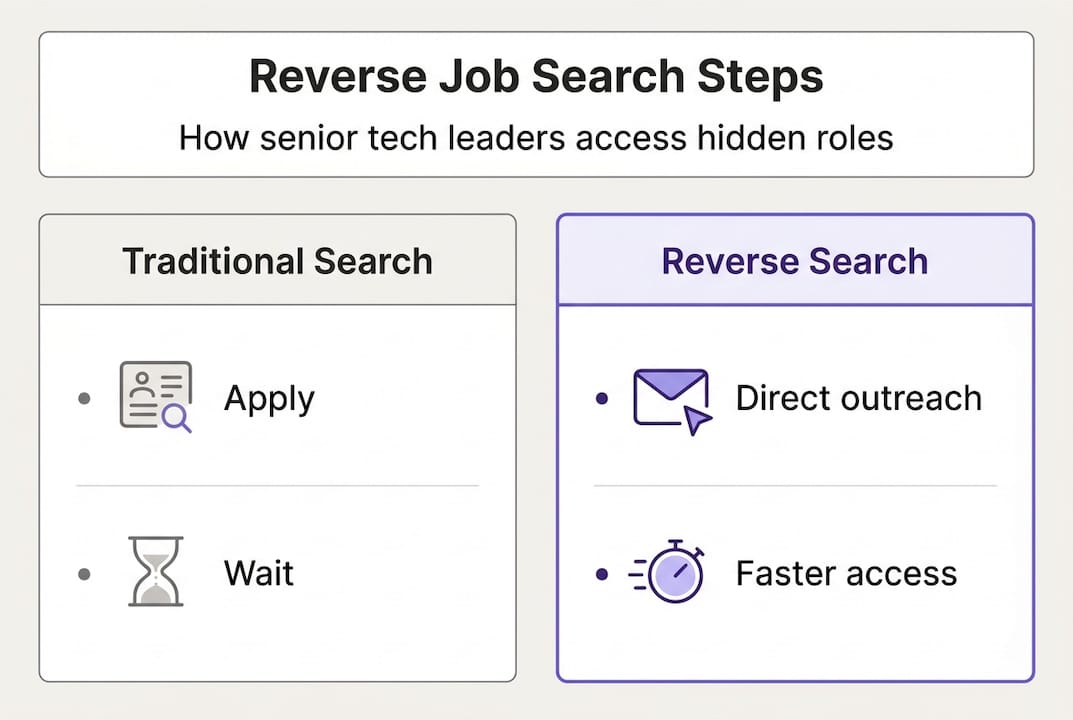
Traditional job searching is passive by design. You scan listings, submit your resume, and wait for a response that may never come. For senior tech professionals, that model is particularly costly because it consumes time, yields low response rates, and rarely surfaces the roles worth pursuing. The reverse job search method changes the equation.
Instead of you chasing employers, a reverse recruiter or structured service actively markets your candidacy to targeted companies on your behalf. Think of it as having a dedicated agent who opens doors before those doors are ever publicly listed. You define your target companies, your ideal role, and your non-negotiables. The service then conducts direct outreach to decision-makers, hiring managers, and executive networks.
For context, reverse methods claim 60-day interview guarantees versus the 90 to 120 days typical for executive hires through traditional approaches. That gap matters significantly when you’re navigating a career transition or pursuing a competitive leadership role.
Here’s a quick comparison to frame the difference:
| Factor | Traditional search | Reverse job search |
|---|---|---|
| Who drives it | Employer posts, you apply | Your team markets you proactively |
| Time to first interview | 90 to 120 days | 30 to 60 days |
| Access to hidden roles | Limited | High |
| Cost to candidate | Low or free | $2,500 to $10,000+ |
| Placement guarantee | None | Often included |
| Effort required | High (you do everything) | Moderate (provider leads outreach) |
You can also explore reverse recruiting services through community-vetted guides before committing to any provider. What sets the best services apart is their ability to position your impact metrics and leadership narrative in a way that resonates before any formal job opening exists.
The core advantage for senior tech leaders is access. The hidden market is where the most senior, highest-compensating roles live. Pairing this approach with an AI job search playbook can sharpen your targeting even further, helping you prioritize companies where your leadership profile will resonate most.
Preparation: Tools and mindset for a successful reverse job search
Before any provider can market you effectively, your professional brand must be ready to impress. The reverse job search is only as strong as the materials and narrative behind it. Showing up underprepared is the fastest way to waste a significant investment.
Start with the essentials:
- Impact-driven resume: Quantify achievements with metrics (revenue generated, team size led, cost savings, system scale). Titles alone do not tell a compelling story.
- Optimized LinkedIn profile: Your profile is the first thing a hiring manager will check. Optimizing your LinkedIn profile for executive visibility means a compelling headline, a strong About section, and keyword alignment with your target roles.
- Target company list: Identify 20 to 50 companies aligned with your values, growth stage, and leadership style.
- Clear value proposition: A one to two sentence statement of who you are, what problems you solve, and what makes you the right leader.
Choosing the right provider is equally critical. Not all reverse recruiting services are created equal, and unpublished executive roles require specialized access, not generic outreach.

Here’s what to look for when evaluating providers:
| Requirement | Who provides it | Role in your search |
|---|---|---|
| Interview guarantee in writing | Service provider | Accountability benchmark |
| Executive-level outreach network | Service provider | Hidden market access |
| Resume and LinkedIn revamp | Individual or service | Brand positioning |
| Target company research | Shared | Precision targeting |
| Coaching on impact storytelling | Individual or service | Candidate differentiation |
Checklist for vetting a reverse recruiting provider:
- Ask for case studies from tech executives specifically
- Confirm the interview guarantee terms in writing
- Verify they have direct relationships with hiring managers, not just LinkedIn automation
- Request a sample outreach sequence before signing
- Check references from past clients in leadership roles
The mindset shift here is significant. Titles no longer lead. What gets executives noticed is the story behind the numbers, the problems solved, the teams built, and the outcomes delivered. Reviewing tech leadership job search strategies can help you frame your career story in a way that attracts the right opportunities.
Pro Tip: If a provider promises a guarantee but cannot show it in a signed agreement with clear terms, walk away. Legitimate services stand behind their commitments with documented deliverables, not verbal assurances.
Step-by-step process: How to run a reverse job search
With preparation complete, the actual execution follows a clear and repeatable workflow. Here’s how to move through it effectively:
-
Define your career goals. Get specific about the role type (CTO, VP of Engineering, Chief Product Officer), industry vertical, company stage (startup, growth, enterprise), compensation range, and geographic preferences. Vague goals produce vague results.
-
Build your target company list. Identify organizations where your experience directly maps to their current challenges. Tools like LinkedIn Sales Navigator and Crunchbase are useful here. Aim for 30 to 50 companies across tiers.
-
Select and vet your reverse recruiting provider. Use the checklist from the previous section. Confirm deliverables in writing: number of companies approached per week, type of outreach, reporting cadence, and what happens if the guarantee isn’t met.
-
Align on messaging and outreach plan. Your provider should develop a tailored pitch that leads with your impact, not just your job history. This is the narrative that will open conversations before any role is listed.
-
Provider executes outreach; you prepare. While your team markets you actively, use this window to rehearse your leadership story, develop executive job search system habits, and identify two or three thought leadership pieces to publish on LinkedIn.
-
Engage with inbound interest. Respond promptly and professionally to outreach from hiring managers. These early conversations are often informal. Your goal is to create curiosity, not close a deal.
-
Navigate interviews and evaluate offers. Ask about company challenges, team dynamics, and growth plans. Evaluate fit beyond compensation. Use competing offers to negotiate from a position of strength.
Understanding your reversed job search system from the inside out will help you stay ahead during each stage.
Services in this space typically cost between $2,500 and $10,000+, with interview guarantees that vary by provider. That investment is meaningful, so treat every step of this process like a project you’re managing.
Pro Tip: Build a public portfolio or create a short case study document that showcases a major leadership win. Sharing this during initial conversations gives hiring managers something concrete to remember and reference, well before the formal interview process begins.
Risks, rewards, and expert tips for senior tech leaders
Every strategy carries trade-offs, and the reverse job search is no exception. Understanding both sides helps you go in with clear expectations and a contingency plan.
Key rewards:
- Access to unpublished senior roles that never appear on job boards
- Significant time savings compared to manual applications and follow-ups
- Stronger negotiating position because you’re being marketed rather than competing in a pool
- Reduced emotional stress of the job search process
- Potential for faster career transitions and higher offer quality
Main risks and pitfalls:
- High costs ranging from $2,500 to $10,000 or more with no placement guarantee in many cases
- Scam services that take upfront fees and deliver little
- Poor fit for early-career professionals (this method is optimized for senior leaders)
- Inconsistent quality in outreach if the provider lacks true executive-level networks
- Over-reliance on the service without maintaining your own network simultaneously
“Not all reverse recruiting services are equal. Before signing a contract, request documented proof of placements at the executive level, a written interview guarantee, and client references from the tech sector specifically. A reputable provider will offer all three without hesitation.”
The smartest approach for senior tech executives is a blended one. Reverse job search opens hidden doors, but personal branding keeps them open. Publishing AI career pivots and impact-driven content on LinkedIn positions you as a thought leader, making every introduction easier and every offer more competitive.
You can also explore executive outplacement services as a complementary resource, particularly if you’re navigating an unexpected career transition and need structured support alongside your reverse search efforts.
Pro Tip: Never stop building your network while a provider is working on your behalf. Warm introductions from mutual connections still convert at a higher rate than cold outreach. The reverse method amplifies your reach; your relationships amplify your credibility.
Best practices for senior tech leaders:
- Review provider contracts carefully for guarantee terms and refund clauses
- Maintain an active LinkedIn presence throughout the process
- Track all outreach activity your provider conducts and ask for weekly updates
- Stay interview-ready from day one, not just when interest arrives
- Combine reverse search with referral outreach to trusted colleagues
The hard truths about reverse job search for tech executives
Here’s what most articles on this topic won’t tell you: the reverse job search method is a tool, not a transformation. Too many senior tech leaders invest in a service expecting it to do all the heavy lifting, then feel let down when results are slower than promised or quality falls short of expectations.
The uncomfortable truth is that providers can only market what you give them. If your LinkedIn profile is outdated, your impact metrics are vague, or your target list is unfocused, no outreach campaign will compensate for those gaps. The full executive search strategy still depends on you showing up with clarity and substance.
Another reality worth naming: chasing titles is the wrong goal. Executives who lead with measurable outcomes and distinct leadership philosophies attract better opportunities than those optimizing purely for seniority. Portfolio work, public thought leadership, and strategic career pivots can often outperform even the most expensive reverse recruiting engagement.
Multi-channel visibility, combining reverse search, personal branding, and warm networking, consistently produces better results than any single approach. For senior tech careers, the professionals who move fastest are those who treat their career as a product worth positioning thoughtfully, not just a resume to submit. Personalized strategy, not a one-size-fits-all service, is what ultimately drives outsized career mobility.
Accelerate your executive search with expert tools
You now have a clear picture of how the reverse job search method works, what it takes to prepare, and where the real risks lie. The next step is putting the right tools behind your strategy.
At TalentFB, we’ve built resources specifically for senior tech professionals who want to move faster and smarter. Start with the AI Job Search Playbook to sharpen your targeting, then use the Executive Visibility Scorecard to identify exactly where your professional brand needs strengthening. Pair those with expert LinkedIn profile optimization to ensure every touchpoint reinforces your leadership narrative. These tools are designed to complement your reverse search efforts and give you an edge before the first conversation begins.
Frequently asked questions
How does the reverse job search method differ from traditional executive search?
The reverse method actively markets the candidate to employers through direct outreach, rather than waiting for job postings and hoping your application surfaces. You’re positioned as a sought-after candidate, not one of hundreds in a queue.
What makes the reverse job search effective for tech executives?
It provides direct access to the unpublished executive job market where senior roles are filled confidentially, saving you significant time and positioning you ahead of the traditional applicant pool.
Are there risks or downsides to the reverse job search?
Yes. High costs, no guarantees, and scam concerns are real risks. Always require a written guarantee, verify client references, and review contract terms carefully before committing to any service.
How long does it usually take to get interviews with this method?
Top providers claim interviews within 60 days, which is significantly faster than the 90 to 120 days typical for executive roles through conventional job search approaches.