

TL;DR:
- Talent mapping is a strategic, ongoing process linking workforce skills to business goals.
- AI enhances talent mapping by providing real-time data analysis and faster market insights.
- Continuous, skills-first mapping enables proactive talent decisions, boosting organizational agility.
Most senior technology executives think workforce planning means keeping seats filled and pipelines warm. That assumption costs organizations more than they realize. Talent mapping is a proactive, strategic process that supports long-term workforce planning, succession, and hiring — not just reactive recruiting. When you treat it as a continuous discipline rather than an occasional exercise, it becomes one of the most powerful levers you have for business transformation. This guide will define talent mapping, break down its core steps, show how AI is reshaping the process, and explore the advanced strategies that separate elite tech organizations from the rest.
Table of Contents
- What talent mapping really means in 2026
- How the talent mapping process works: Steps and framework
- Integrating technology and AI: The future of talent mapping
- Advanced strategies: Overcoming edge cases and unlocking value
- The real-world edge: Why talent mapping pays off for senior tech executives
- Next steps: Level up your talent strategy
- Frequently asked questions
Key Takeaways
| Point | Details |
|---|---|
| Strategic talent forecasting | Talent mapping predicts workforce needs and drives proactive hiring and development. |
| Skills-first advantage | Shifting from job titles to skills keeps organizations agile and competitive in technology sectors. |
| Technology accelerators | Integrating AI and analytics tools streamlines the talent mapping process and improves decision quality. |
| Continuous improvement | Successful talent mapping requires ongoing review, adaptation, and alignment with business strategy. |
What talent mapping really means in 2026
Talent mapping is not a spreadsheet of names and titles. It is a living, forward-facing system that connects your business strategy to the human capital required to execute it. According to OysterHR, talent mapping analyzes current workforce skills, forecasts future talent needs based on business goals, identifies skill gaps, and builds both internal and external pipelines. That definition alone sets it apart from traditional recruiting, which typically starts when someone resigns.
Senior tech managers often confuse talent mapping with succession planning. Succession planning is a subset focused on key leadership roles. Talent mapping covers every critical function across the organization, from individual contributors with rare certifications to entire engineering disciplines that may not yet exist on your org chart.
“Talent mapping transforms workforce planning from a reactive function into a strategic advantage — aligning people decisions with business outcomes before the need becomes urgent.”
Here is what a mature talent mapping practice actually covers:
- Current skills analysis: A clear, honest picture of what your team can do today
- Future needs forecasting: Projecting what roles and competencies your roadmap demands in 12 to 36 months
- Gap identification: Spotting the distance between where you are and where you need to be
- Internal pipeline development: Identifying and nurturing high-potential employees before vacancies appear
- External pipeline building: Maintaining relationships with passive candidates and niche talent communities
- Continuous refresh: Updating the map as business conditions, technology, and markets shift
Organizations that invest in this level of talent pipeline advantage consistently outperform peers on time-to-fill, retention, and cost-per-hire. For a broader operational breakdown, the detailed guide from Paychex offers a solid reference point for tech leaders building out their first formal program.
How the talent mapping process works: Steps and framework
Understanding talent mapping conceptually is one thing. Executing it systematically is another. The core talent mapping methodology follows a clear sequence: define business goals, assess current and future workforce needs, map skills, analyze gaps, build hire-upskill-promote strategies, and review regularly. Each phase feeds the next, and skipping steps is where most programs break down.
Here is how that sequence looks in practice for a technology organization:
- Align with business goals: Start with your product roadmap, market expansion plans, and revenue targets. Mapping divorced from strategy is just an HR exercise.
- Assess current workforce: Inventory skills, certifications, performance trajectories, and flight risk across your entire team.
- Define critical roles: Identify which roles are linchpins for your strategy — roles where a vacancy or skill gap would slow execution.
- Analyze gaps: Measure the distance between current capabilities and what your roadmap demands.
- Scan the external market: Understand supply and demand for key talent pools, compensation benchmarks, and competitor hiring patterns.
- Formulate your strategy: Decide what to hire, what to upskill internally, and what to build through partnerships or automation.
- Visualize and share: Create visual workforce maps your leadership team can actually use in planning sessions.
- Review and iterate: Set a cadence. Markets shift. Your map should, too.
The contrast between reactive recruiting and proactive mapping is stark:
| Factor | Reactive recruiting | Proactive talent mapping |
|---|---|---|
| Trigger | Open vacancy | Business goal or forecast |
| Timeline | Weeks to months | Ongoing, 12 to 36 month horizon |
| Cost | High (urgent hires cost more) | Lower (planned pipelines reduce urgency) |
| Risk | High (wrong hire under pressure) | Lower (vetted, relationship-based pools) |
| Retention impact | Minimal | Significant (internal mobility paths) |
For further tech leader talent acquisition strategies that complement this process, explore how organizations are combining mapping with structured outreach. You can also review OysterHR best practices for specific implementation tactics.
Pro Tip: In fast-moving tech environments, skills-first mapping consistently outperforms job-title-based models. A candidate with transferable cloud architecture skills may add more value than someone with a matching job title but narrower experience.
Integrating technology and AI: The future of talent mapping
AI is not replacing talent mapping. It is making it dramatically more precise and faster. Modern talent intelligence platforms now analyze millions of data points across job postings, professional profiles, compensation surveys, and skills trends in real time. AI-driven talent intelligence enables skills-based approaches, real-time market forecasting, and time savings of up to 40% on time-to-fill roles. For a technology organization managing complex hiring cycles, that is a material operational improvement.

Here is how AI-powered platforms are changing specific aspects of the mapping process:
| Capability | Traditional approach | AI-enhanced approach |
|---|---|---|
| Skills analysis | Manual surveys and manager input | Automated skill inference from profile and performance data |
| Market intelligence | Periodic compensation surveys | Real-time benchmarking across live market data |
| Succession risk | Spreadsheet-based tracking | Predictive flight risk and readiness scores |
| Gap identification | Annual HR review | Continuous, automated gap alerts |
Key questions to ask any talent intelligence vendor before committing:
- How does the platform handle data privacy across jurisdictions?
- What bias mitigation practices are built into the AI models?
- Can the system integrate with your existing HRIS and ATS?
- How is model accuracy validated, and how often is it updated?
For deeper insight into AI for talent strategy, especially at the executive level, the frameworks for technology evaluation matter as much as the tools themselves. You should also explore tech talent acquisition methods that pair well with AI-driven mapping. Gartner recommendations on talent management highlight that human judgment must remain central even as automation increases. Explore AI-driven tools purpose-built for talent teams to see what the landscape looks like today.
Advanced strategies: Overcoming edge cases and unlocking value
Most organizations get the basics right eventually. The real separation happens when talent mapping encounters complexity. Edge cases including global expansion, succession pipeline gaps, single points of failure, and data accuracy challenges are where immature programs stall and elite programs accelerate.
Global expansion adds a significant layer of complexity. You cannot apply a single talent map to a team operating across six time zones and four regulatory environments. Location-specific labor law, compensation norms, and skills availability must all be factored in. Layering geography into your mapping framework is not optional for technology organizations scaling internationally.
Single points of failure are a real and under-discussed risk. If one person holds the institutional knowledge for a critical system and leaves, your roadmap stalls. Talent mapping surfaces these dependencies before they become crises.
Here are actionable tactics for the toughest scenarios:
- For niche skills: Build relationships with university programs, open-source communities, and specialized bootcamps before the need is urgent
- For fast-evolving disciplines: Partner with internal learning and development teams to create upskilling tracks tied directly to your roadmap
- For global talent pools: Use regional talent intelligence data rather than global averages to benchmark compensation and availability accurately
- For succession gaps: Identify two or three internal candidates per critical role and give them structured development assignments now
- For data accuracy: Audit your skills data at least annually. Self-reported skills degrade quickly in fast-moving fields
Review proven talent management tips for building team resilience at scale, and consider how modern HR strategies are evolving to support continuous mapping programs. For a detailed breakdown of global organization challenges, OysterHR’s edge case guide is particularly useful.
Pro Tip: Treat talent mapping as an ongoing business process, not an annual HR report. The organizations that tie mapping insights directly to quarterly workforce decisions consistently move faster than those that revisit maps only during budget season.
The real-world edge: Why talent mapping pays off for senior tech executives
Here is an uncomfortable truth many talent mapping programs will not tell you. Most organizations deploy mapping as a replacement pipeline exercise, tracking who could step into a role if someone leaves. That is necessary but far too narrow. The shift to skills-first, continuous mapping with technology tools yields demonstrably higher ROI precisely because it links workforce decisions to business outcomes, not just HR continuity.
We have seen a technology leader use continuous mapping to identify that a core engineering team had 80% of the skills needed to pivot to a new cloud-native architecture. By recognizing this early and launching a targeted upskilling track, the organization shifted two quarters ahead of its original timeline. No emergency hiring. No costly contract staff. Just strategic awareness applied in advance.
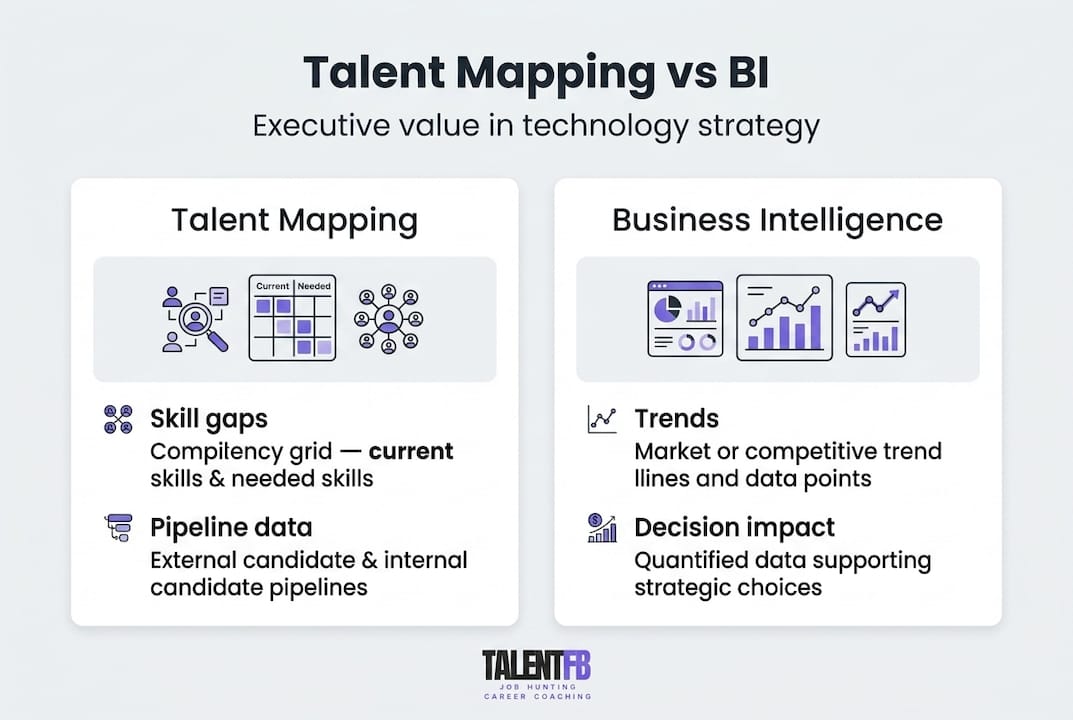
The executives who get the most from talent mapping treat it as a business intelligence function, not an HR function. They tie it to product launches, market entries, and competitive moves. They review tech leader management tips not just for team performance but for connecting workforce capacity to strategic ambition. When mapping is embedded at that level, it stops being a cost center and starts being a competitive advantage.
Next steps: Level up your talent strategy
Talent mapping is not a one-time project. It is a discipline that compounds in value the longer you practice it. If this guide has clarified the stakes and raised the right questions, the next move is to go deeper on implementation.
At TalentFB, we work with senior technology managers and executives to translate workforce strategy into execution. Whether you are building your first formal mapping program or refining an existing one, our strategic talent acquisition guide gives you the frameworks to move forward with confidence. If you are ready to build a proactive, resilient talent pipeline, start with our talent pipeline playbook and see how structured strategy accelerates results.
Frequently asked questions
What is the difference between talent mapping and talent acquisition?
Talent mapping is proactive and continuous, focused on forecasting needs and building pipelines over time, while talent acquisition is the transactional process of filling current open roles. One anticipates demand; the other responds to it.
How does AI enhance talent mapping for technology leaders?
AI platforms accelerate analysis, surface skill gaps in real time, and provide market intelligence that would take weeks to gather manually. AI tools can speed up mapping by up to 40%, giving technology leaders a meaningful advantage in competitive hiring markets.
Why is skills-first mapping preferred over job-title-based models?
Skills-first mapping reflects how work actually gets done in technology environments, where a developer’s capabilities matter far more than their previous title. Skills-first, continuous mapping creates greater organizational agility and better prepares teams for rapid change.
How often should organizations review and update their talent maps?
At minimum, talent maps should be reviewed biannually, but continuous iterative mapping is the standard for high-performing technology organizations. Quarterly touchpoints tied to business planning cycles work well in practice.
What is the biggest mistake executives make with talent mapping?
The most common mistake is treating mapping as a one-time deliverable rather than an ongoing process. Focusing only on replacement pipelines rather than strategic business outcomes limits the program’s impact and leaves significant value on the table.