

TL;DR:
- A structured, step-by-step sourcing framework improves hiring efficiency for tech roles.
- Using multiple channels and personalized outreach increases candidate quality and engagement.
- Regular measurement and optimization are key to building a strong, resilient tech talent pipeline.
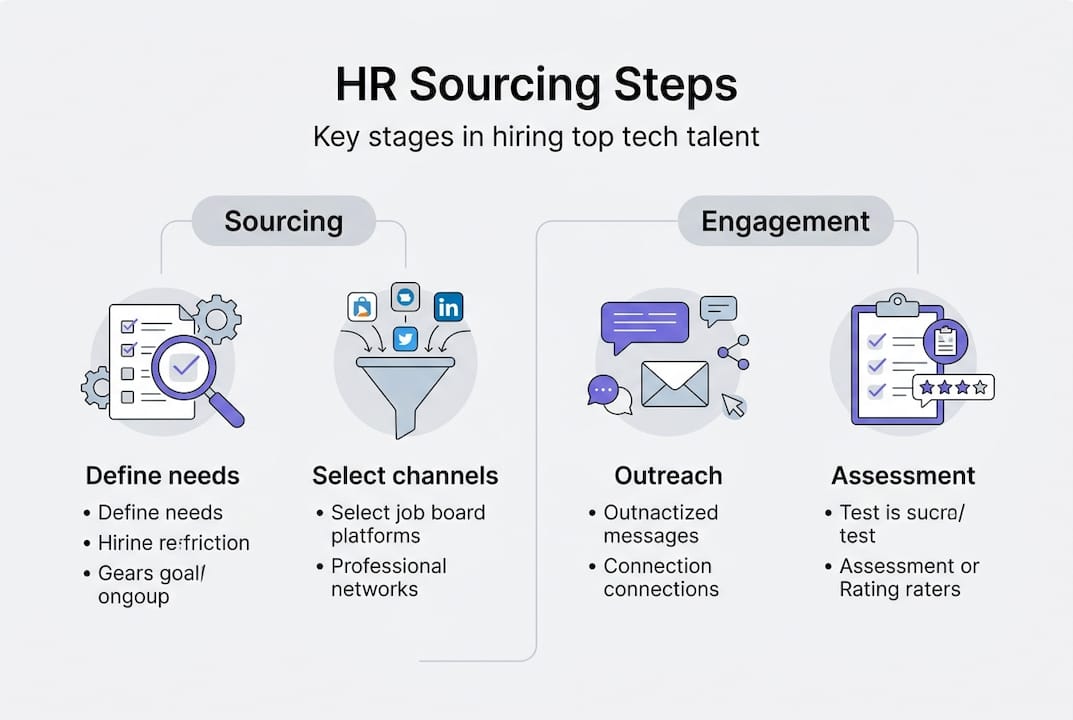
Finding qualified tech talent is one of the most pressure-filled challenges HR teams face today. Roles stay open too long, pipelines run dry, and generic sourcing tactics consistently miss the mark with specialized candidates. The good news is that a structured, step-by-step framework can cut through that frustration and turn sourcing into a repeatable, measurable process. This guide breaks down every essential stage, from defining what you actually need to optimizing results over time, so your team can source smarter, engage better, and hire with greater confidence in the technology sector.
Table of Contents
- Assess your hiring needs and goals
- Select sourcing channels and prepare your toolkit
- Execute outreach and engagement
- Screen, assess, and manage your pipeline
- Measure, optimize, and repeat the sourcing process
- What most HR teams misunderstand about tech talent sourcing
- Accelerate tech hiring with TalentFB tools and resources
- Frequently asked questions
Key Takeaways
| Point | Details |
|---|---|
| Start with clear needs | A precise hiring plan targets the right talent from the beginning. |
| Diversify sourcing channels | Using multiple channels expands access to top tech talent. |
| Personalize communication | Tailored outreach boosts candidate engagement and response rates. |
| Continuously improve | Track and refine your process for better results each hiring cycle. |
Assess your hiring needs and goals
To address confusion at the start, the first step is to clarify exactly what your organization needs and why. Sourcing without a clear target is like navigating without a map. You will spend time and budget reaching the wrong people, and defining job requirements leads to a 50% faster sourcing timeline.
A strong role profile is your foundation. It should capture not just technical qualifications, but also the behavioral and cultural dimensions that predict long-term success. Here are the core elements every tech role profile should include:
- Technical skills: Programming languages, frameworks, certifications, and tools specific to the role
- Experience level: Years in similar positions, scope of past projects, and relevant industry exposure
- Soft skills: Communication, problem-solving approach, and collaboration style
- Culture fit: Alignment with team values, work style preferences, and growth mindset indicators
- Remote or on-site requirements: Clarity on flexibility expectations to filter candidates early
Use data from past hiring cycles to refine these profiles. Look at which hires succeeded and which did not, then reverse-engineer the patterns. This historical lens makes your job descriptions sharper and your sourcing criteria more predictive.
| Role profile element | Why it matters | Common gap |
|---|---|---|
| Technical skills | Ensures baseline competency | Overloading must-have requirements |
| Soft skills | Predicts team integration | Often overlooked in tech roles |
| Culture fit | Drives retention | Rarely defined with specificity |
| Remote readiness | Sets clear expectations | Assumed rather than stated |
Pro Tip: Loop in technical leads when building role profiles. They will catch nuances in skill requirements that general HR teams often miss, and their input makes job descriptions far more credible to candidates.
Select sourcing channels and prepare your toolkit
Once goals are set, the next challenge is ensuring you have the right resources to source candidates effectively. Relying on a single channel, like one job board or LinkedIn alone, significantly limits your reach. Multiple digital sourcing channels can improve candidate quality by 35%, which makes channel diversity a strategic priority, not an optional add-on.
Here is a comparison of the top sourcing channels available to tech HR teams:
| Channel | Cost | Speed | Talent pool diversity |
|---|---|---|---|
| LinkedIn Recruiter | High | Medium | Broad |
| Niche tech job boards | Low to medium | Medium | Specialized |
| Employee referrals | Low | Fast | Moderate |
| Internal mobility programs | Very low | Very fast | Limited |
| Talent communities | Low | Slow to medium | High quality |
Beyond channels, your toolkit shapes how efficiently you work. Every tech-focused recruiting team should have these tools configured and ready:
- Applicant Tracking System (ATS): Centralizes candidate data and tracks progress through stages
- Candidate Relationship Management (CRM): Maintains warm pipelines and nurtures past candidates
- AI screening software: Automates initial filtering based on role criteria to reduce manual review time
- LinkedIn Recruiter: Essential for proactive outreach in the tech space, especially when you apply the strategic guide for tech leaders approach
Pro Tip: Audit your tools every quarter. Many teams accumulate subscriptions that overlap or underperform. Streamlining your stack reduces friction and helps your team focus on what actually moves candidates forward.
Execute outreach and engagement
With tools and channels ready, it is time to connect with candidates purposefully and efficiently. Many HR teams treat outreach as a volume game, sending hundreds of identical messages and hoping something sticks. That approach burns goodwill and wastes time.
Here is a clear process for executing outreach that actually gets responses:
- Segment your candidate list by role fit, source, and engagement level before writing a single message
- Craft targeted message templates that address each segment’s likely motivations, such as growth opportunities, tech stack, or remote flexibility
- Personalize key details in every message, including the candidate’s specific experience, a relevant project they worked on, or a mutual connection
- Set a follow-up schedule with no more than two follow-up touches over two weeks to respect candidate time
- Track all responses inside your CRM to measure which messages perform best by role type and channel
“Candidate experience begins at the first message. A generic InMail tells a top engineer everything they need to know about how you treat your team.”
Personalized outreach is twice as likely to receive a response from tech talent, and this gap widens significantly for senior and specialized candidates who receive high volumes of generic requests daily.

Think about building a talent pipeline as a long game. Not every candidate you contact is ready to move now, but a warm, well-managed pipeline means your best leads are accessible when timing aligns.
Pro Tip: Build a library of message templates organized by role and persona. Customize the opening two sentences for each candidate. That small personalization effort dramatically shifts response rates without slowing your process.
Screen, assess, and manage your pipeline
After you have made contact, it is essential to fairly and efficiently evaluate and organize potential hires. Speed matters here, but consistency matters more. Rushed or inconsistent screening is one of the top reasons great candidates fall through the cracks.
Here is a reliable sequence from initial contact to shortlist:
- Complete an initial resume review against your role profile criteria
- Send a brief qualification questionnaire to confirm basics like availability, location, and salary range
- Conduct a 20-minute phone screen focused on motivation, career trajectory, and role alignment
- Score each candidate on a consistent rubric before advancing them
- Present a shortlist to the hiring manager with context notes, not just resumes
Structured assessment at the sourcing stage reduces final-stage dropouts by 27%, making this step far more than administrative housekeeping. Here is a scoring framework you can adapt:
| Assessment criterion | Weight | What to look for |
|---|---|---|
| Skills match | High | Direct alignment to role profile |
| Relevant experience | High | Similar scope, industry, and complexity |
| Motivation to move | Medium | Genuine pull factors, not just push |
| Remote work fit | Medium | Communication style, self-management signals |
| Long-term potential | Low to medium | Growth trajectory and learning orientation |
Common mistakes to avoid during pipeline management:
- Letting candidates sit in limbo without status updates
- Advancing candidates based on gut feeling rather than criteria
- Ignoring silver-medal candidates who could be strong for future roles
For candidates who are not the right fit right now, use your CRM and talent management tips to tag and nurture them. A brief quarterly check-in keeps these relationships warm and your pipeline healthy.
Measure, optimize, and repeat the sourcing process
To ensure these efforts pay off long term, consistently monitor and adjust your sourcing approach. Without measurement, even a well-executed process drifts into inefficiency over time. Consistent metrics review has been shown to increase sourcing efficiency for top-performing HR teams.
Start by defining the metrics that matter most for your team:
- Time-to-fill: Days from job opening to accepted offer
- Cost-per-hire: Total recruiting spend divided by number of hires
- Sourcing channel ROI: Quality and conversion rate of candidates by source
- Pipeline conversion rate: Percentage of sourced candidates who advance to interview
- Offer acceptance rate: A proxy for candidate experience and compensation competitiveness
| Metric | Benchmark goal | Action if below target |
|---|---|---|
| Time-to-fill | Under 45 days | Audit screening bottlenecks |
| Cost-per-hire | Track monthly trend | Shift budget to higher-ROI channels |
| Sourcing channel ROI | 3:1 quality ratio | Test new channels quarterly |
| Offer acceptance rate | Above 80% | Review compensation and candidate experience |
Best practices for ongoing optimization include:
- Reviewing sourcing data monthly with your recruiting team
- Running quarterly channel audits to reallocate budget toward what works
- Collecting feedback from hiring managers after each hire to refine profiles
- Documenting wins and lessons from every completed search
Pro Tip: Schedule a 60-minute team debrief after every significant hire or failed search. The patterns you surface in those sessions are worth more than any sourcing tool.
What most HR teams misunderstand about tech talent sourcing
Here is an uncomfortable truth: most sourcing frameworks fail not because of poor execution, but because of a flawed mindset. Many HR professionals treat sourcing as a transaction, something to complete quickly and hand off. That mindset is precisely what separates average teams from exceptional ones.
The deeper problem is over-reliance on volume. Sending 300 messages is not a strategy. It is noise. The teams that consistently win top tech talent are the ones building genuine relationships with candidates long before a role opens, partnering closely with hiring managers, and using real-time data to adjust in weeks, not quarters. They study C-suite hiring strategies and apply that same precision thinking to every level of sourcing.
Patience is also undervalued. Strategic pipelining, where you invest in candidates who are not ready today, pays enormous dividends when the market tightens. The teams with the shortest time-to-fill are almost always the ones who started building relationships six months ago.
Accelerate tech hiring with TalentFB tools and resources
For tech HR professionals ready to upgrade their sourcing techniques, TalentFB offers a focused set of resources and coaching solutions designed specifically for the talent acquisition space.
Whether you want to sharpen your LinkedIn strategy with an AI Job Search Playbook, refine your sourcing approach through AI career coaching, or explore the full range of TalentFB solutions built for tech recruiters and HR leaders, there is a clear path forward. These tools help you target better candidates, improve interview conversion rates, and build a stronger, more resilient pipeline. The next step is yours to take.
Frequently asked questions
What are the key steps in HR talent sourcing for tech roles?
The main steps are defining hiring needs, preparing sourcing tools, executing outreach, candidate screening, and ongoing optimization. Defining job requirements and using a structured process speeds up tech hiring considerably.
How can HR measure the effectiveness of their sourcing process?
Track metrics like time-to-fill, cost-per-hire, candidate quality, and pipeline conversion rates to get a full picture of sourcing performance. Consistent metrics review increases sourcing efficiency for teams that make it a regular habit.
What sourcing channels work best for finding tech talent?
Top channels include LinkedIn, niche job boards, employee referrals, and talent communities, ideally used in combination. Multiple digital sourcing channels improve candidate quality when deployed strategically together.
How important is candidate engagement in the sourcing process?
Engaging candidates personally dramatically increases response and acceptance rates, especially in competitive tech markets. Personalized outreach doubles the response rate from tech candidates compared to generic messaging.