
TL;DR:
- Senior tech professionals must focus on organizational impact and system-building to break career plateaus.
- Networking, strategic goal-setting, and visibility are critical for securing executive roles in Singapore.
- Leveraging AI tools and coaching accelerates career progression and effective job search strategies.
Many senior technology professionals in Singapore assume that shipping more projects and mastering new frameworks will naturally lead to the next promotion. It rarely works that way. High-performers stall without an internal shift in focus, and the executives who break through are the ones who learn to trade output for organizational leverage. This guide walks you through why career plateaus happen, how to reframe your goals, and what job search strategies actually work for senior tech leaders navigating Singapore’s competitive landscape in 2026.
Table of Contents
- Why career plateaus happen for senior technology professionals
- Frameworks: Setting strategic goals and maximizing leverage
- Leadership transition: Building systems, mentoring, and executive presence
- Job search strategies: Networking, tailoring, and executive resources in Singapore
- Perspective: The real path to executive advancement in Singapore tech
- Next steps: Accelerate your career with AI-driven solutions
- Frequently asked questions
Key Takeaways
| Point | Details |
|---|---|
| Plateaus require a shift | Senior leaders must transition from output focus to strategic leverage to advance. |
| Frameworks drive progress | Applying impact-focused goal frameworks prevents stagnation and increases visibility. |
| Leadership skills unlock executive roles | Mentoring, system-building, and executive presence are crucial for career growth beyond technical mastery. |
| Networking is the main driver | Referrals and tailored applications far outperform cold job submissions in Singapore. |
Why career plateaus happen for senior technology professionals
Picture a senior engineer who has led three successful product launches in two years. By every traditional measure, performance is exceptional. Yet the VP Engineering role goes to someone else, someone who shipped less but influenced more. This scenario plays out across Singapore’s technology sector more often than most professionals realize.
The root cause is straightforward. As your career climbs, your impact must scale beyond what you personally produce. A manager who codes brilliantly but cannot design processes that make an entire team faster is, in organizational terms, still an individual contributor wearing a manager’s badge. The business rewards those who solve higher-level problems.
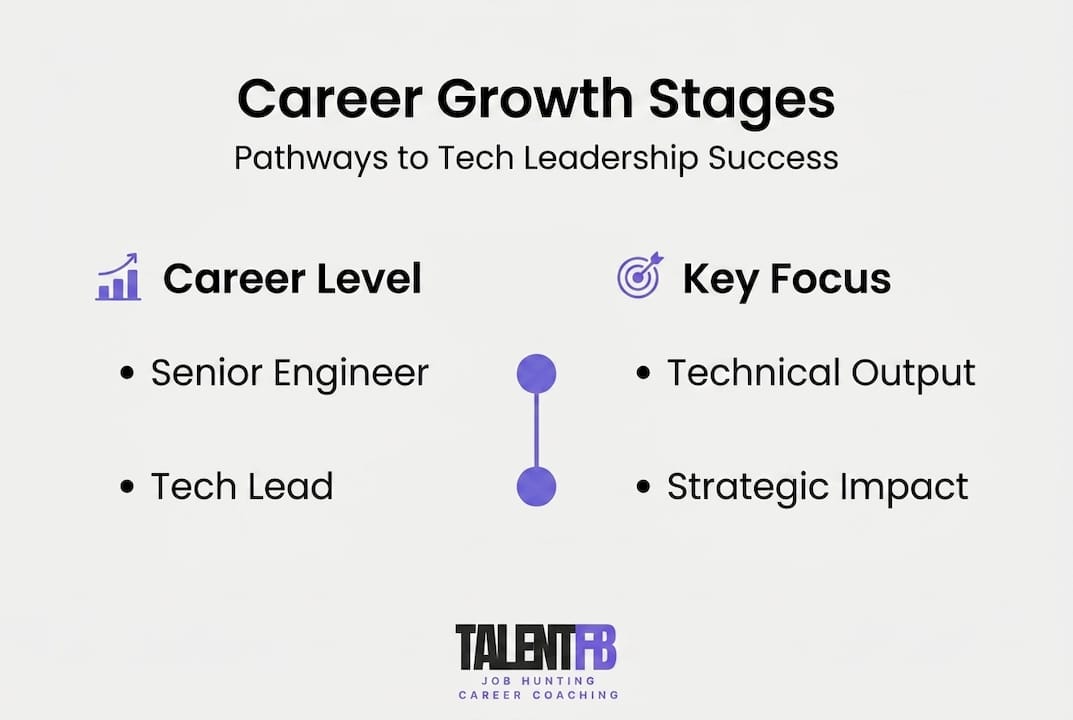
Consider the difference in value delivered at each level:
| Career level | Primary value driver | Impact reach |
|---|---|---|
| Senior engineer | Technical output | Individual |
| Engineering manager | Team productivity | Team (5-15 people) |
| Director / VP | System and strategy | Division or company |
| CTO / C-suite | Business transformation | Entire organization |
Moving up that table requires a deliberate shift in where you invest your energy. The skills that earned you your current role, deep technical expertise and fast individual delivery, are not the same skills that earn you the next one.
Here are the most common reasons senior tech professionals plateau:
- Staying in delivery mode: Prioritizing sprint completion over cross-team coordination
- Avoiding ambiguity: Declining projects that lack clear specs instead of shaping them
- Invisible impact: Solving important problems without communicating results upward
- Neglecting relationships: Building technical depth without building organizational influence
Exploring strategic advancement methods can help you identify which of these patterns may be quietly limiting your trajectory. The shift required is not about working harder. It is about working on fundamentally different things.
Frameworks: Setting strategic goals and maximizing leverage
Understanding why plateaus happen, we now turn to frameworks that help you refocus and grow. The goal is not to abandon technical skill. It is to channel that skill toward work that multiplies your impact across people and systems.
Start by redefining what a career goal looks like at your level. Vague ambitions like “become a VP” offer no traction. Instead, write goals that specify business outcomes, executive visibility, and a timeline. For example: “Lead the migration of our data platform to reduce infrastructure costs by 20%, present quarterly results to the CTO, and build a cross-functional working group within six months.”
Next, audit how you spend your time using a simple impact-versus-effort matrix. Plot your current tasks on two axes: how much effort they require and how broadly they impact the organization. High-impact, lower-effort work, such as establishing engineering standards or mentoring leads, belongs at the top of your priority list. High-effort, low-impact work should be delegated or eliminated.
Here is how output-focused work compares to leverage-focused work:
| Output-focused work | Leverage-focused work |
|---|---|
| Writing individual code modules | Designing architecture standards for the team |
| Fixing bugs in production | Building automated monitoring systems |
| Attending every meeting | Facilitating key cross-team decisions |
| Completing assigned tasks | Identifying and proposing strategic initiatives |
A practical prioritization sequence for senior leaders:
- Identify the three business problems your organization most needs solved in the next quarter
- Map those problems to work only you or your team can uniquely address
- Propose leading that work and make your involvement visible to decision-makers
- Document results in a running leadership portfolio with measurable outcomes
- Share portfolio highlights during performance reviews and skip-level conversations
Pro Tip: Keep a “wins document” updated monthly. When promotion conversations happen, you will have concrete, quantified examples ready rather than struggling to recall contributions from 18 months ago.
Building your profile externally supports this internal work. Master networking as part of your strategy, and make sure your LinkedIn optimization reflects your leadership narrative, not just your technical credentials. Strategic goal-setting shifts your trajectory from output to organizational impact, which is precisely what boards and hiring committees evaluate.

Leadership transition: Building systems, mentoring, and executive presence
With your frameworks set, let’s discuss how to step into leadership and system-building, the highest leverage point in tech careers. This transition is where many capable professionals hesitate, partly because it feels less tangible than writing code or closing sprints.
Building scalable systems is the clearest signal that you are operating at an executive level. A system is anything that produces reliable results without requiring your direct involvement every time. Examples include:
- Engineering playbooks: Documented standards for code review, incident response, and deployment that any engineer can follow
- Hiring pipelines: Structured interview processes that consistently surface strong candidates without your presence at every screen
- Onboarding programs: Structured ramp-up plans that get new engineers productive in 30 days instead of 90
- Decision frameworks: Clear criteria for build-versus-buy, technology selection, and resource allocation
Mentoring is the second pillar of this transition. When you invest in growing the people around you, your impact multiplies. A team of eight engineers who each perform 10% better because of your coaching delivers more organizational value than any single project you could complete alone. That math is visible to leadership.
Shifting to system-building is precisely how high-performing leaders avoid plateaus and signal readiness for VP and C-suite roles. If you want to explore how targeting the right roles matches these skills, the reverse job search approach can help you identify companies actively seeking this profile.
Executive presence is the third element, and it is often misunderstood. It is not about charisma. It is about clarity, consistency, and confidence in cross-functional settings.
Pro Tip: Practice leading without authority. Volunteer to facilitate cross-team working groups or present roadmap decisions to stakeholders outside your department. Each interaction builds the communication credibility that hiring managers and boards associate with executive readiness.
Job search strategies: Networking, tailoring, and executive resources in Singapore
After shifting into leadership, you may seek new opportunities. Here’s how to strategically approach the job search process in Singapore.
The numbers paint a clear picture. Referrals drive 80% of successful job placements, while cold applications yield less than 10% positive outcomes. If you are spending most of your search time on job boards, you are fishing in the wrong pond.
Statistic: Senior tech professionals who prioritize networking and referrals over cold applications reduce their average search timeline from six months to under three months in the Singapore market.
Here is a 7-day executive job search plan to reorient your approach:
- Day 1: Audit your LinkedIn profile for leadership narrative, not just technical keywords. Tailor your headline and summary for ATS and human readers equally
- Day 2: List 20 target companies in Singapore aligned with your leadership goals and identify mutual connections at each
- Day 3: Reach out to five former colleagues or managers for coffee chats, not job leads. Rebuild warm relationships first
- Day 4: Review the Tech@SG initiative, which supports the hiring of senior engineers including principal engineers and VP-level professionals into Singapore-based roles
- Day 5: Tailor your resume and LinkedIn for two to three specific target roles, using language from actual job descriptions to improve ATS scoring
- Day 6: Engage meaningfully on LinkedIn, comment on posts by hiring managers and tech leaders at target companies
- Day 7: Review your tech leadership job strategy and set weekly outreach targets going forward
Additional resources to support your search:
- Use the AI job search playbook to automate personalized outreach at scale
- Access templates, guides, and trackers through job search resources built for senior tech professionals
- Engage Singapore-specific communities such as SGTech, the Singapore Computer Society, and tech-focused LinkedIn groups
Tailoring is not optional at the executive level. Hiring committees at this tier read carefully. Generic resumes signal generic thinking.
Perspective: The real path to executive advancement in Singapore tech
Having covered practical frameworks, it is time for some candid perspective.
Most senior tech professionals we speak with have impressive certification portfolios, AWS, GCP, Kubernetes, the full stack. And most of them are frustrated because those certifications have not moved their careers forward in years. Here is the uncomfortable truth: technical mastery past a certain level becomes a credential, not a differentiator.
What actually moves the needle is visibility paired with business impact. Promotions reward business leverage, not certification count. And in Singapore’s tech market, 80% of senior roles are filled through relationships, not job postings.
We have seen professionals land VP Engineering offers not because they had a perfect resume, but because they had spent two years building genuine credibility with people who became hiring decision-makers. That is the real currency at the executive level.
Getting honest career coaching advice from someone who understands the Singapore tech landscape can accelerate this shift considerably. And pairing that with the reverse leadership job search method means you stop chasing roles and start attracting them.
Next steps: Accelerate your career with AI-driven solutions
The strategies in this guide are evidence-based and actionable. But execution is where most senior professionals stall, not from lack of knowledge but from lack of a structured system and accountability.
TalentFB’s AI job search playbook gives you a step-by-step system to implement these strategies faster than going it alone. If you want personalized guidance, our AI career coaching sessions help you identify your highest-leverage moves and execute them with precision. For senior leaders entering interview processes, executive interview coaching ensures you walk in ready to position your leadership story with confidence and clarity.
Frequently asked questions
Why do high-performing tech leaders often hit a career plateau?
They focus on output rather than strategic leverage and leadership skills, which are required for executive roles. Shifting that focus to system-building and organizational impact is what drives advancement past the senior level.
What leadership skills do companies value for senior technology roles?
Companies value system-building, mentoring, executive presence, and solving business-wide challenges more than technical output. Leadership and strategy skills are what distinguish directors and VPs from senior individual contributors.
How should I approach job searching as a senior tech leader in Singapore?
Networking and tailored applications are the key; referrals drive 80% of job search success while cold applications rarely clear a 10% success threshold, making relationship-building your most valuable search tool.
What is Tech@SG and how can it help senior engineers?
Tech@SG is a Singapore government-supported program that facilitates the hiring of senior tech professionals, including principal and VP engineers, into roles based in Singapore. It is a valuable resource for both candidates and companies seeking top-tier technology leadership talent.