
TL;DR:
- Tech companies invest in coaching to accelerate leadership development and surface blind spots.
- Coaching is most impactful during key career inflection points like role transitions and organizational scaling.
- Both organizations and individual leaders gain faster effectiveness, better communication, and career mobility from coaching.
Coaching is not a remedial tool reserved for underperformers. In the highest-performing technology companies, executive coaches accelerate leadership development, surface blind spots that even brilliant engineers miss, and sharpen the interpersonal skills that separate good managers from exceptional executives. If you are a senior tech professional wondering why your company invests in coaching for its top talent, or whether coaching could accelerate your own trajectory, this guide breaks down the business logic, the optimal timing, the measurable returns, and the practical steps you can take to leverage coaching as a career accelerator.
Table of Contents
- Understanding the corporate logic: why coaching for tech leaders?
- High-impact moments: when do companies bring in coaches?
- Benefits realized: what do tech companies and leaders gain?
- Practical steps: how to leverage coaching for your tech career
- Why coaching is the missing link in tech leadership growth
- Next steps: find your coaching advantage
- Frequently asked questions
Key Takeaways
| Point | Details |
|---|---|
| Strategic driver | Coaching accelerates growth and clarity for tech leaders facing new challenges. |
| Best ROI moments | Companies maximize coaching ROI during major transitions, scaling, and crisis periods. |
| Tangible benefits | Leaders gain sharper judgment, stronger teams, and accelerated promotions from coaching. |
| Application tips | Senior tech professionals should proactively identify coaching needs and set measurable goals. |
Understanding the corporate logic: why coaching for tech leaders?
To understand why leading tech firms invest in coaches for senior professionals, let’s break down the core motivations behind this trend.
Technology companies operate in an environment of relentless change. The pressure to ship products, scale teams, manage stakeholders, and stay ahead of competitive threats is immense. In that context, coaching is not a perk. It is a deliberate investment in leadership capacity that pays back in measurable ways.
Here are the primary business drivers that prompt tech companies to engage coaches for their senior talent:
- Accelerating leadership development: Technical expertise gets professionals to the director or VP level. Leading at scale requires a different skill set entirely, and coaching shortens the time it takes to close that gap.
- Surfacing blind spots: Most executives receive filtered feedback. A coach using structured tools like 360-degree assessments cuts through the noise and reveals patterns that peers and direct reports rarely voice directly.
- Confidential strategic space: High-stakes decisions require a thinking partner with no political agenda. Coaching creates a private environment where leaders can process pressure, test ideas, and refine their judgment.
- Reducing costly leadership failures: A misaligned VP of Engineering or a newly promoted director who struggles with people management can cost a company millions in productivity loss and talent turnover. Coaching provides confidential space for strategic clarity, emotional containment, and reduces the likelihood of costly mis-hires and critical missteps.
- Supporting the technical-to-people-manager transition: This transition is one of the most underestimated challenges in tech careers. Engineers who excelled at solving complex systems problems suddenly discover that leading humans requires an entirely different operating model.
“The best investment a company can make in a high-potential engineer is giving them a structured space to develop the leadership instincts that no coding bootcamp teaches.” This is the reality that drives coaching adoption at companies like Google, Microsoft, and Salesforce.
For senior professionals already exploring career advancement strategies, understanding this corporate logic gives you a strategic advantage. When you know why companies buy coaching, you can speak the same language as your sponsors and HR business partners when advocating for your own development investment.
It is also worth noting that tech executive recruiters consistently report that candidates who have had access to executive coaching present significantly more clearly in interviews, articulate their leadership philosophy with precision, and negotiate with greater confidence.
High-impact moments: when do companies bring in coaches?
With the “why” established, the next question is timing: when do leading companies decide to invest in coaching?
The return on coaching investment is not uniform across a leader’s career. It spikes dramatically at specific inflection points where the complexity of the role increases faster than the individual’s existing toolkit can absorb. Getting coaching support at these moments is not just helpful; it is often decisive for long-term success.
Tech companies invest in coaching during high-ROI moments including the first 90 days in a new role, scaling engineering organizations past the 100, 500, or 1,500 engineer threshold, post-acquisition integration, and incident recovery following major organizational or technical crises. Each scenario presents unique leadership demands that benefit enormously from structured, expert guidance.
| Coaching trigger | Why it matters | Optimal coaching window |
|---|---|---|
| New executive role | Role clarity, stakeholder alignment | Days 1 to 90 |
| Scaling teams past 100 | Org design, delegation, culture | 3 to 6 months |
| Post-acquisition integration | Cultural alignment, communication | 6 to 12 months |
| Incident or crisis recovery | Reputation management, trust repair | Immediately after |
| Promotion from IC to manager | People skills, feedback, accountability | First 60 days |
The first 30 to 90 days in any senior role are particularly powerful. Research consistently shows this window as the highest-leverage period for shaping relationships, setting expectations, and establishing credibility with the team. Without a coach, many executives rely on instinct alone during this period, often missing early signals that compound into bigger problems later.
Here is a practical sequence for maximizing coaching at a career inflection point:
- Identify the transition trigger: Are you stepping into a new title, absorbing a larger org, or navigating a post-merger environment?
- Engage a coach before the change takes effect, not after problems emerge.
- Establish a clear goal framework tied to the first 90 days deliverables.
- Schedule biweekly sessions to process early feedback and recalibrate actions.
- Use the coach to rehearse high-stakes conversations before they happen.
Pro Tip: If you are waiting until you feel overwhelmed to ask for a coach, you have already missed the most valuable window. The best coaching happens when things are going well but the complexity is rising fast.
For senior professionals seeking guidance for tech leadership growth, the timing dimension of coaching is one of the most frequently overlooked elements. Many professionals think about coaching as something you get when you are struggling. The data says the opposite. Companies that use the reverse job search for tech leaders model to fill executive positions typically include coaching as part of onboarding precisely because they know the transition risk is real and expensive.
Benefits realized: what do tech companies and leaders gain?
Now that we have pinpointed the high-stakes moments for tech coaching, let’s examine what companies and their leaders actually achieve through the investment.
The returns from executive coaching fall into two categories: organizational gains for the company, and individual gains for the leader. Both are substantial, and the most compelling cases show them reinforcing each other.
What companies gain:
- Faster time to effectiveness for new executives, often reducing the typical 6 to 12 month ramp to under 90 days.
- Improved team engagement scores, as leaders who receive coaching become more skilled at giving feedback and creating psychological safety.
- Better retention of high-potential talent, since coaching signals investment and recognition.
- Stronger succession pipelines, because coached leaders develop the judgment to grow the next generation of managers beneath them.
What individual tech leaders gain:
- Sharper executive presence: the ability to command a room, drive decisions, and communicate with clarity under pressure.
- Improved hiring judgment: coaching enhances executive judgment, presence, and hiring patterns, positioning executives more effectively for promotions and broader market opportunities.
- Greater career mobility: leaders with coaching experience tend to be more articulate about their value proposition, which directly impacts their ability to navigate internal promotions and external opportunities.
- Emotional resilience: tech leadership at the VP level and above involves managing ambiguity, delivering difficult messages, and absorbing significant organizational stress. Coaching builds the mental frameworks to handle this sustainably.
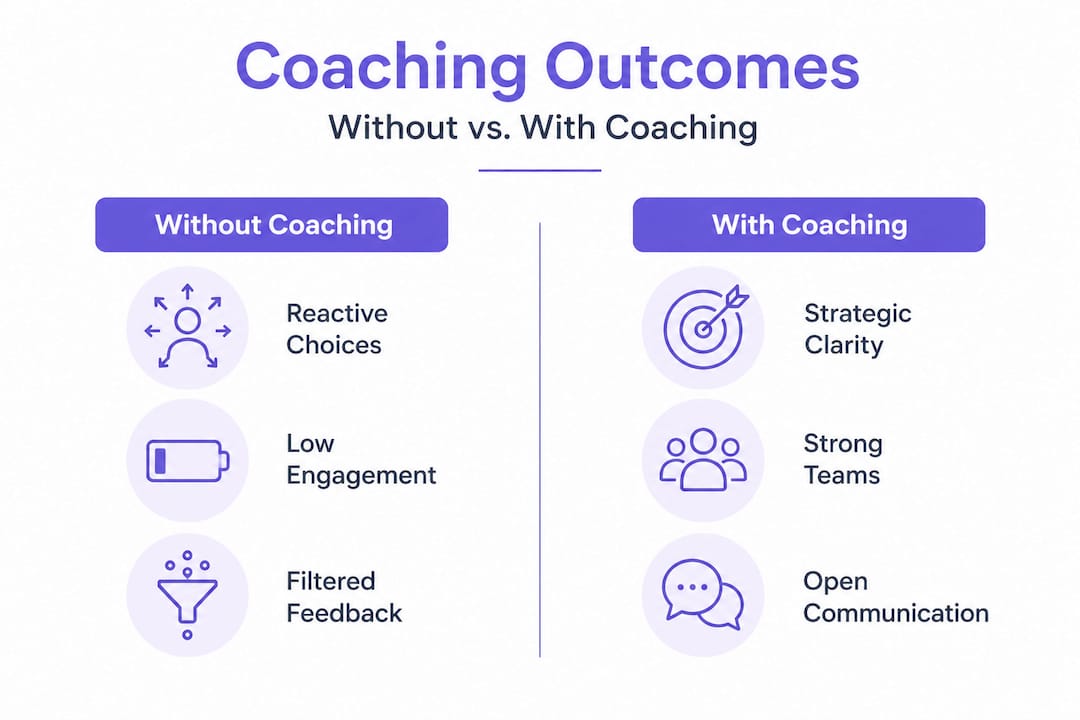
| Without coaching | With coaching |
|---|---|
| Reactive decision-making | Proactive strategic clarity |
| Filtered upward feedback | Structured 360 insights |
| Trial-and-error with people management | Guided frameworks for leadership |
| Isolated under pressure | Supported with a confidential thought partner |
| Undefined executive presence | Intentional presence and communication style |
A concrete example: a director of engineering promoted to VP at a mid-sized SaaS company may have exceptional technical credibility. But the VP role requires influencing across sales, product, and finance, none of which report to engineering. Without coaching, that leader often defaults to what worked before, making technical arguments where political navigation is needed. A coach helps them read the room faster, adjust their communication register, and build coalition support for their initiatives.

For anyone actively working on executive LinkedIn optimization, coaching also provides one underappreciated benefit: clarity of personal brand. When a leader can articulate their leadership philosophy, signature strengths, and career narrative with precision, that clarity flows directly into how they present on LinkedIn, in interviews, and in boardroom conversations.
Practical steps: how to leverage coaching for your tech career
Understanding the benefits is only the beginning. Here are practical ways senior tech professionals can take initiative and maximize coaching value.
The most effective leaders do not wait for their company to offer coaching. They advocate for it, position it as a business investment, and arrive at the first session with clear goals. Here is how to get started:
-
Conduct an honest self-assessment. Use frameworks like the Leadership Circle Profile or a self-administered 360 survey to identify your current leadership gaps. Be specific. “I need to improve communication” is too vague. “I need to be more direct with underperformers without damaging the relationship” is actionable.
-
Build the business case for sponsorship. Approach your manager, HR business partner, or People team with a clear proposal. Frame it around business outcomes: reduced team turnover, faster decision-making, stronger stakeholder alignment. Most mid-to-large tech companies have leadership development budgets that go unspent because leaders do not ask.
-
Select a coach with tech-specific experience. A generalist coach may understand leadership theory, but a coach who has worked with engineering VPs, CTOs, and product leaders understands the specific dynamics of technical cultures. Ask potential coaches about their experience with tech organizations and request referrals.
-
Set measurable goals from the first session. Effective coaching is outcome-oriented. Work with your coach to define two or three measurable goals tied to your role performance: for example, a 10-point improvement in your team’s quarterly engagement score, or promotion readiness by a specific date.
-
Track progress and communicate results. After 60 to 90 days, share your progress with your sponsor. This reinforces the business case, demonstrates your commitment to development, and positions you as a leader who takes growth seriously.
Coaching builds relational leadership alongside technical skills, placing executives in a stronger position for promotions or external market opportunities. If you are simultaneously working on your career positioning, the AI job search playbook can help you translate your coaching-refined leadership narrative into a compelling market presence.
Pro Tip: Document your coaching insights in a leadership journal. The act of writing reinforces behavioral change and gives you concrete examples to use in performance reviews, promotion conversations, and job interviews.
Why coaching is the missing link in tech leadership growth
Having explored steps for leveraging coaching, let’s look at what most company playbooks still miss, and why this matters for tech leadership.
Here is the uncomfortable reality: most technology companies treat coaching as a reactive measure. They engage a coach after the new VP is clearly struggling, after the 360 results come back alarming, or after a high-profile team departure signals that something is broken. By then, the leader has already absorbed reputational damage, and the coach is working in crisis mode rather than growth mode.
This reactive posture is a strategic mistake. The companies that see the highest returns from coaching investment are the ones that embed it into leadership transitions proactively, not as a remediation tool but as a standard operating procedure for any senior hire or significant promotion.
There is also a cultural signal embedded in this choice. When a company offers coaching to its best leaders, not its weakest ones, it communicates a powerful message: we invest in people who are already succeeding because we want them to succeed even more. That message attracts and retains the kind of talent that drives competitive advantage in tech.
From an individual perspective, forward-thinking executives are not waiting for their employer to initiate coaching conversations. They are seeking out coaches independently, treating the investment the way they treat any other high-ROI professional decision. Coaching provides confidential space for strategic clarity and emotional containment, particularly during executive transitions, and the executives who access this support consistently outperform those who navigate transitions alone.
If you are in interview coaching for executives mode right now, preparing for a senior role or making a case for your next promotion, the coaching mindset is already your advantage. The question is whether you are using it fully.
Next steps: find your coaching advantage
If you are ready to unlock more from your career, expert support is just a step away.
Senior tech professionals who engage the right coaching support do not just grow faster, they position themselves more strategically in a competitive market. At TalentFB, we work specifically with managers, directors, VPs, and technology executives who are ready to accelerate their careers with structure and precision.
Our AI-powered coaching sessions combine executive coaching frameworks with AI-enhanced career strategy to help you close leadership gaps, sharpen your positioning, and move decisively toward your next role. Whether you need end-to-end career coaching for tech leaders or a focused sprint using the AI job search playbook, we have the tools and expertise to help you get there faster. The professionals who move quickest are the ones who take action before the opportunity is obvious.
Frequently asked questions
What are the most common triggers for companies to hire executive coaches?
Companies hire coaches most frequently during new executive onboarding, team scaling milestones, post-acquisition integration, and following organizational crises or leadership incidents.
How do leaders measure ROI on coaching engagements?
ROI is tracked through improvements in leadership effectiveness ratings, team engagement scores, retention rates, and progress against clearly defined KPIs established at the start of the engagement.
Are coaching programs confidential for executives?
Yes, professional coaching provides a fully confidential environment, and coaches create safe space for strategic clarity and emotional containment without organizational judgment.
How does coaching help technical leaders make the jump to people management?
Coaching targets the specific gaps that trip up technical leaders, including feedback delivery, communication style, and building team trust, which are skills that relational leadership coaching addresses directly alongside technical expertise.
Do companies sponsor coaching or must leaders pay out of pocket?
Most mature tech companies include executive coaching within their leadership development budgets, and companies routinely hire coaches for senior professionals as a standard talent investment rather than an exception.