
TL;DR:
- LinkedIn’s recruitment engine surfaces candidates through behavioral signals, profile completeness, and AI.
- Skills taxonomy and consistent profile signals significantly expand visibility beyond traditional titles.
- Automated AI workflows mean profiles must be optimized for both human and AI recruiters to succeed.
Most senior technology professionals treat LinkedIn like a digital bulletin board, posting their credentials and waiting for something to happen. That passive approach costs them time, visibility, and in many cases, significant salary. LinkedIn is not a job board with a social layer on top. It operates as a living, signal-based recruitment engine that surfaces candidates through behavioral data, profile completeness, skills taxonomies, and increasingly, agentic AI. For professionals in job transition, understanding how this engine actually works is the difference between being found and being invisible.
Table of Contents
- How LinkedIn powers recruitment beyond traditional job boards
- Skills taxonomy, profile signals, and visibility: LinkedIn’s new recruitment mechanics
- Recruiter workflow and agentic AI: How tech hiring has changed in 2026
- Leveraging hiring signals and workforce reports for smarter job transition
- What most senior tech professionals miss about LinkedIn’s recruitment power
- Optimize your job search with executive career support
- Frequently asked questions
Key Takeaways
| Point | Details |
|---|---|
| Skills-first profiles win | Emphasizing relevant skills on LinkedIn greatly increases your visibility to recruiters using skills-based search. |
| AI shapes the hiring process | Recruiter workflows on LinkedIn are increasingly automated by agentic AI, making strong profile signals essential. |
| Leverage workforce reports | Tracking LinkedIn workforce reports helps you time and target your job search more strategically. |
| Profile completeness matters | Completing all sections of your LinkedIn profile boosts your chances of being shortlisted during search. |
How LinkedIn powers recruitment beyond traditional job boards
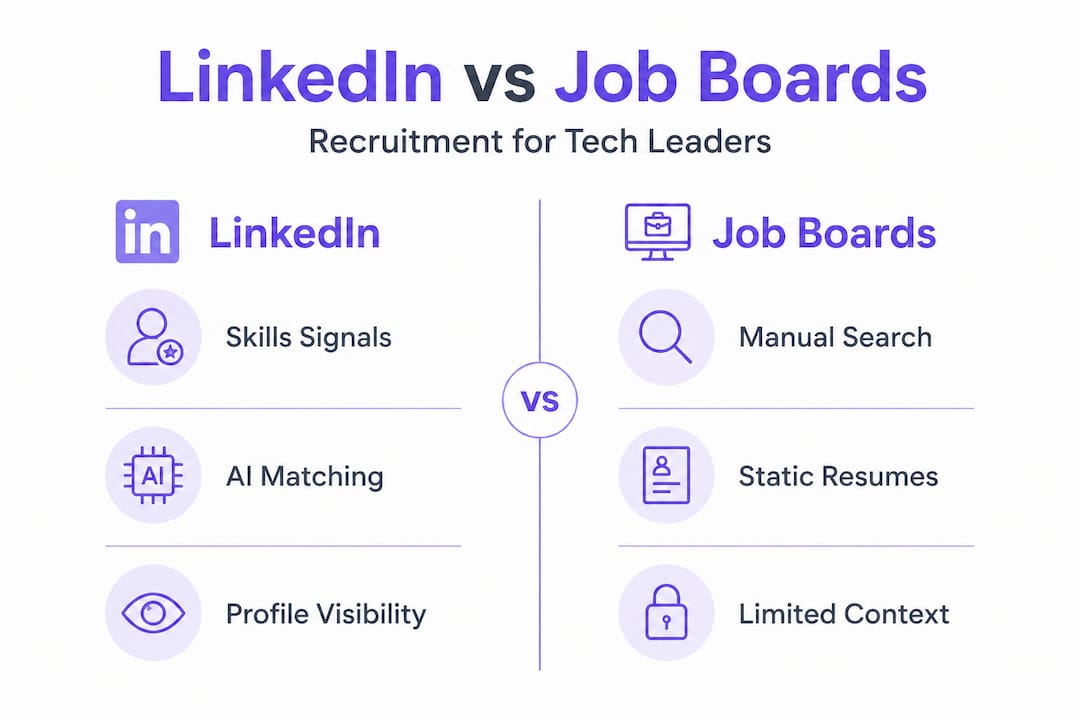
Traditional job boards operate on a simple premise: you apply, a recruiter reviews, and a decision follows. The process is static, application-driven, and largely reactive. LinkedIn works on an entirely different model. It continuously indexes live data pulled from member profiles, including employer changes, skills updates, endorsements, and engagement signals, to generate a dynamic picture of workforce movement.
LinkedIn’s Workforce Reports are built on real hiring activity captured from member profiles, measuring how frequently professionals add new employers each month. This is not survey data. It is behavioral data at scale, which is why it carries weight with recruiters and hiring teams. For senior tech job transitionists, LinkedIn can function as a signal-based channel that traditional boards simply cannot replicate.
Here is how LinkedIn tracks hiring activity in ways that directly affect your visibility:
- Profile updates and completeness scores influence how often your profile appears in recruiter search results.
- New employer additions are logged and fed into LinkedIn’s Workforce Reports, contributing to regional and industry-level hiring rate data.
- Engagement signals, such as commenting on posts or following companies, indicate active job-seeking behavior to LinkedIn’s algorithms.
- Open to Work settings (visible only to recruiters) trigger placement in targeted recruiter search filters.
- Connection growth in relevant industries or companies increases the probability of referral-driven introductions.
“LinkedIn’s Workforce Reports measure hiring activity using the number of LinkedIn members who added a new employer to their profile each month, providing real-time directional data on labor market movement.” — LinkedIn Economic Graph
Compare this to a job board like Indeed or Dice: you submit a resume, your application enters a queue, and you wait. There is no behavioral layer. There is no real-time matching engine. You are not discoverable unless you apply first. LinkedIn, by contrast, allows recruiters to find you before you ever apply, which is a fundamental structural advantage. Access our job search resources to see how this changes your overall outreach approach.
Skills taxonomy, profile signals, and visibility: LinkedIn’s new recruitment mechanics
A skills taxonomy is a structured classification system that organizes related skills into clusters, such as grouping “cloud architecture,” “AWS,” and “Kubernetes” under a broader infrastructure competency. LinkedIn’s Skills Genome uses this kind of taxonomy to expand recruiter search results beyond job title matching, pulling in candidates who have the relevant skill clusters even if their title does not exactly match the open role.
A profile signal is any data point on your LinkedIn profile that tells LinkedIn’s algorithm or a recruiter something meaningful about your experience, expertise, or intent. Skills endorsements, certifications, featured projects, and even the keywords in your About section all function as signals.

Research on skills-based hiring shows that LinkedIn’s Skills Genome can expand the eligible talent pool substantially compared to conventional title-only approaches. This is critical for senior tech professionals who may hold titles like “VP of Engineering” at one company and “Head of Technology” at another, doing essentially the same job. Skills-based matching captures both candidates; title-only searching might miss one entirely.
| Search Approach | Talent Pool Size | Visibility Likelihood | Recruiter Match Rate |
|---|---|---|---|
| Title-driven search | Narrower, excludes non-standard titles | Lower for career changers | Moderate |
| Skills-driven search | Significantly broader | Higher across diverse backgrounds | Substantially higher |
| Combined title + skills | Broadest reach | Highest | Highest |
For practical guidance on understanding the skills taxonomy for tech execs, the alignment process involves three clear steps:
- Identify the top ten skills appearing in job postings for your target roles. Use LinkedIn’s job search to scan at least 20 to 30 relevant postings and note recurring terms.
- Validate which of those skills you actually possess by cross-referencing your current experience, certifications, and project work.
- Add those validated skills to your LinkedIn profile in the Skills section, and where possible, weave them naturally into your headline, About section, and experience descriptions.
Pro Tip: LinkedIn gives higher search weighting to skills that appear in multiple sections of your profile rather than just the Skills list. If “product strategy” or “enterprise architecture” appears in your headline, About section, and job descriptions, your signal strength for those terms increases substantially. Recruiters using LinkedIn Recruiter filters for those skills are far more likely to surface your profile.
For broader executive career tips that complement this skills-first approach, consistent profile auditing every 60 to 90 days keeps your signal current and aligned with shifting market demand. That kind of consistent maintenance is one of the highest-leverage habits a senior tech professional can build during a job transition.
Recruiter workflow and agentic AI: How tech hiring has changed in 2026
The recruiter experience on LinkedIn has shifted dramatically in the past 18 months. Where a recruiter once manually sifted through dozens of profiles to build a shortlist, agentic AI now handles much of that workflow automatically. Agentic AI refers to AI-driven agents that can carry out multi-step tasks independently, including searching for candidates, filtering by fit, drafting outreach messages, and scheduling follow-ups, without requiring manual input at each stage.
LinkedIn’s AI hiring products are on track to generate US$450 million in sales annually, which signals just how aggressively the platform is integrating automation into the recruiter workflow. This is not a pilot program. It is a fully scaled commercial product, which means the AI-driven screening of your profile is already happening, whether you are aware of it or not.
| Step | Manual Recruiter Workflow | AI-Enhanced Workflow |
|---|---|---|
| Candidate search | Manual keyword input, profile-by-profile review | Automated search with multi-parameter matching |
| Shortlisting | Manual scoring and comparison | AI-ranked candidate lists with fit scores |
| Initial outreach | Manually written and sent InMails | AI-drafted, personalized InMails sent at scale |
| Follow-up | Calendar-managed, often inconsistent | Automated sequences with conditional logic |
| Reporting | Manual tracking in spreadsheets | Real-time dashboards with conversion metrics |
For senior tech candidates, the automation of recruiter workflows creates both opportunity and risk. Opportunity: well-optimized profiles surface more frequently and receive outreach faster. Risk: profiles with weak signals, incomplete sections, or misaligned skills simply do not appear in the automated shortlists.
Top actions that recruiters now automate using LinkedIn include:
- Candidate pool building, where AI agents scan thousands of profiles simultaneously to build a preliminary list based on required skills and experience thresholds.
- Fit scoring, which assigns a numerical relevance ranking to each candidate based on how closely their profile aligns with the job’s skills taxonomy.
- InMail drafting and sending, where AI generates personalized outreach at scale, making it easier for recruiters to contact 50 to 100 candidates in the time it previously took to contact ten.
- Follow-up sequencing, where candidates who do not respond receive a second or third touchpoint automatically.
Pro Tip: To appeal to both human recruiters and AI agents, write your profile in natural language that mirrors the language used in job postings for your target roles. Avoid jargon-heavy or overly creative language in your headline and About section. AI agents parse your profile for keyword and skills matches, so clarity beats cleverness every time. Review the landscape of AI recruiting tools that recruiters are already deploying to understand what your profile is being evaluated against.
Understanding how tech talent strategies are evolving on the recruiter side gives you a genuine competitive edge. Most candidates optimize their profiles for human readers alone. Those who optimize for both humans and AI agents position themselves at the intersection where the most screening actually happens.
Leveraging hiring signals and workforce reports for smarter job transition
LinkedIn’s Workforce Reports are one of the most underutilized strategic assets available to senior tech professionals in job transition. Published monthly, they track hiring activity by industry, region, and function, giving you a real-time directional read on which markets are heating up and which are cooling down.
The April 2025 Workforce Report highlights that LinkedIn’s hiring activity signals can lag real market conditions by four to six weeks, because they measure profile employer changes that happen after someone has already accepted a role. That lag is important context, but it does not reduce the value of the data. The directional trend, whether hiring in a particular sector is accelerating or contracting, remains accurate and actionable.
“Workforce Reports give you a map, not a GPS. The direction is right, even if the exact position is slightly behind. Use them to inform your strategy, not to set precise timelines.” — Career Strategy Insight
Here is a practical four-step process for using these reports to sharpen your job transition approach:
- Track your target sector monthly. Bookmark LinkedIn’s Workforce Report page and check it on the first week of each month. Note whether hiring in technology, cybersecurity, cloud infrastructure, or your specific vertical is trending up or down.
- Calibrate your outreach pace. In a hiring-accelerating market, increase your outreach frequency and target mid-tier companies expanding their teams. In a slowing market, prioritize quality over quantity and focus on companies known to be counter-cyclical.
- Set realistic interview timeline expectations. When the report shows hiring rates declining, expect longer hiring cycles. Build that into your financial planning and avoid accepting premature urgency that leads to poor decisions.
- Time your job switch strategically. If you are currently employed but considering a move, use three consecutive months of accelerating hiring data as a signal that market conditions favor your transition. Do not act on a single month’s data.
This kind of data-informed, strategic approach is exactly what distinguishes senior professionals who land strong roles quickly from those who search reactively for months without traction. The reports are free, publicly accessible, and updated consistently. Use them as part of your monthly job search rhythm, not as an afterthought.
What most senior tech professionals miss about LinkedIn’s recruitment power
Here is a truth that most career advice does not acknowledge plainly: polishing your profile once and hoping for results is not a strategy. It is wishful thinking dressed up as action. The professionals who consistently attract strong recruiter attention are those who treat LinkedIn as a dynamic system, not a static document.
The real competition in a senior tech job search is not the other candidate applying for the same role. It is the algorithm’s match logic and the recruiter’s increasingly automated workflow. If your profile is not generating the right signals continuously, you are invisible to the system regardless of how impressive your actual experience is.
Three counterintuitive truths worth internalizing:
- Skills matter more than pedigree. Recruiters using LinkedIn’s AI-powered tools are filtering by skills clusters, not prestige logos. A well-optimized profile from a mid-market company will consistently outperform an incomplete profile from a FAANG company in recruiter search results.
- Visibility is algorithm-driven. Consistently engaging with content in your niche, publishing short posts about your expertise, and commenting thoughtfully in industry conversations all send engagement signals that improve your profile’s appearance frequency in recruiter feeds.
- Workforce trend data is a goldmine for timing. Most candidates ignore it entirely, which means those who read and apply it have a meaningful first-mover advantage.
What surprises many professionals is how much hiring activity moves off-platform entirely. Recruiters use LinkedIn’s backend tools to identify candidates, then move those conversations to email, phone, or internal ATS systems quickly. Your hidden job market strategies need to account for this. Being found on LinkedIn is often just step one. Having a strong referral network layered on top is what converts discovery into an actual conversation.
The professionals who treat LinkedIn as both a visibility tool and a market intelligence platform tend to move through transitions faster, with more confidence and better offers.
Optimize your job search with executive career support
Now that you understand what makes LinkedIn essential and effective for senior-level job transitions, the logical next step is making sure your profile and strategy are genuinely optimized, not just updated.
At TalentFB, we work specifically with senior technology professionals who are ready to move faster, smarter, and with far more strategic clarity than a solo job search allows. Our executive career coaching program covers every dimension of LinkedIn positioning, from skills alignment to recruiter outreach to AI-readiness. If you are not sure where your profile stands right now, start with our LinkedIn profile optimization guide designed specifically for tech leaders. You can also measure your current positioning with the Executive Visibility Scorecard, a practical tool that shows you exactly where you stand and what to prioritize next.
Is LinkedIn a social network or a recruitment platform?
Both, and senior professionals who treat it as only one miss half its value. LinkedIn has feeds, posts, comments and messages like any social network. But unlike other platforms, most of its users are there for work, and recruiters pay for tools that search every profile on it. That combination means your content and your profile work together: posts make people remember you, and your profile is what they check before they reach out. Treat your activity as professional reputation building, not social media.
Frequently asked questions
How is LinkedIn different from traditional job boards for senior tech recruitment?
LinkedIn uses real hiring activity, skills signals, and AI-powered tools to match recruiters and candidates dynamically, rather than relying on applications alone. As LinkedIn’s Workforce Report shows, it can function as a signal-based channel that job boards simply cannot replicate.
How can I improve my LinkedIn profile’s visibility for tech recruiter searches?
Focus on adding in-demand skills, completing every profile section, and aligning your language with the skills taxonomy relevant to your target roles. Skills-based approaches using LinkedIn’s Skills Genome expand the eligible talent pool significantly compared to title-only searches.
What is agentic AI, and how does it impact my job search?
Agentic AI refers to automated agents that handle recruiter tasks such as searching, shortlisting, and sending outreach independently. LinkedIn’s AI-powered hiring products are on track to generate US$450 million annually, meaning your profile is already being evaluated by automated systems.
How do LinkedIn’s Workforce Reports help my job transition strategy?
They provide month-to-month hiring trend data by industry and region so you can time your outreach, set realistic expectations, and focus your energy on growth areas. The April 2025 report confirms that these signals are directionally accurate even when they lag slightly behind real-time market movement.