
TL;DR:
- Candidate experience in tech hiring encompasses every touchpoint that shapes candidate perceptions from application to onboarding. Improving clarity, communication, and structure at each stage increases offer acceptance rates and strengthens employer brand reputation. Addressing process flaws and leveraging measurement ensures a faster, fairer, and more effective talent acquisition strategy.
Competitive salaries and cutting-edge tech stacks do not guarantee a “yes” from the candidates you want most. In fact, only 26% of candidates report having a great experience during the hiring process, and candidates who feel respected throughout are 38% more likely to accept an offer. For senior technology leaders responsible for hiring top engineers, architects, and product managers, candidate experience has become the most underestimated variable in talent acquisition. This guide cuts through the noise to show you what candidate experience actually means, why it drives real business outcomes, and how to improve it with precision.
Table of Contents
- Defining candidate experience in tech hiring
- Why candidate experience drives tech talent outcomes
- Building a world-class candidate journey: Best practices
- The tech sector’s candidate experience ‘trap doors’
- Measuring, benchmarking, and iterating candidate experience
- Why most tech leaders still get candidate experience wrong
- Take candidate experience—and hiring results—to the next level
- Frequently asked questions
Key Takeaways
| Point | Details |
|---|---|
| Candidate experience defined | It is the sum of perceptions a candidate forms at every stage, from application to offer and beyond. |
| Drives hiring success | Quality candidate experience boosts offer acceptance, referrals, and employer reputation in competitive tech hiring. |
| Best practices matter | Structured interviews, clear communications, and feedback loops make the biggest impact for senior talent. |
| Avoid common pitfalls | Over-automation, slow responses, and too many interviews quickly undermine the candidate experience. |
| Measure and iterate results | Tracking cNPS and related metrics enables continuous improvement and stronger hiring outcomes. |
Defining candidate experience in tech hiring
Candidate experience is not a vague measure of whether candidates felt good about your company. It is something far more operational than that. Candidate experience is the perception and feelings of job seekers across every touchpoint of the hiring process, from the first moment they see your job description to the point of final feedback or onboarding. Every interaction shapes it: the clarity of your job advertisement, how easy your application is to complete, how quickly your team communicates, the quality of your interviews, and the structure of your offer.
In the tech sector, this definition takes on specific weight. Senior engineers and technical leaders carry expectations shaped by years in a high-accountability industry. They can spot a disorganized process immediately, and they interpret it as a signal about your broader organizational health.
The key touchpoints in a tech hiring journey include:
- Job advertisement: Does it clearly define scope, leveling, compensation range, and technical stack? Vague postings cost you credibility before a conversation begins.
- Application process: Is it streamlined, mobile-friendly, and respectful of a candidate’s time? Requiring 45 minutes of form-filling for a senior role sends a message.
- Communication cadence: Are candidates informed of next steps within a predictable window? Silence is a rejection signal even when it is not intended to be.
- Technical assessment and interviews: Are these structured, relevant, and calibrated to the actual role? Over-engineering or under-structuring your evaluation process signals dysfunction.
- Offer stage: Is the offer competitive, clearly presented, and delivered with transparency about terms and flexibility?
- Onboarding and feedback: Whether a candidate accepts or declines, how you close the experience determines whether they refer others or warn their network away.
“The candidate experience is your employer brand in real-time. Every recruiter email, every scheduling glitch, every silent week is a data point your candidates are using to evaluate your culture.”
For tech leaders serious about improving candidate experience, clarity at each touchpoint is not a courtesy. It is a competitive requirement.
Why candidate experience drives tech talent outcomes
Candidate experience is not a soft HR metric you optimize when things slow down. It is a direct lever for hiring velocity, offer acceptance, referral volume, and employer brand equity. The data makes this hard to ignore.

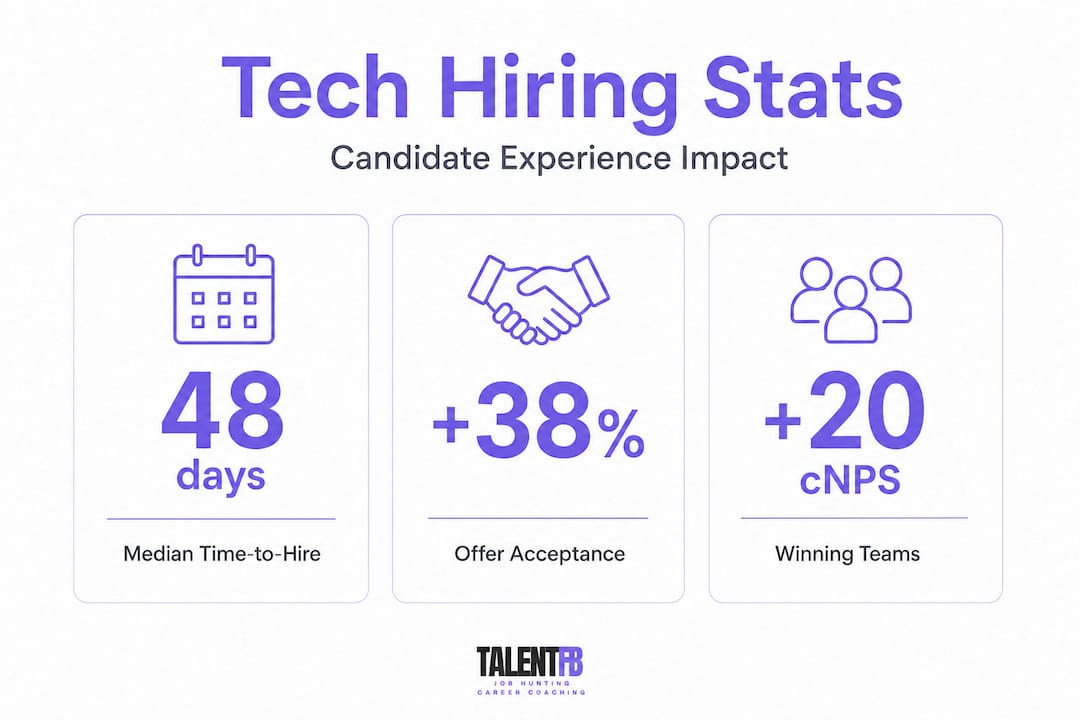
Candidates are 38% more likely to accept an offer after a positive candidate experience. That single statistic translates, at scale, to fewer failed searches, less time-to-fill delay, and lower recruiter burnout from restarts. But the tech sector’s own benchmarks reveal a deeper problem.
The technology sector median time-to-hire sits at 48 days, which is 26% slower than the cross-industry average. Tech companies also average 110 applications per hire and an offer acceptance rate of only 77%, which is 12 percentage points below the broader market benchmark. These are not random fluctuations. They reflect a structural deficit in how tech organizations design and deliver the hiring experience.
| Metric | Tech sector | Cross-industry benchmark |
|---|---|---|
| Median time-to-hire | 48 days | 38 days |
| Applications per hire | 110 | 72 |
| Offer acceptance rate | 77% | 89% |
| Referral share of hires | 16% | 12% |
To start measuring where you stand, track candidate NPS and recruiting metrics from the moment candidates enter your funnel. The candidate NPS benchmark, known as cNPS, targets a score of +20 or higher. Leading organizations also monitor application completion rates to identify where drop-off occurs, offer acceptance rates against the 85 to 95% benchmark, and time-to-hire alongside time-to-archive. These metrics, tracked consistently, reveal exactly where your candidate experience breaks down and where fixing it will have the highest return.
Building a world-class candidate journey: Best practices
Knowing why candidate experience matters is only half the equation. Knowing what to do about it is where most organizations fall short. The best-in-class approach is not about adding perks or sending a thank-you email. It requires a deliberate, stage-by-stage redesign of your hiring process.
Here is a structured approach to raising the standard:
- Audit your job descriptions for precision. Every posting should include role level, compensation band, required vs. preferred qualifications, and what success looks like in the first 90 days. Ambiguity at this stage filters out the wrong candidates and frustrates the right ones.
- Simplify and mobilize the application process. Top senior candidates often browse roles on mobile during limited windows of time. An application that requires toggling to a desktop, re-entering resume information manually, or completing lengthy open-text fields mid-process will lose them before they start.
- Set communication SLAs and honor them. Commit to 48-hour response windows at every stage. Timely personalized communication is one of the highest-leverage improvements any hiring team can make, and it costs nothing but discipline.
- Use structured interviews with scorecards. Every interviewer on your panel should evaluate the same competencies using the same rubric. This is not just about fairness. It is about predictive accuracy and legal defensibility.
- Deliver feedback, even for rejections. A brief, specific, constructive note after a final-stage rejection preserves the relationship and reinforces your employer brand. Generic rejection emails do the opposite.
For senior tech talent specifically, structured processes with behavioral benchmarks outperform unstructured conversations every time. Technical assessments should reflect real work, not algorithmic puzzles disconnected from day-to-day responsibilities. Clear leveling guides help candidates self-select appropriately and help interviewers calibrate fairly. Respecting seniority means not asking a VP of Engineering to spend 8 hours on a take-home project before a first conversation.
| Hiring stage | Common failure | Best practice improvement |
|---|---|---|
| Job advertisement | Vague scope and no salary range | Clear leveling, comp band, and 90-day outcomes |
| Application | Desktop-only, multi-step forms | Mobile-optimized, 10-minute max for senior roles |
| Screening call | Inconsistent questions | Structured intake with defined evaluation criteria |
| Technical assessment | Irrelevant algorithm puzzles | Work-sample tasks tied to actual role scope |
| Final interviews | No debrief structure | Scorecard-driven panel with calibration session |
| Offer and close | Slow or vague offer delivery | Transparent, prompt, and flexible offer framing |
If candidates are navigating your process for the first time, their experience mirrors what your best application tips recommend for candidates themselves: clarity, brevity, and respect for the other party’s time.
Pro Tip: When delivering rejections to senior candidates, include one specific strength you observed and one honest, respectful reason the fit was not right at this time. This two-line addition transforms a rejection into a brand-building moment that generates referrals and goodwill.
The tech sector’s candidate experience ‘trap doors’
Even organizations with strong intentions fall into structural traps that quietly erode candidate experience. Knowing them in advance is far less costly than discovering them through declining offer acceptance rates.
The most common pitfalls in tech hiring include:
- Ghosting after interviews. Candidate NPS drops sharply when more than three weeks pass without a decision. For senior candidates, this is career-limiting behavior on your company’s part, not theirs.
- Excessive interview rounds. Five to seven rounds may feel rigorous, but they signal poor process design and disrespect for the candidate’s current commitments. Three to four targeted, well-structured rounds are almost always sufficient.
- Over-reliance on automation without governance. AI enhances speed and scale in screening and scheduling, but ungoverned use creates new risks. Bias in screening models, opaque rejection logic, and hallucinations in AI-generated outreach all damage trust. Disclose AI use. Apply it to low-stakes tasks. Reserve human judgment for finalist decisions.
- Assumptions about nontraditional profiles. Many high-performing senior candidates follow nonlinear career paths, including career pivots, gaps, or cross-industry moves. AI and manual screening processes built on pattern-matching often filter these candidates out at scale.
“The biggest invisible cost in tech hiring is not a failed search. It is the candidate who left your process frustrated, told three colleagues, and quietly shifted your employer brand in the market.”
For organizations exploring AI in talent acquisition, the challenge is governance, not adoption. The technology itself is powerful. The question is where human oversight is non-negotiable. For senior and specialized roles, automated screening should surface candidates, not eliminate them. Final decisions, feedback delivery, and offer conversations require a human voice.
When evaluating AI candidate sourcing tools, look for explainability features, bias auditing, and the ability to flag edge cases for human review rather than auto-reject them. The HR’s role in tech hiring has evolved precisely because the stakes of getting this balance wrong are higher than ever. Smart use of resume automation with AI on the candidate side also means your inbound talent is more polished and better-matched. Your process needs to rise to meet that standard.
Pro Tip: Build a “human touch” checkpoint into your ATS workflow at three stages: after screening, before final-round scheduling, and at offer delivery. This does not slow the process. It prevents the costly mistakes that automation alone cannot catch.
Measuring, benchmarking, and iterating candidate experience
Improvement without measurement is guesswork. To sustain meaningful progress on candidate experience, you need a consistent feedback loop built into your process architecture.
Here is a practical measurement framework:
- Deploy post-stage candidate surveys. Short, three-question pulse surveys after the screening call, post-interview, and at offer or rejection capture sentiment at the moments that matter most.
- Calculate your cNPS monthly. The net promoter score approach applied to candidates gives you a single number that tracks direction over time. Benchmark against the +20 floor.
- Monitor application drop-off by stage. Your ATS data will show where candidates abandon the process. High drop-off at the application form signals UX problems. High drop-off post-interview signals a communication or timeline issue.
- Track offer acceptance rate vs. benchmark. If you are consistently below 85%, your issue is likely at the offer stage or the experience leading up to it.
- Connect referral rate to candidate experience quality. Candidates who had a positive experience, even without receiving an offer, refer others at measurably higher rates.
The impact of rigorous measurement is striking. Organizations recognized as CandE benchmark winners achieve a candidate NPS of 59 at the attract stage versus the industry average of 40, and their candidates show 56% higher willingness to refer others. That referral premium compounds over time, reducing cost-per-hire and improving the quality of your talent pipeline without additional sourcing spend.
| Metric | CandE winners | Industry average | Your target |
|---|---|---|---|
| cNPS at attract stage | 59 | 40 | +20 minimum |
| Offer acceptance rate | 90%+ | 77% (tech) | 85-95% |
| Referral willingness | +56% above average | Baseline | Measurable increase |
For a deeper look at refining your talent acquisition strategies, weave these metrics into your quarterly hiring reviews alongside time-to-fill and cost-per-hire data.
Why most tech leaders still get candidate experience wrong
Here is the uncomfortable truth that most talent acquisition content avoids: investing in an ATS upgrade, deploying a chatbot, or launching a new careers page does not fix candidate experience. These are additions to a broken process, not transformations of it.
The root cause of poor candidate experience in tech organizations is almost never a lack of tools. It is a lack of feedback loops and process accountability. Hiring managers who do not debrief. Recruiters without SLA commitments. Interview panels without scorecards. Offers that take two weeks to get approved. These are structural and cultural failures, and no software layer resolves them.
The deepest tradeoff in this space is one that most leaders do not acknowledge openly: speed versus personalization versus fairness. Moving fast narrows personalization. Maximizing thoroughness extends timelines. Optimizing for speed and fairness simultaneously requires more upfront process design than most organizations invest in. The organizations that get candidate experience right are the ones that have made an explicit decision about what they are optimizing for, built the process around that decision, and measured it relentlessly.
Authentic human connection at critical moments, even when AI handles the administrative load, is what separates the companies candidates recommend from the ones they warn their network about. A well-timed, genuine message from a hiring manager after a final interview costs 90 seconds and generates goodwill that no automated sequence replicates. Start there, before you redesign your entire tech stack.
For leaders looking to anchor all of this in a structured approach, your hiring strategy for tech leaders needs to treat candidate experience as a first-class component, not an afterthought of HR branding.
Take candidate experience—and hiring results—to the next level
Transforming your candidate experience is one of the highest-leverage moves a tech leader can make in 2026. The data is clear, the practices are proven, and the competitive advantage is real. The gap between organizations that invest deliberately in this area and those that do not is widening every quarter.
Whether you are a hiring leader sharpening your process or a senior technology professional preparing for your own next move, TalentFB offers the strategic depth to accelerate your outcomes. Explore our resources on advanced interview prep for leaders on both sides of the table, or connect with our career coaching for tech executives to build a search strategy that reflects the experience-level you bring. If you are ready to move faster and smarter, the AI Job Search Accelerator is the structured program that brings it all together.
Frequently asked questions
How is candidate experience measured in tech recruiting?
Candidate experience is typically measured using cNPS targeting +20 or higher, alongside application completion rates, offer acceptance rates benchmarked at 85 to 95%, and time-to-hire. Post-stage pulse surveys add qualitative depth to these quantitative indicators.
What factors most often damage candidate experience in tech?
The most common issues are slow communication, ghosting, and excessive interview rounds. Candidate NPS drops sharply when more than three weeks pass without a decision, and multiple unnecessary rounds signal poor process design rather than rigor.
How does AI use impact the candidate experience?
AI enhances speed and scale in tasks like screening and scheduling but risks trust and fairness if not governed carefully. Disclosing AI use, applying it to low-stakes tasks, and preserving human review for final decisions keeps the experience credible and fair.
What practical steps improve candidate experience fast?
Clear job descriptions, mobile-optimized applications, 48-hour communication SLAs, and structured interviews with constructive feedback are the highest-impact, fastest-to-implement improvements for most tech hiring teams.
Why does candidate experience matter more for senior talent?
Senior candidates evaluate your process as a proxy for your organizational health. Structured processes with behavioral benchmarks and clear leveling signals respect for their expertise, which directly influences whether they accept offers and refer colleagues.