
TL;DR:
- Career mobility enables professionals to build skills, increase resilience, and achieve higher earnings through strategic role changes. It also strengthens organizations by promoting cross-functional understanding, faster decision-making, and innovative leadership pipelines. Overcoming barriers like managerial gatekeeping and lack of transparency is essential for maximizing its benefits.
Career mobility is defined as the deliberate movement of professionals across roles, functions, or organizations to build skills, expand influence, and accelerate long-term growth. It is the single most underutilized lever available to both employees and the companies that employ them. Research from Cornell University, Bank of America, and Frontiers in Psychology confirms that professionals who move strategically across roles adapt faster, earn more, and build resilience that static careers simply cannot replicate. Understanding why career mobility matters is not an abstract exercise. It is the foundation of every sound career strategy in 2026.
Why career mobility matters for employees and organizations alike
Career mobility delivers measurable benefits at both the individual and organizational level, and the two are deeply connected. When employees grow, organizations grow with them. When organizations create genuine pathways for movement, employees stay, contribute more, and perform at higher levels.
For individuals, the benefits are concrete:
- Skill diversification: Moving across roles exposes you to different tools, teams, and problem sets. A product manager who spends 18 months in a customer success role returns with empathy and context that no training program can replicate.
- Higher engagement: Professionals who see a clear path forward are more committed to their current work. Stagnation is one of the leading drivers of disengagement, and mobility is its direct antidote.
- Stronger negotiating position: A broader skill set and demonstrated adaptability make you a more compelling candidate, whether you are seeking a promotion internally or exploring external opportunities.
- Career resilience: Professionals who have navigated multiple transitions are better equipped to handle industry disruptions, layoffs, or organizational restructuring.
For organizations, the importance of career mobility extends well beyond retention. Internal mobility programs build broader cross-functional understanding and workforce resilience. A workforce that has moved across departments understands the business holistically, which produces better decisions, faster collaboration, and stronger leadership pipelines.
Pro Tip: If you manage a team, track how many of your direct reports have moved into new roles or projects in the past 12 months. That number is a direct indicator of your team’s long-term adaptability.

What does research say about mobility’s impact on pay and performance?
The data on career mobility is more nuanced than most professionals realize, and understanding that nuance is what separates strategic movers from those who change jobs reactively.
Pay growth and job switching
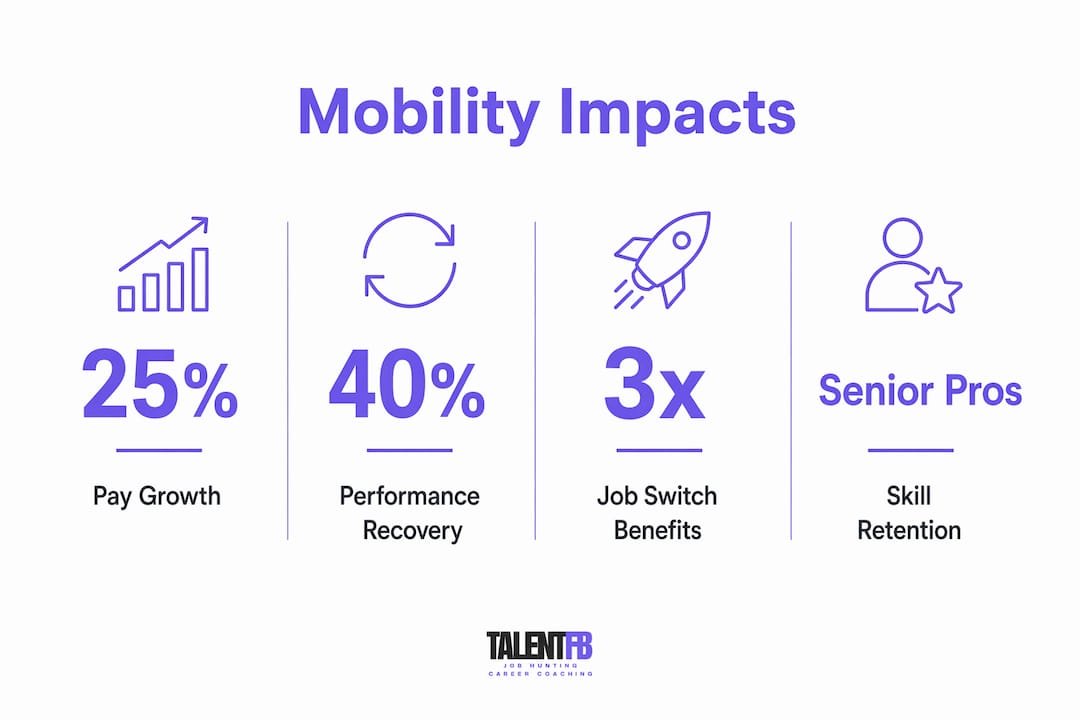
Bank of America research shows that job switching correlates with stronger after-tax wage growth compared to staying put, particularly for Millennials and Gen Z. More than 40% of workers experience flat or declining pay over time, making strategic movement a financial necessity for many professionals. That said, the same research notes that top earners in specialized roles often benefit more by staying, since their compensation is tied to institutional knowledge and seniority.
The hidden performance benefit of frequent moves
Cornell University’s 2026 research identified what it calls a hidden mobility benefit: professionals who change jobs frequently experience a smaller initial performance drop when starting new roles and recover to full productivity faster. The mechanism is straightforward. Repeated transitions teach you how to read new cultures, build relationships quickly, and identify what matters in an unfamiliar environment. These are transferable skills that compound over time.
“The more often people start new jobs, the smaller the initial performance drop and the quicker they come up to speed.” — Cornell Chronicle, 2026
Mobility returns by demographic group
Not all professionals benefit equally from career moves. Research published in EPJ Data Science found that intra-firm occupation changes facilitate upward mobility more strongly for some groups than others, with women and Black graduates receiving significantly lower returns from job mobility compared to men and White peers. This is not a reflection of capability. It reflects structural inequities in how opportunities are allocated and how performance is evaluated across demographic groups.
| Mobility type | Pay impact | Performance recovery | Equity consideration |
|---|---|---|---|
| Internal role change | Moderate pay growth | Fast | Varies by demographic |
| External job switch | Higher short-term gain | Moderate | Stronger for majority groups |
| Lateral move | Minimal pay change | Fast | Broadens skill base |
| Upward promotion | Strongest pay growth | Slower | Often gatekept |
The table above reflects patterns from current research and is intended as directional guidance, not absolute prediction. Your individual outcome depends on industry, organization, and the quality of your transition strategy.
What are the common challenges and barriers to career mobility?
Understanding the benefits of job flexibility and movement is only half the picture. The barriers are real, and ignoring them leads to frustration and stalled careers.
-
Managerial gatekeeping. High-performing employees often face manager vetoes when they express interest in internal moves. Talent hoarding is one of the most common and least discussed barriers to internal mobility. Managers who fear losing their best people block transfers, delay approvals, or simply fail to share internal opportunities with their teams.
-
Lack of transparent pathways. Many organizations have internal job boards that are technically available but culturally invisible. Employees do not know the unwritten rules about who gets considered, what relationships matter, or how to signal interest without damaging their current role.
-
Flexible work without structure. A meta-analysis across 19 countries found that flexible work arrangements improve well-being and organizational commitment, but also risk social isolation and limited advancement opportunities when not paired with structured career pathways. Flexibility without direction is not mobility. It is drift.
-
Equity gaps in access. Structural barriers mean that mobility benefits vary widely across demographic groups. Organizations that do not actively audit who is moving, who is being passed over, and why will perpetuate inequity even with the best intentions.
-
Fear of being seen as disloyal. Many professionals, particularly those in senior roles, hesitate to express interest in a different function because they worry it signals dissatisfaction or lack of commitment. This fear is understandable but often unfounded, especially in organizations that genuinely value development.
Pro Tip: Before requesting an internal move, document the business case for why your skills benefit the target team. Framing it as organizational value rather than personal preference dramatically increases approval rates.
How can you enhance career growth through strategic mobility?
The impact of workforce mobility is maximized when both individuals and organizations take deliberate steps to create and use pathways effectively.
What individuals can do
- Map your skill gaps against roles you want in two to three years, then seek projects or lateral moves that close those gaps now.
- Build relationships across departments before you need them. Internal moves are often relationship-driven, not just merit-driven.
- Use your LinkedIn profile to signal cross-functional experience. Recruiters and hiring managers value candidates who have demonstrated adaptability across contexts.
- Treat every new role as a learning sprint. Set a 90-day goal to understand the team’s priorities, key stakeholders, and success metrics.
What organizations can do
| Approach | Individual benefit | Organizational benefit |
|---|---|---|
| Transparent internal job boards | Visibility into opportunities | Broader candidate pool |
| Mentoring and sponsorship programs | Guided career development | Stronger leadership pipeline |
| Internal talent mobility platforms | Access to projects and stretch roles | Cross-functional knowledge transfer |
| Structured transition support | Faster onboarding to new roles | Reduced productivity loss |
Career adaptability research from Frontiers in Psychology confirms that transparent access to projects and mobility opportunities is the linchpin of turning internal programs into real development outcomes. Policy alone is not enough. The system must make it genuinely easy for employees to raise their hand and move.
For senior professionals in technology, the stakes are particularly high. The strategic career growth decisions you make in the next 12 to 24 months will define your positioning for the next decade. Mobility is not a detour from your career path. It is the path.
A well-designed job application strategy, like the one outlined in SparkCV’s 2026 guide, reinforces that targeted, intentional movement outperforms reactive job searching every time. Knowing why you are moving and where you are headed is what separates professionals who advance from those who simply change employers.
Why I believe most professionals underestimate mobility as a career skill
I have worked with hundreds of senior professionals in technology, and the pattern I see most often is this: they treat career mobility as something that happens to them rather than something they design. They move when pushed by a layoff, a bad manager, or a stalled promotion. They rarely move from a position of strength, with a clear thesis about what they are building toward.
The research from Cornell changed how I think about this. The mobility benefit is not just about pay or titles. It is about building a specific kind of professional intelligence: the ability to walk into an unfamiliar environment and become effective quickly. That skill is worth more than any single credential or tenure milestone.
What I find most underappreciated is the organizational side of this equation. Companies that build genuine internal mobility systems do not just retain people longer. They build workforces that can pivot, collaborate across silos, and develop leaders from within. That is a competitive advantage that no hiring budget can replicate.
My honest recommendation: stop waiting for your organization to hand you a career path. Map it yourself. Identify the two or three moves that would make you genuinely more valuable and more resilient, then pursue them with the same rigor you would apply to any strategic business decision. The professionals I have seen thrive long-term are not the ones who stayed safe. They are the ones who moved with intention.
— Frederic
How Talentfb can accelerate your next career move
If you are a senior professional in technology ready to move with intention, Talentfb’s AI Job Search Accelerator is built specifically for you. The program combines personalized career strategy, LinkedIn profile optimization, and AI-driven outreach techniques to help you land the right role within 90 days.
Whether you are targeting a leadership transition, a cross-functional move, or a step up in compensation, the Job Search OS Masterclass gives you the structured framework and expert coaching to make it happen. You can also explore career advice for senior professionals to find guidance tailored to where you are right now. Mobility is the strategy. Talentfb is the execution partner.
FAQ
What is career mobility, exactly?
Career mobility is the movement of professionals across roles, functions, or organizations to build skills and advance their careers. It includes internal transfers, promotions, lateral moves, and external job changes.
Does job hopping hurt your career?
Not necessarily. Cornell University’s 2026 research found that frequent job changers adapt faster to new roles and experience a smaller performance drop during transitions, making them more attractive to hiring managers in dynamic environments.
Why is career progression essential for senior professionals?
Senior professionals who stop moving risk skill stagnation and reduced market value. Strategic mobility keeps your expertise current, expands your network, and positions you for leadership roles that require cross-functional experience.
How does career mobility affect pay?
Bank of America research shows that job switching correlates with stronger wage growth for Millennials and Gen Z, though more than 40% of workers see flat or declining pay regardless of movement. Strategic timing and targeting matter significantly.
What stops organizations from supporting internal mobility?
The two most common barriers are managerial talent hoarding and the absence of transparent internal opportunity systems. Research confirms that without visible pathways and cultural support, capable employees leave rather than move internally.