TL;DR:
- Mentorship provides personalized guidance, honest feedback, and network access that significantly accelerate career growth.
- Building multiple structured relationships with mentors and sponsors enhances promotion prospects, work-life balance, and professional confidence.
The role of mentors in career growth is to provide personalized guidance, honest feedback, and access to networks that accelerate professional advancement in ways that self-study and experience alone rarely achieve. Mentorship, the recognized industry term for this structured developmental relationship, is not a soft benefit. Mentored individuals show measurable gains in self-esteem, career focus, leadership capability, and financial outcomes. For mid-level managers and emerging leaders, this distinction matters enormously. Programs like Mentorloop and the International Women in Resource Management Program (IWRMP) have demonstrated that structured mentoring relationships produce promotions, salary increases, and stronger retention rates. If you are serious about your next career move, mentorship is not optional.
How mentors influence career development
Mentors do three things that no course or certification can replicate: they share hard-won experience, they expand your professional network, and they give you honest feedback that colleagues rarely will. Each of these mechanisms directly shapes your career trajectory.

The experience transfer alone is worth more than most professionals realize. A mentor who has navigated a merger, managed a difficult board, or transitioned from an individual contributor role to a VP position carries pattern recognition you simply cannot buy. They help you avoid the mistakes that cost others two or three years of momentum.
The network effect is equally powerful. When a respected senior leader introduces you to a hiring manager or recommends you for a high-visibility project, your credibility arrives before you do. This is not about nepotism. It is about social proof in professional environments where trust is the primary currency.
The numbers support this. Mentored employees are promoted roughly five to six times more often than their non-mentored peers, and 25% of mentees experience salary grade changes compared to just 5% of those without a mentor. That gap is not marginal. It represents the difference between a career that compounds and one that plateaus.
Key ways mentors influence your career:
- Clarity on career goals: Mentors help you articulate where you want to go and what is actually blocking you, which is often more valuable than tactical advice.
- Constructive, candid feedback: Unlike managers who have performance reviews to protect, mentors can tell you the truth about your blind spots.
- Network introductions: A single warm introduction from a credible mentor can open doors that years of cold outreach cannot.
- Mistake avoidance: Mentors who have made the errors you are about to make can redirect you before the cost becomes real.
Pro Tip: When you first connect with a mentor, ask them directly: “What is the one mistake you see professionals at my level make most often?” The answer will tell you more than three months of general advice.
Mentorship vs. sponsorship: what is the difference?
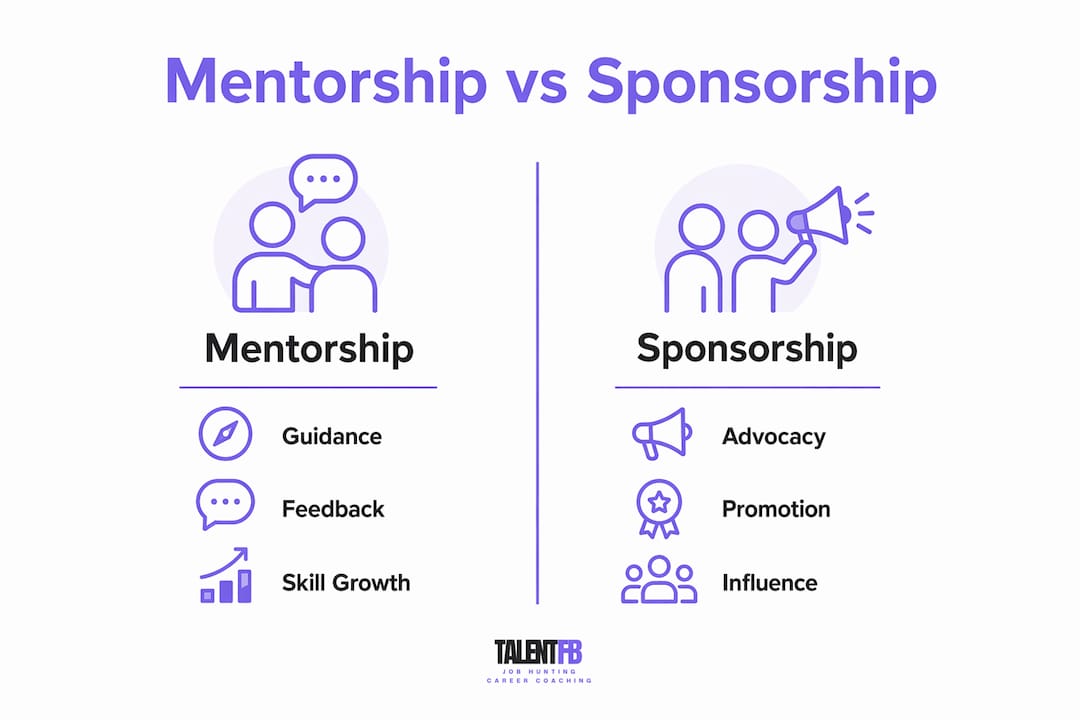
Mentorship and sponsorship are not the same thing, and confusing them is one of the most common strategic errors mid-level professionals make. Understanding both is critical to building a career support system that actually produces results.
| Dimension | Mentorship | Sponsorship |
|---|---|---|
| Primary function | Guidance, listening, and feedback | Advocacy, references, and opportunity access |
| Relationship type | Developmental and ongoing | Strategic and often project-specific |
| Who benefits most | Mentee’s skills and confidence | Mentee’s visibility and promotion prospects |
| How it works | Regular conversations and coaching | Sponsor speaks on your behalf in rooms you are not in |
| Best used for | Building capability and clarity | Securing promotions and high-profile projects |
According to GOV.UK research on development programs, mentorship schemes increase the chances of higher salaries, bonuses, and promotions, while sponsorship goes further by providing direct advocacy and access to opportunities that mentors typically cannot offer. The distinction is not academic. A mentor prepares you for the promotion conversation. A sponsor has that conversation on your behalf.
Mid-level professionals often need both simultaneously. You need a mentor to sharpen your leadership presence and a sponsor to put your name in front of the right decision-makers. The professionals who advance fastest are the ones who build both relationships deliberately, not by accident.
The strategic move is to identify one or two mentors for skill development and one sponsor who already has influence in the rooms where your next role gets decided. These are different asks, different relationships, and different conversations.
Does mentorship improve job satisfaction and work-life balance?
Most professionals think of mentorship purely in terms of promotions and salary. The research tells a more complete story. Mentorship’s impact on career sustainability, job satisfaction, and work-life balance is just as significant, and for many professionals, it is what keeps them in the game long enough to reach senior leadership.
A study published in Nature involving 1,364 faculty members found that mentorship significantly improves work-life balance and employee satisfaction, with technology further amplifying this effect. Work-life balance acts as a mediating factor. When mentors help mentees set realistic expectations, prioritize effectively, and manage organizational politics, the downstream effect is a more sustainable professional life.
| Mentorship benefit | Impact area | Evidence base |
|---|---|---|
| Improved work-life balance | Career sustainability | Nature study, 1,364 faculty |
| Higher job satisfaction | Retention and engagement | Nature study, mediated by balance |
| Promotion rate increase | Career advancement | 5-6x higher than non-mentored peers |
| Salary grade changes | Financial growth | 25% vs. 5% without mentoring |
| Leadership capability | Professional development | Psychology Today findings |
This matters for mid-level managers in particular. Burnout at the Director and Senior Manager level is common, and it often stems from a lack of clarity, not a lack of effort. Mentors who have navigated similar pressures can help you see which battles are worth fighting and which ones drain energy without return.
Pro Tip: Ask your mentor specifically how they protect their time and energy at your career stage. Most mentors have never been asked this directly, and the answer is almost always more practical and specific than anything you will find in a book.
How to build a mentorship relationship that actually works
Effective mentorship does not happen by accident. The relationships that produce real career results are built on structure, specificity, and mutual respect. Here is how to approach it with intention.
-
Set clear goals before your first meeting. Structured mentorship with defined goals, meeting frequency, and success metrics dramatically increases relationship success. Know what you want to achieve in three months, six months, and one year before you sit down with your mentor.
-
Make specific asks, not vague ones. Vague requests are the primary reason mentor relationships fail. “Can you help me with my career?” is not a request. “I am preparing for a VP-level interview in fintech and would like your perspective on how to position my leadership experience” is a request a mentor can actually act on.
-
Build a mentorship team, not a single relationship. Successful professionals typically have three types of mentors: a career mentor for overall direction, a technical mentor for domain expertise, and a peer mentor for real-time support. Each serves a different function, and no single person can fill all three roles well.
-
Schedule midpoint check-ins. Treat the relationship as a feedback system with periodic reviews. At the three-month mark, ask your mentor directly: “Are we focusing on the right things? What would you change about how we are working together?”
-
Engage with structured programs when available. Programs like the IWRMP connect emerging leaders with experienced mentors through a six-month structure that includes training, multiple sessions, and networking. The M.A.P.S. program from the Page Society offers a free, one-year mentorship linking senior leaders with emerging professionals, including underrepresented groups, with an emphasis on two-way learning.
-
Prepare for every session. Come with a specific question or challenge, not an open agenda. Mentors give their best when they can focus. Bring context, share what you have already tried, and ask for their perspective on a specific decision or obstacle.
Pro Tip: After each mentoring session, send a brief follow-up note summarizing what you discussed and what you plan to do next. This single habit signals professionalism, keeps you accountable, and makes your mentor feel their time is well spent.
What I have learned about mentorship after 15 years in hiring rooms
After spending 15 years inside hiring rooms across tech, fintech, adtech, and gaming in APAC, I have a perspective on mentorship that differs from what most career guides tell you.
The professionals I watched advance the fastest were not always the most technically skilled. They were the ones who had someone in their corner who had already made the mistakes, knew the political terrain, and could make a phone call on their behalf. Mentorship was the variable that separated them from equally talented peers who stayed stuck.
What I rarely see discussed is the confidence dimension. The mentees who grew most were not the ones who got the best tactical advice. They were the ones whose mentors believed in them before they believed in themselves. That kind of faith, from someone who has no obligation to give it, changes how you carry yourself in a room. It changes how you negotiate. It changes what roles you apply for.
My honest advice: stop waiting to be mentored and start being intentional about it. Most professionals are passive. They hope a senior leader will notice them and offer guidance. That is not how it works, especially at the Director and VP level where everyone is busy and no one is looking for extra responsibility. You have to ask, and you have to ask specifically.
The other thing I would tell you is this: do not limit yourself to one mentor. The professionals I coach through TalentFB who make the most progress are the ones who build a small, deliberate network of advisors. One person for career strategy, one for technical depth, one who is a peer going through the same challenges. That combination is far more powerful than any single relationship.
If you are a mid-level manager reading this and you do not have at least one active mentoring relationship, that is the most important gap in your career strategy right now. Not your resume. Not your LinkedIn profile. This.
— Frederic Bonifassy
Ready to accelerate your career beyond mentorship alone?
Mentorship is one of the most powerful tools in your career arsenal, but it works best when paired with a clear strategy for where you are going and how you plan to get there. At TalentFB, we work with senior tech professionals, Directors, and VPs who are ready to move to their next leadership role with intention and speed.
If you want to combine the insights from a strong mentoring relationship with a structured, AI-driven approach to your job search, the career coaching guide for tech executives is a strong place to start. You can also explore why coaching unlocks leadership growth for professionals in the APAC tech sector. TalentFB has coached 350+ senior professionals, and the results speak for themselves.
FAQ
What is the role of a mentor in career growth?
A mentor provides personalized guidance, honest feedback, and network access that accelerates career advancement. Mentored individuals show measurable gains in leadership capability, career focus, and financial outcomes compared to those without mentoring.
How often are mentored employees promoted?
Mentored employees are promoted roughly five to six times more often than non-mentored peers, and 25% experience salary grade changes versus just 5% of those without a mentor.
What is the difference between a mentor and a sponsor?
A mentor provides guidance and feedback to develop your skills and confidence. A sponsor advocates for you directly in promotion decisions and high-visibility opportunities, often in rooms you are not present in.
How do you make a mentorship relationship effective?
Set clear goals early, make specific asks rather than vague ones, and treat the relationship as a structured feedback system with periodic reviews. Building a team of three mentors covering career, technical, and peer support produces the strongest results.
Does mentorship improve work-life balance?
Yes. A study of 1,364 faculty members found that mentorship significantly improves work-life balance and job satisfaction, with work-life balance acting as a key mediating factor in the relationship between mentoring and employee wellbeing.