TL;DR:
- Strong HR support is essential for CEO success, particularly through the strategic role of the CHRO. Effective HR leaders act as close partners on talent, culture, and risk, directly influencing organizational performance and growth. CEOs who prioritize HR integration see better talent retention, faster critical role fills, and stronger long-term strategic execution.
The role of HR in CEO success is defined by one core truth: a CEO without strong HR support is flying blind on the most critical variable in business, which is people. 65% of senior leaders now view HR as a key business enabler, and organizations with strong HR functions cut the time to fill critical roles by 17–18 days on average. That gap matters enormously when a key leadership position sits empty. The Chief Human Resources Officer, or CHRO, is the industry term for the HR leader who sits at the CEO’s table. Understanding what that relationship should look like, and what it costs when it breaks down, is what this guide is about.
How HR strategies directly enhance CEO performance
The CHRO is not a support function. The CHRO is the CEO’s closest operational partner on talent, culture, and organizational risk. CHROs spend roughly 33% of their time advising the CEO directly. That is one third of a senior executive’s calendar dedicated to shaping the decisions that determine whether a company grows or stalls.
Three HR-led initiatives have the most direct impact on CEO performance:
- Talent acquisition aligned to CEO priorities. HR does not just fill roles. A strong CHRO maps every hire to the CEO’s 12-month and 3-year priorities. This means the CEO’s role in recruitment becomes a shared function, not a delegated afterthought. When HR and the CEO align on the profile of a hire before the search begins, time-to-productivity drops significantly.
- Leadership coaching across management tiers. HR now coaches frontline and middle managers who largely shape company culture and determine whether change initiatives succeed or fail. This is not soft work. It is the mechanism by which a CEO’s vision reaches every team in the organization.
- CEO succession planning as a continuous duty. The CHRO who builds CEO succession pipelines from the day a new CEO is appointed fundamentally changes the organization’s risk profile. Succession planning is not a reactive task triggered by a departure. It is an evergreen process that protects the business and gives the board confidence.
Pro Tip: If your CHRO is not in the room when you set annual business priorities, move them in. The talent plan must be built alongside the business plan, not after it.
What CEOs expect from HR and how HR must align

CEOs who get the most from their HR leaders share one expectation: HR must speak the language of business, not the language of compliance. Progressive organizations redesign the leadership table so HR speaks in terms of profit, sustainability, and risk. That shift changes everything about how HR is perceived and used.
Here is what the most effective CEO-HR partnerships look like in practice:
- HR presents data, not requests. The CHRO walks into the CEO’s office with workforce analytics, retention risk scores, and talent ROI projections. The CEO does not have to ask for the data. It arrives proactively, framed in business terms.
- HR owns culture alongside the CEO. Culture is not an HR program. It is a CEO-level responsibility that HR operationalizes. When both leaders own it together, culture becomes a competitive advantage rather than a talking point.
- HR advises on risk mitigation. Workforce risk, succession gaps, and compensation equity are business risks. A CHRO who flags these issues before they become headlines protects the CEO and the board.
- HR measures talent ROI. The best HR leaders quantify the return on every major people investment, from leadership development programs to executive search fees. This is the language CEOs trust.
- HR supports C-suite hiring decisions with structured frameworks. Gut instinct is not a hiring strategy at the executive level. HR brings structured interview processes, competency models, and market benchmarks to every senior hire.
“CEOs often misperceive the CHRO as an administrative role instead of their highest-leverage ally bridging business strategy and culture. The organizations that correct this misperception outperform those that don’t.”
This reframing is not cosmetic. It determines whether the CEO has a true thought partner or an expensive administrator sitting in the C-suite.
Overcoming common challenges in the HR-CEO partnership
The most common failure in the HR-CEO relationship is not conflict. It is underestimation. CEOs underestimate what a great CHRO can do, and CHROs underestimate how much the CEO needs them to lead, not just advise.
The data reveals a real trust problem inside organizations. Only 35% of HR directors trust managers to handle difficult employees without HR supervision. That number reflects a leadership development gap that HR must address, not just manage around. When managers cannot handle hard conversations, HR becomes a bottleneck instead of a force multiplier.
Three patterns consistently derail the HR-CEO partnership:
- CEOs who micromanage culture. When a CEO dictates every cultural initiative, HR loses the authority to make real decisions. Culture work requires HR to have genuine power, not just a seat at the table.
- HR leaders who wait for permission. Modern CHROs act as business operators who bring data-driven talent narratives to the CEO proactively. Waiting for a compliance request is the old model. It signals that HR sees itself as a service desk, not a strategic function.
- CEOs who exclude HR from early strategy conversations. If HR only hears about a new market expansion after the decision is made, the talent plan will always lag the business plan. That lag is expensive.
HR directors need partnership and autonomy from CEOs to drive culture and make tough calls. The CEO’s job is to set the direction and then trust HR to build the people infrastructure that gets the organization there.
Pro Tip: Ask your CHRO one question every quarter: “What talent risk are we not talking about?” The answer will tell you whether your HR leader is operating strategically or reactively.
Measuring the impact of HR leadership on organizational performance
The business case for investing in strong HR leadership is no longer theoretical. The numbers are clear and the implications are significant.
| HR Leadership Quality | Business Outcome |
|---|---|
| Well-compensated, strategic CHRO | Higher stock price, stronger retention |
| Proactive succession planning | Lower organizational risk during transitions |
| HR-led leadership coaching | Higher change initiative success rates |
| Data-driven talent acquisition | 17–18 day reduction in time to fill critical roles |
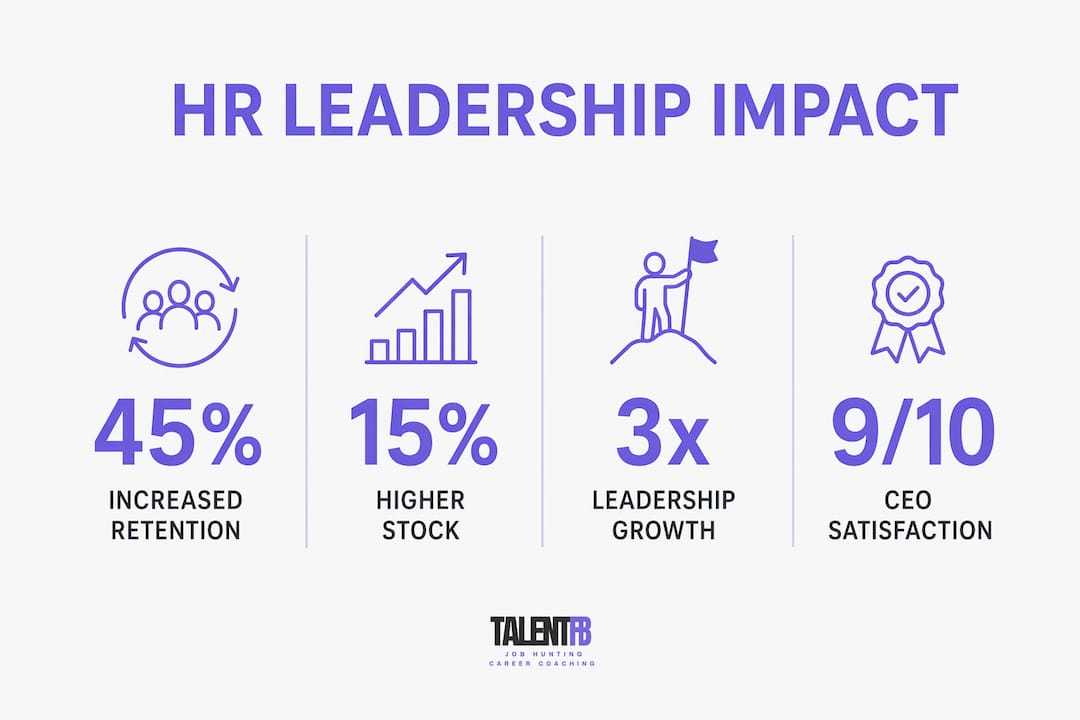
Strategic, well-compensated CHROs correlate with higher stock prices and better talent retention. This is not correlation without cause. When HR leadership is treated as a senior investment rather than a cost center, the entire workforce system performs at a higher level.
Organizations with strong HR leadership attract better talent and innovate at higher rates than peers with weak HR leadership. That gap compounds over time. A CEO who builds a great CHRO relationship in year one will have a meaningfully stronger organization by year three than a CEO who treats HR as administrative overhead.
The role of HR in succession planning also directly affects how well a CEO can execute long-term strategy. When the leadership pipeline is deep and well-managed, the CEO can take calculated risks on growth because the bench strength exists to absorb the pressure. When the pipeline is thin, every senior departure becomes a crisis.
For CEOs who want to understand leadership training best practices that close skill gaps at the manager level, the evidence consistently points to HR-led programs as the most cost-effective mechanism. External training vendors can supplement, but the sustained behavior change happens when HR owns the development architecture.
What I have learned about the CEO-CHRO relationship after 15 years in hiring rooms
After spending 15 years inside hiring rooms across tech, fintech, adtech, and maritime-tech in APAC, I have watched this relationship play out in every configuration imaginable. And I want to give you my honest take, because the polished version of this conversation leaves out the uncomfortable parts.
Most CEOs I have worked with did not fully trust their CHRO. Not because the CHRO was incompetent, but because the CEO had never experienced what a truly great CHRO could do. They had only seen HR in its administrative form. So they kept HR at arm’s length, made talent decisions without HR input, and then wondered why their leadership pipeline was thin and their retention was poor.
The CEOs who got this right shared one habit. They treated the CHRO as the person most responsible for whether the CEO’s strategy could actually be executed. Not the CFO. Not the COO. The CHRO. Because every strategy lives or dies on whether the right people are in the right roles, and that is HR’s domain.
My recommendation is direct: if you are a CEO, pick three to five business-critical outcomes you care about most this year and ask your CHRO to build a talent plan around each one. If your CHRO cannot do that, you have a hiring problem, not an HR problem. If you are an HR leader, stop waiting to be invited into the strategy conversation. Bring the data. Frame it in business terms. Show up as the business operator you are. The executive coaching best practices that work for individual leaders apply here too: clarity of purpose, consistent feedback loops, and the courage to say what others are not saying.
The CEO-CHRO relationship is the highest-leverage partnership in any organization. Treat it that way.
— Frederic Bonifassy
How TalentFB supports HR leaders and CEOs in building stronger partnerships
CEOs and HR leaders who want to close the gap between strategy and execution need more than good intentions. They need a clear system for building leadership visibility, attracting top talent, and making the right hiring decisions at the executive level.
TalentFB works directly with CEOs, founders, and senior HR professionals to build the executive presence and talent infrastructure that makes this partnership work. The Talent/OS™ program helps CEOs and their C-suite rebrand their LinkedIn profiles and build content systems that attract top talent organically, without paying executive search fees. For HR leaders and executives focused on career advancement, the C-suite hiring strategies and career advancement roadmap resources offer a practical starting point. If you want to see what this looks like in practice, the TalentFB success stories page shows real outcomes from real executives.
FAQ
What is the role of HR in CEO success?
HR directly supports CEO success by managing talent acquisition, leadership development, succession planning, and culture. A strong CHRO acts as the CEO’s closest strategic partner on all people-related decisions.
How much time do CHROs spend advising CEOs?
CHROs spend approximately 33% of their time advising the CEO directly. That level of involvement reflects how central the HR-CEO relationship is to organizational performance.
Why do CEOs undervalue their CHRO?
Most CEOs have historically viewed the CHRO as an administrative role rather than a strategic partner. Organizations that correct this misperception see measurable improvements in talent retention, culture, and business execution.
How does HR leadership affect company performance?
Well-compensated, strategic CHROs correlate with higher stock prices and stronger talent retention. Organizations with strong HR leadership also attract better candidates and innovate at higher rates than peers with weak HR leadership.
What does a CEO need from HR to succeed?
A CEO needs HR to deliver proactive data-driven talent insights, manage succession pipelines continuously, coach leadership tiers, and align every major hire to the CEO’s business priorities.